Artwork
Untitled
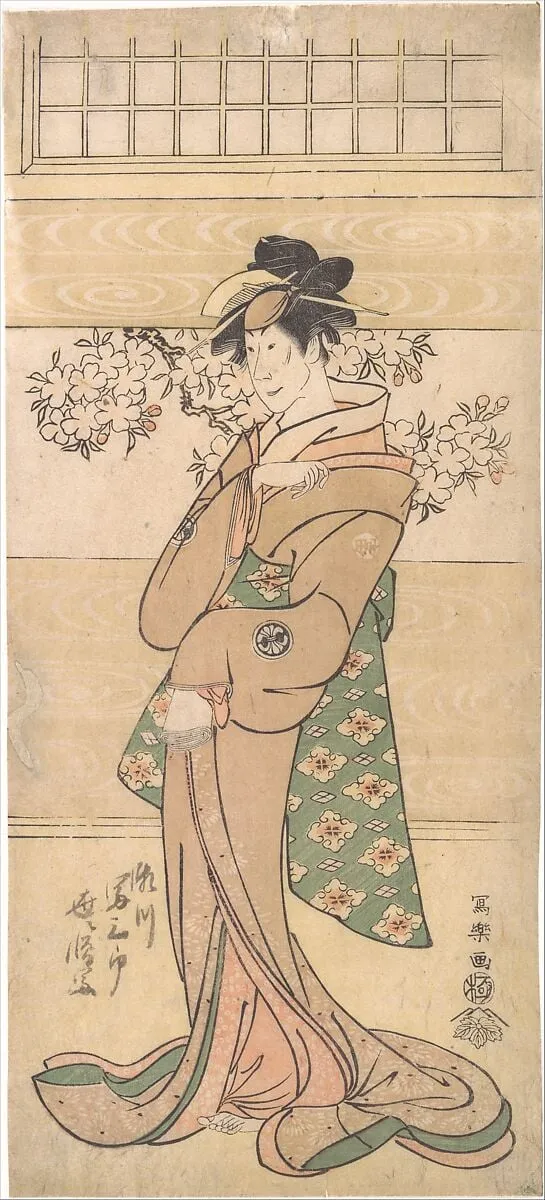
Untitled is an ink print by the Romanticist artist Tōshūsai Sharaku. It dates from 1794 and is held in the collection of the Metropolitan Museum of Art.
About this work
Most prints at the time were soft and idealized, but Sharaku’s faces feel raw, almost exaggerated.
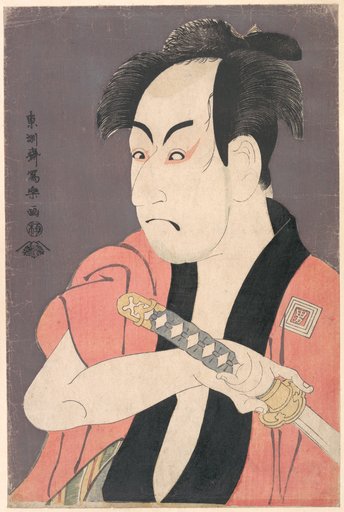
A man in a dark robe scowls at the viewer, his face half-lit by harsh light. His eyebrows are thick, his mouth tight, like he’s about to speak. The background is plain, so your eyes stay on his expression.
Sharaku made this print in 1794, part of a series showing Kabuki actors. Most prints at the time were soft and idealized, but Sharaku’s faces feel raw, almost exaggerated. Experts think he worked for less than a year, no one knows why he stopped.
If you like how the light and shadow shape his face, look up cross-hatching.
Overview
Untitled is a woodblock print by Tōshūsai Sharaku, created in 1794 as one sheet of a pentaptych. Executpinned in ink and color on paper, this nishiki-e print belongs to the yakusha-e genre of actor portraits that defined Sharaku's brief but meteoric career. The work is now held in the collection of the Metropolitan Museum of Art. Sharaku produced an astonishing body of approximately 145 individual prints during a working period of only ten months, from the fifth month of 1794 to the first month of 1795, making his output one of the most concentrated and enigmatic in the history of Japanese art. This particular sheet exemplifies the artist's penetrating approach to theatrical portraiture during the culturally vibrant yet economically constrained Kansei era.
Subject & Meaning
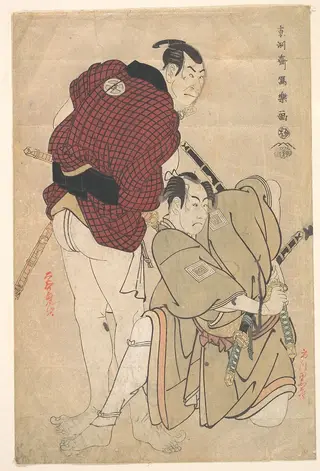
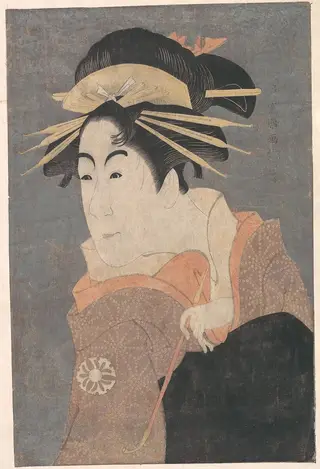
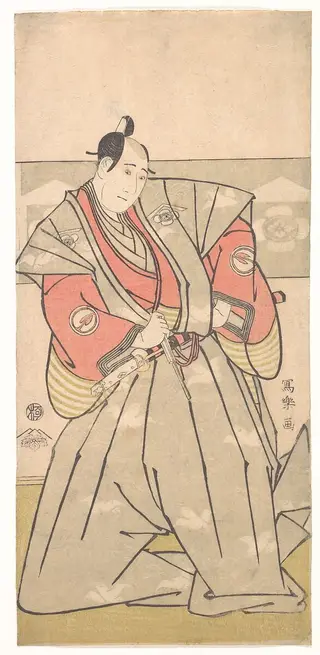
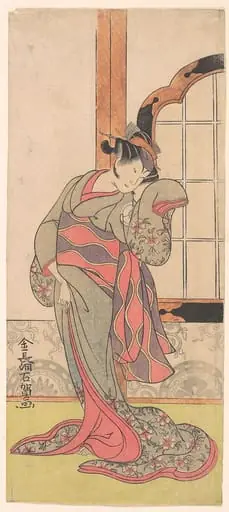
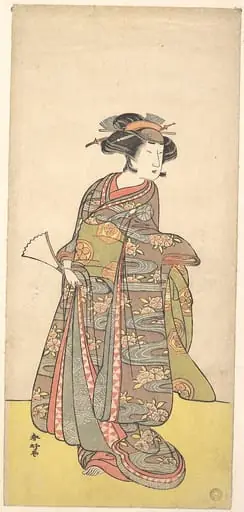
The print depicts a single figure in a vertical composition, facing left with the head turned toward the viewer. The subject wears layered garments: a pale brown outer robe with wide sleeves and a green underrobe patterned with floral and diamond motifs, with a circular crest visible on the outer sleeve. The figure's left hand holds the robe at the chest, while the right hand rests lower, gripping fabric. The hair is elaborately arranged with pins and a comb. Behind the figure, a horizontal band of cherry blossoms stretches across the middle ground, with a gridded window above and pale wave or cloud patterns below. Calligraphic inscriptions appear in the lower left and right corners, accompanied by a small seal. The depiction of an actor in role, with careful attention to costume detail and pose, reflects Sharaku's characteristic interest in capturing performers as they appeared on stage rather than idealizing them for fan consumption.
Technique & Style
The technique displays flat color areas with precise black contour lines, typical of woodblock printing, with no strong shadows; the image relies on line and flat pattern rather than modeled light. The palette is muted, consisting of beiges, pale pinks, soft greens, and black outlines. This approach aligns with Sharaku's broader stylistic methods, which emphasized penetrating realism and exaggeration verging on caricature rather than the idealized portraits common among his contemporaries. Unlike other ukiyo-e artists, Sharaku attempted to penetrate the actors' characters and show them in poses revealing their ways of acting. The flat color application and precise linearity are consistent with nishiki-e production techniques of the period, though the specific handling here lacks the dramatic black mica backgrounds that characterized Sharaku's first-period ōkubi-e of early summer 1794. The work's composition, with its decorative background elements and careful attention to textile pattern, reflects the formalized qualities that became more pronounced in Sharaku's later production periods.
History & Provenance
The print dates to 1794, placing it within Sharaku's extraordinarily brief ten-month career. It was created as one sheet of a pentaptych, a multi-panel format that allowed for expanded narrative or compositional possibilities in actor portraiture. The work is now in the collection of the Metropolitan Museum of Art, though specific accession details are not provided in the available sources. The print's survival as part of a pentaptych is notable given that many of Sharaku's third-period works, produced toward the end of 1794, survive in only one copy or not at all, suggesting limited commercial success during the artist's lifetime. The publisher Tsutaya Jūzaburō, who took a chance on the unknown Sharaku in early summer 1794, likely commissioned and distributed this work as part of his strategy to enter the theatrical print market during a period of disruption in Edo's kabuki industry.
Context
Sharaku emerged in the early summer of 1794 when publisher Tsutaya Jūzaburō simultaneously released 28 large actor portraits with black mica backgrounds, introducing an unknown artist to the Edo public. The timing was significant: the Kansei reforms had economically squeezed Edo's three licensed kabuki theaters, and by 1794 performances were limited to substitute venues with temporary licenses. This crisis created both challenges and opportunities for new promotional methods in the theater world. Sharaku's contemporary critical reception was mixed; the artist and writer Ota Nanpō recorded that Sharaku's excessive realism was considered strange by his contemporaries and his popularity was short-lived. However, the relatively high number of surviving impressions of certain ōkubi-e designs, some known in as many as 20 impressions, suggests a small but dedicated patronage base that preserved his work more carefully than collectors of other artists. The identity of Sharaku himself remains one of art history's most persistent mysteries. The most plausible theory, based on the 1844 account by historian Saitō Gesshin, identifies him as Saitō Jūrōbei, a Nō actor in the troupe of the Lord of Awa, with possible Osaka training connections. Other theories linking him to Hokusai, Toyokuni, Utamaro, or various other figures lack convincing corroborating evidence. Sharaku was not widely popular during his lifetime; only after Western collectors and scholars elevated his work was he fully recognized in Japan.
Legacy
Sharaku's posthumous reputation underwent a dramatic reversal from near-obscurity to canonical status. Initially dismissed by contemporaries for his unflinching realism, he became highly regarded by Western collectors and scholars before achieving full recognition in Japan. His approximately 145 known individual sheets and 18 attributed drawings constitute one of the most intensively studied bodies of work in ukiyo-e scholarship, precisely because of its brevity and mystery. The government's later prohibition of mica-ground backgrounds, which Sharaku had employed to striking effect, further isolated his early achievements as a distinctive moment in print history. His influence on subsequent actor portraiture can be traced in the emphasis on psychological penetration and the rejection of idealization, though few artists maintained his level of confrontational directness. The Metropolitan Museum of Art's holding of this pentaptych sheet contributes to the institutional preservation and study of Sharaku's work, ensuring continued access for scholars and the public. The persistent fascination with Sharaku's identity, the circumstances of his disappearance, and the concentrated power of his brief output continue to generate scholarly debate and popular interest, securing his position as one of the most original and enigmatic figures of the ukiyo-e movement.
Artist & collection

 Untitled
 Untitled
 Untitled
 Untitled
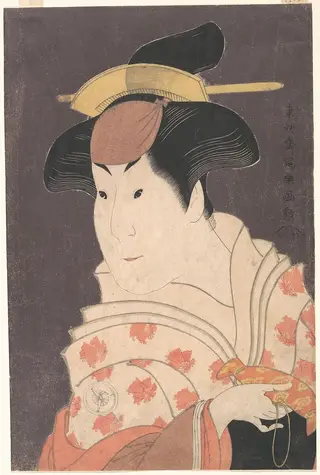 東洲斎写楽画 四代岩井半四郎の重の井 『恋女房染分手綱』|Iwai Hanshirō IV as Shigenoi in the Play "Koinyōbō Somewake Tazuna"
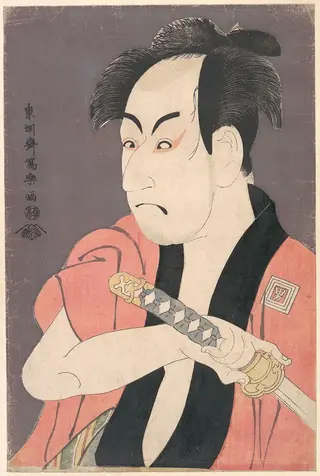 東洲斎写楽画 初代市川男女蔵の奴一平 『恋女房染分手綱』|Ichikawa Omezō I in the Role of Yakko Ippei from the Play "Koinyōbō somewake tazuna"
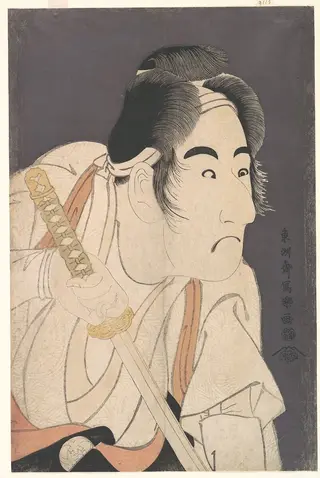 東洲斎写楽画 二世坂東三津五郎の石井源蔵 『花菖蒲文禄曽我』|Bandō Mitsugorō II as Ishii Genzō in the Play "Hana-ayame Bunroku Soga"
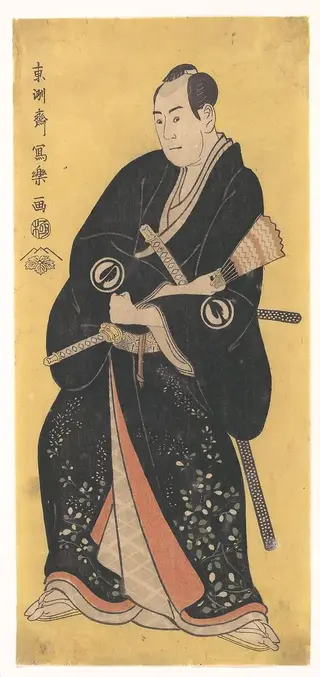 Untitled
- Untitled
 Untitled
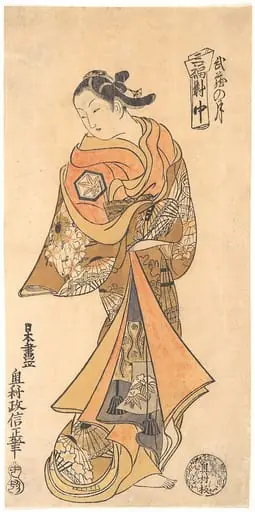 Sanpuku Tsui|Moon in Musashi Province
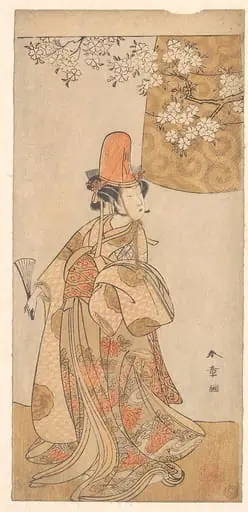 花形見風折烏帽子瀬川富三郎の娘道成寺|Segawa Tomisaburo in the Role of Musume Dojoji in "Hanagatami Kazaori Eboshi"
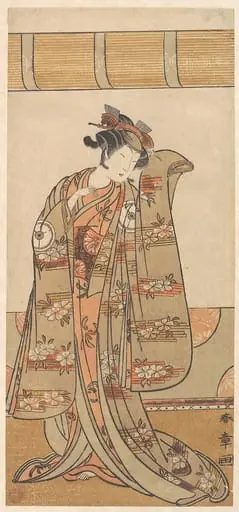 Untitled
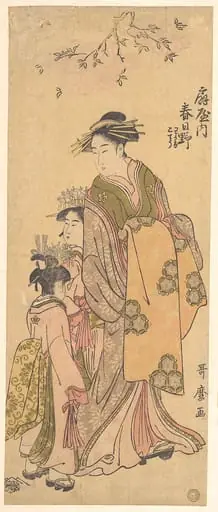 扇屋内春日野わかな こてう|The Oiran Kasugano of Ōgiya on Parade
 Untitled
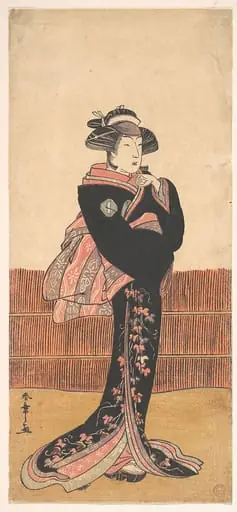 勝川春章画 三代目吾妻藤蔵|Kabuki Actor Azuma Tōzō III
 Untitled
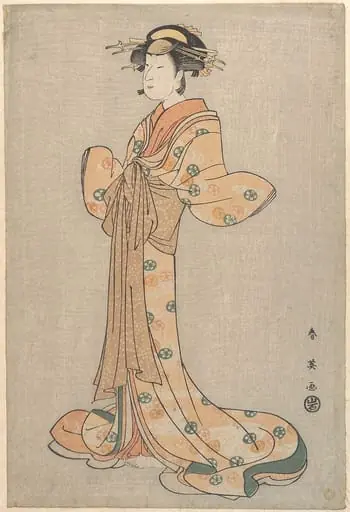 二代目中村二代目中村野塩のお軽|The Actor Nakamura Noshio II as the Courtesan Okaru