Artwork
伝託磨為遠筆 月光菩薩像 「金胎仏画帖」断簡|Gakkō Bosatsu, from “Album of Buddhist Deities from the Diamond World and Womb World Mandalas” (“Kontai butsugajō”)
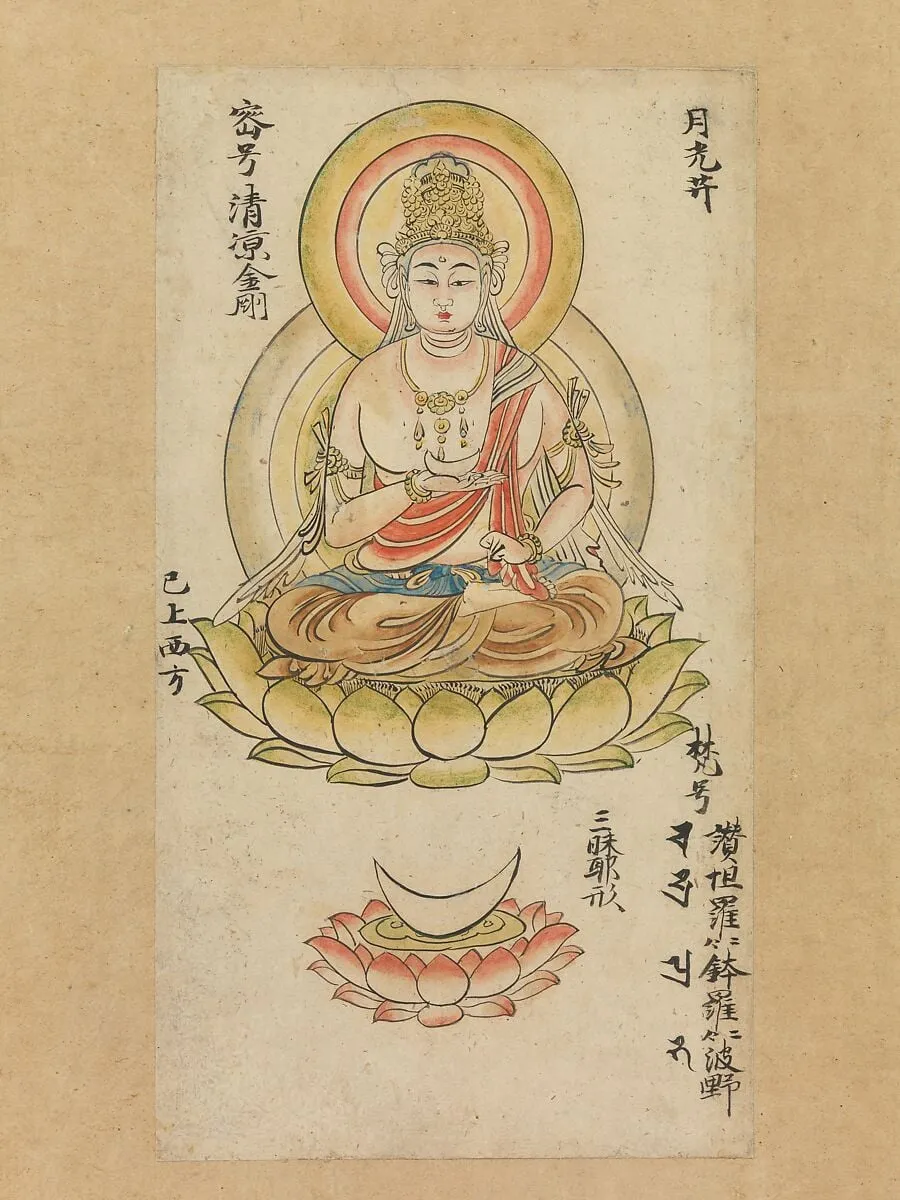
伝託磨為遠筆 月光菩薩像 「金胎仏画帖」断簡|Gakkō Bosatsu, from “Album of Buddhist Deities from the Diamond World and Womb World Mandalas” (“Kontai butsugajō”) is an ink painting by Takuma Tametō. It dates from 1150 and is held in the collection of the Metropolitan Museum of Art.
- Accession no.
- 1975.268.8
- Credit line
- The Harry G. C. Packard Collection of Asian Art, Gift of Harry G. C. Packard, and Purchase, Fletcher, Rogers, Harris Brisbane Dick, and Louis V. Bell Funds, Joseph Pulitzer Bequest, and The Annenberg Fund Inc. Gift, 1975
About this work
Subject & Meaning
The work depicts Gakkō Bosatsu (Moonlight Bodhisattva) from the “Album of Buddhist Deities from the Diamond World and Womb World Mandalas”.
The work depicts Gakkō Bosatsu (Moonlight Bodhisattva) from the “Album of Buddhist Deities from the Diamond World and Womb World Mandalas”. It is a fragment of a painted album, created by Takuma Tametō in 1150, rendered in ink, color, gold on paper, mounted as a hanging scroll. Iconographically, the figure holds a crescent moon, wears a jeweled crown, and is surrounded by mandala motifs symbolizing the luminous wisdom of the moon and the compassionate activity of the Bodhisattva within the Vajrayana cosmology.
The piece represents the integration of celestial light with enlightened activity, embodying the protective and illuminating qualities of the Moon Bodhisattva in Japanese Buddhist art.
Technique & Style
The work is a fragment (断簡) of a book page that has been affixed to a hanging‑scroll support. It is executed in ink with additional color and gold leaf applied to paper, a technique typical of Heian‑Kamakura Buddhist paintings. The surface bears the characteristic brushwork and subtle gradations of tone used to render the lunar Bodhisattva figure, while the gold accents highlight the halo and ornamental details.
As a mounted fragment, the piece shows signs of handling along the edges and minor loss of pigment, yet the composition retains its original stylized proportions and balanced spatial arrangement. The formal style reflects the mandala tradition, combining delicate line work with richly saturated pigments.
History & Provenance
Attributed to the artist Takuma Tametō, this depiction of Gakkō Bosatsu (Moonlight Bodhisattva) was created in Japan around 1150. The work originally functioned as a single page within a larger volume titled the "Album of Buddhist Deities from the Diamond World and Womb World Mandalas" (Kontai butsugajō). Executed using ink, mineral colors, and gold on paper, the fragment was later remounted as an independent hanging scroll.
The piece is currently held in the collection of the Metropolitan Museum of Art. While the specific circumstances of its original commission or the intermediate steps of its ownership history prior to entering the museum are not detailed in the available records, its classification as a religious painting from the mid-twelfth century establishes its historical context within Japanese Buddhist art.
The hanging scroll depicting Gakkō Bosatsu, attributed to Takuma Tametō and dated to 1150, is held in the collection of the Metropolitan Museum of Art in New York. Originating from Japan, this work is a fragment from the "Album of Buddhist Deities from the Diamond World and Womb World Mandalas" (Kontai butsugajō). The piece is classified as a religious painting executed in ink, color, and gold on paper.
While the specific accession number is not detailed in the provided records, the museum's catalog identifies the work as a significant example of 12th-century Japanese Buddhist art. No specific exhibition history or past display dates are recorded in the available source material.
Overview
Created around 1150 by the Japanese artist Takuma Tametō, this work depicts Gakkō Bosatsu (Moonlight Bodhisattva), a figure from the Womb World Mandala. Originally a page from the 'Album of Buddhist Deities from the Diamond World and Womb World Mandalas' (Kontai butsugajō), the image was later remounted as a hanging scroll. The composition features the bodhisattva floating against a background of gold leaf, seated upon a stylized cloud.
Gakkō Bosatsu holds a small moon disk in one hand, a defining iconographic attribute. The figure wears soft blue robes layered over a red undergarment, with a radiant golden halo framing the head. Executed in ink, color, and gold on paper, the work exemplifies the high Heian period style of the Takuma school, known for its precise line work and luminous use of gold.
This fragment represents a rare surviving element of a larger liturgical manuscript intended for esoteric Buddhist practice, illustrating the synthesis of Indian Buddhist iconography with distinct Japanese aesthetic sensibilities of the 12th century.
Artist & collection

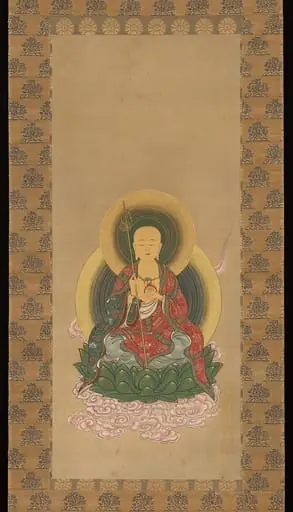
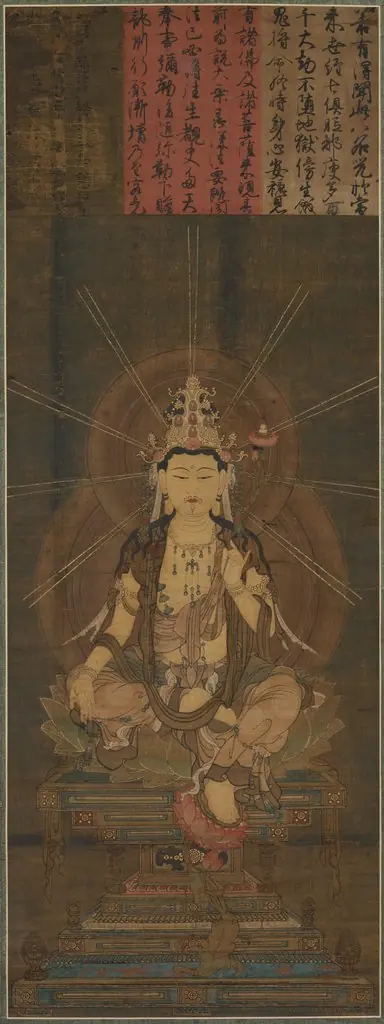
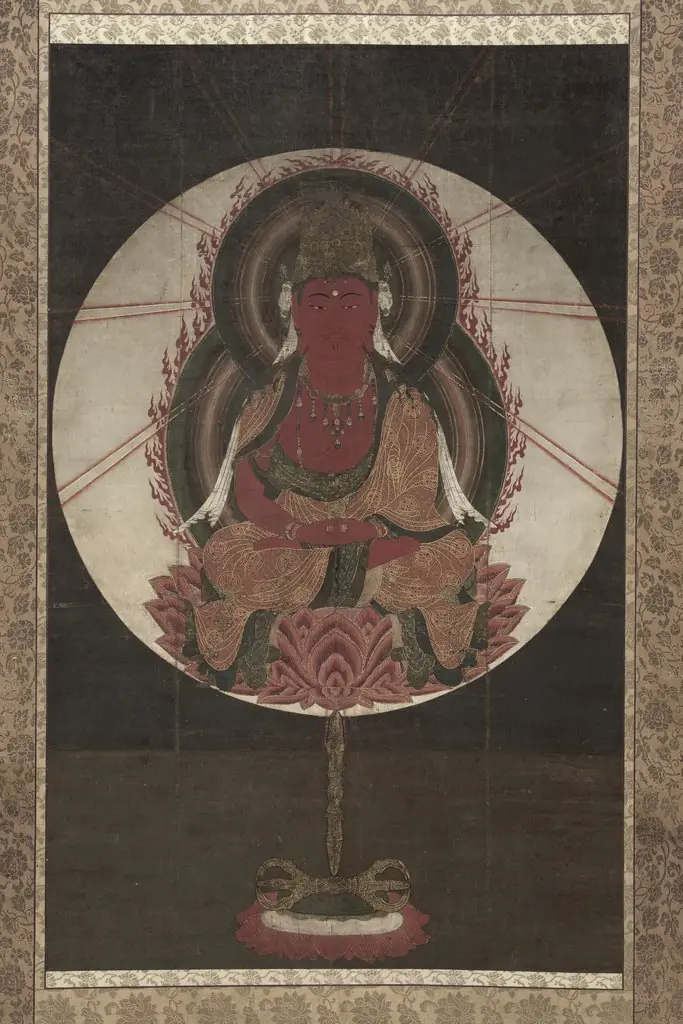
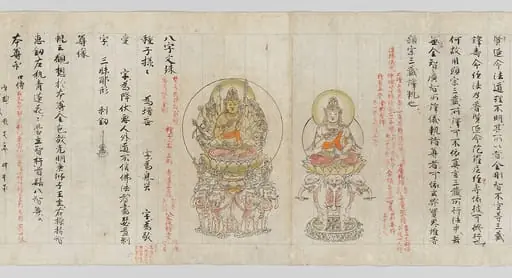
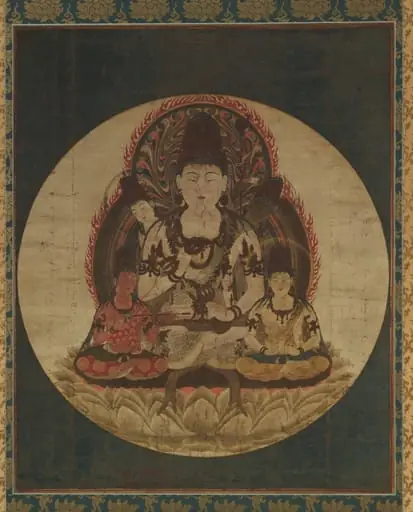
- 大精進菩薩図像 (「金胎仏画帖」より)|Daishōjin Bosatsu, from “Album of Buddhist Deities from the Diamond World and Womb World Mandalas”
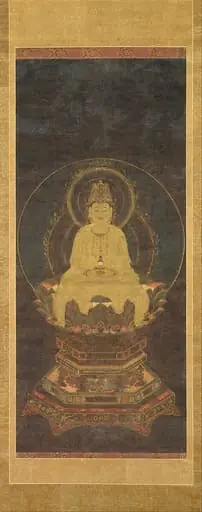 弥勒菩薩像|Miroku Bosatsu
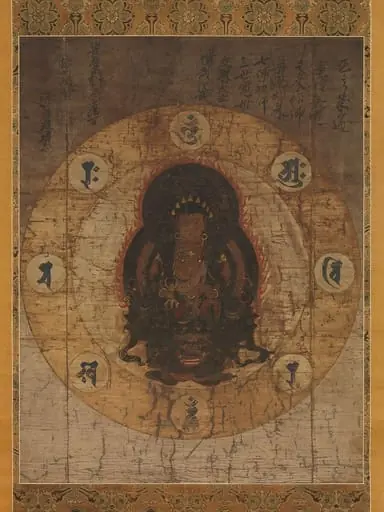 八字文殊菩薩像|Monju Bosatsu with Eight Sacred Sanskrit Syllables
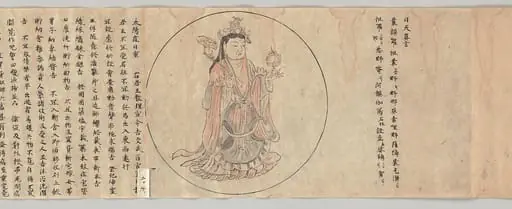 宗観筆 九曜秘暦図像 |Iconographic Drawings of the Secrets of the Nine Luminaries
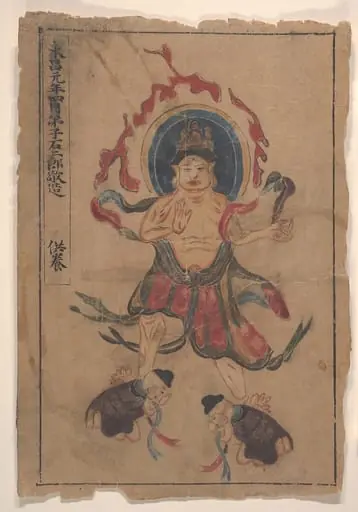 唐(?) 佚名 佛畫八幅 散頁|Eight Buddhist Paintings