Artwork
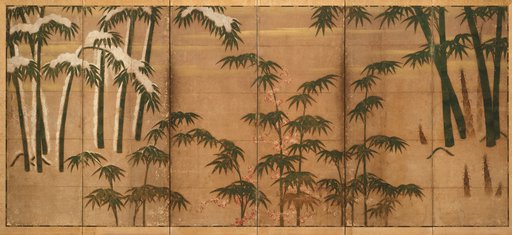
伝土佐光信筆 四季竹図屏風|Bamboo in the Four Seasons
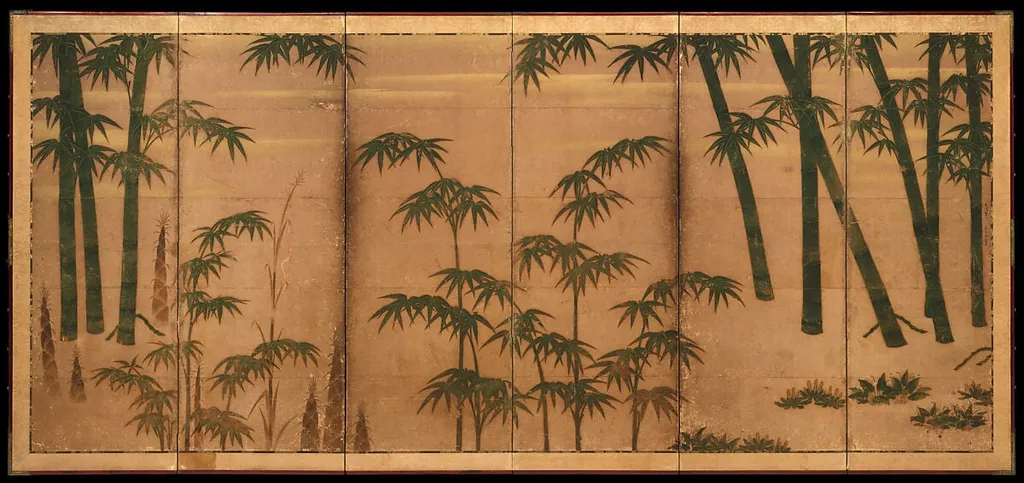
伝土佐光信筆 四季竹図屏風|Bamboo in the Four Seasons is an ink painting by the Renaissance artist Tosa Mitsunobu. It dates from 1502 and is held in the collection of the Metropolitan Museum of Art.
About this work
Subject & Meaning
A gold‑leaf background creates a luminous void that emphasizes spatial ambiguity and reinforces the symbolic focus on change and renewal.
The six‑panel folding screen depicts Bambusoideae, showing bamboo at different stages of growth that correspond to the four seasons. By arranging shoots, mature stalks and withered culms across the panels, the work visualizes impermanence and the cyclical passage of time, a theme linked to Shinto and Buddhist concepts of transience. The composition reflects the Tosa school’s early adaptation of Chinese kara‑e bamboo imagery, marking a formative phase of the school within the Muromachi aesthetic.
A gold‑leaf background creates a luminous void that emphasizes spatial ambiguity and reinforces the symbolic focus on change and renewal.
Technique & Style
The work is a pair of six‑panel folding screens executed in ink, color and gold leaf on paper, a medium typical of Muromachi‑period Japanese screens. The composition depicts bamboo shoots progressing through the four seasons, rendered from right to left with a gold‑leaf background that suggests spatial depth. As an early Tosa‑school piece, it adapts the Chinese bamboo motif while emphasizing transience through seasonal variation, a formal concern linked to Shinto and Buddhist ideas of impermanence.
The screens (accession 1975.268.44,45) are housed in the Metropolitan Museum of Art, have been publicly displayed and rotated within the museum’s collection.
History & Provenance
The work dates to the late 15th–early 16th century, a period contemporaneous with the career of Tosa Mitsunobu (1434–1525), and is attributed to him though securely placed within the Tosa school. Its ownership chain begins with Yabumoto Shōgorō of Osaka, passed to collector Harry G.C. Packard, who donated the pair of six‑panel screens to the Metropolitan Museum of Art in 1975 (accession 1975.268.44, 45). No record of a specific commission appears in the sources.
Since entering the MET, the screens have remained in the permanent collection, with notable loans to the Tokyo Metropolitan Teien Art Museum (Oct–Nov 1986) for the Osaka Castle quincentenary and to the Cleveland Museum of Art (Oct–Dec 1991) for a survey of 16th‑century Japanese art.
The folding screen Bamboo in the Four Seasons, executed in ink, color and gold leaf on paper by the Tosa school in the late fifteenth to early sixteenth century, has been part of the Metropolitan Museum of Art’s collection since 1975, recorded under accession numbers 1975.268.44 and 1975.268.45. The museum has displayed the work in its permanent galleries and has included it in special exhibitions, notably a 1986 showing at the Tokyo Metropolitan Teien Art Museum commemorating the 500th anniversary of Osaka Castle and a 1991 presentation at the Cleveland Museum of Art focused on sixteenth‑century Japanese art. The work remains on view in the museum’s Asian art wing and has been photographed for catalogues documenting the museum’s Japanese screen holdings.
Legacy
Attributed to Tosa Mitsunobu yet definitive of the Tosa school, Bamboo in the Four Seasons serves as a critical early-stage work illustrating the adaptation of Chinese bamboo motifs into Japanese aesthetics. Over subsequent centuries, its depiction of seasonal transience and growth cycles influenced the evolution of painting styles, specifically bridging Muromachi traditions with the later Rinpa school of the Edo period. Independent painters and townsman artists in the Azuchi–Momoyama and Edo eras studied the screen to inform their own techniques, impacting prominent figures such as Tawaraya Sōtatsu.
The work's scholarly significance was further cemented through its acquisition by Harry G.C. Packard and subsequent donation to the Metropolitan Museum of Art in 1975. Its enduring legacy is reflected in its rotation within the museum's permanent collection and its inclusion in major exhibitions, such as the 1986 commemoration of Osaka Castle and the 1991 display of 16th-century Japanese art at the Cleveland Museum of Art.
Overview
This pair of six-panel folding screens, titled "Bamboo in the Four Seasons," is attributed to the Japanese painter Tosa Mitsunobu and dates to 1502. Executed with ink, color, and gold leaf on paper, the work depicts bamboo across various seasonal conditions. The large-scale format and vibrant materials suggest its intended role as a prominent decorative element within a domestic interior, showcasing a common natural motif in a luxurious manner.
Context
Created as a pair of folding screens, this artwork was designed for display within a private residence rather than a religious institution. The extensive use of gold leaf, while often associated with sacred art, here serves a primarily decorative function, reflecting the aesthetic preferences and wealth of its patron. Such screens were integral to defining and enriching the interior spaces of aristocratic homes during this period.
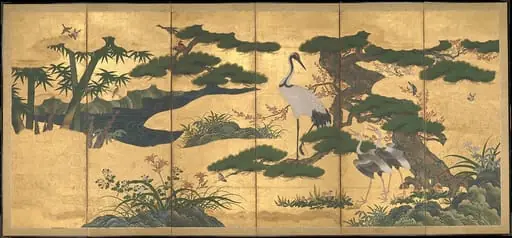
Artist & collection

- 四季花鳥図屏風|Birds and Flowers of the Four Seasons
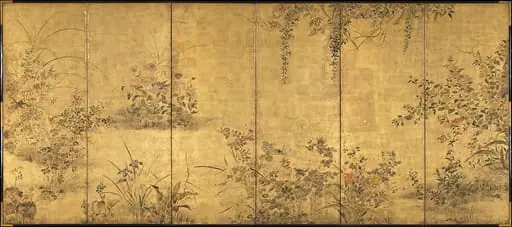 四季花野菜図屏風|Flowering Plants and Vegetables of the Four Seasons
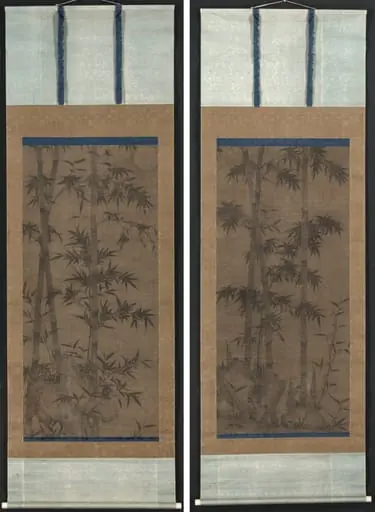 Bamboo in Four Seasons: Spring and Autumn
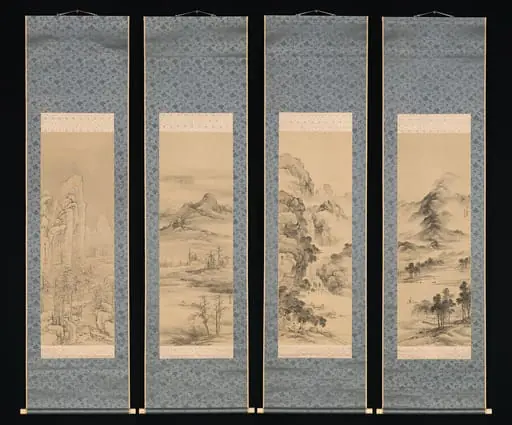 山本梅逸筆 四季山水図|Landscapes of the Four Seasons
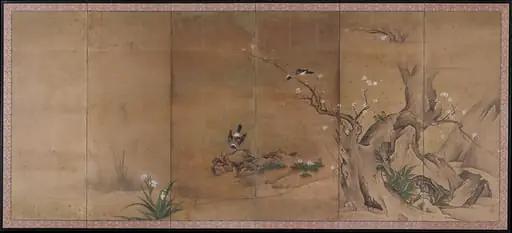 狩野山卜筆四季花鳥図屏風|Birds and Flowers of the Four Seasons
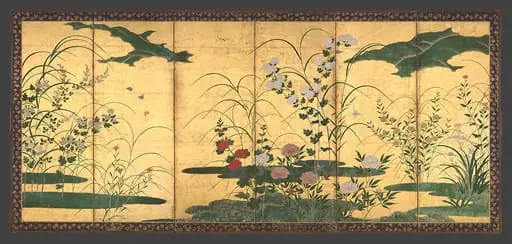 四季花草図屏風|Flowers and Grasses of the Four Seasons
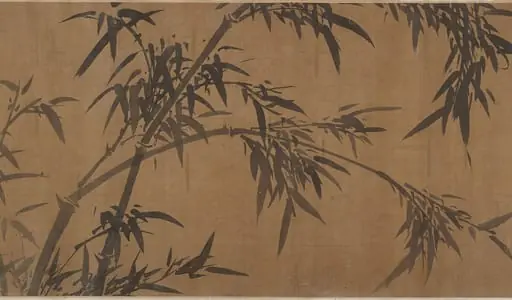 明 佚名 吳鎮(僞款) 枯木竹石圖 卷|Bamboos
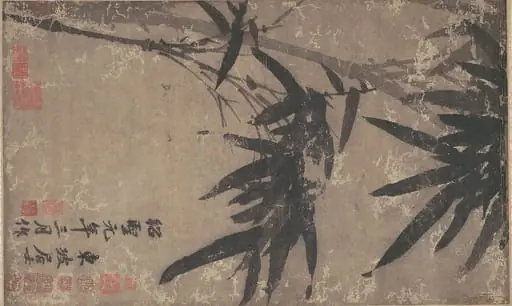 傳南宋 蘇軾 墨竹圖 卷|Bamboo
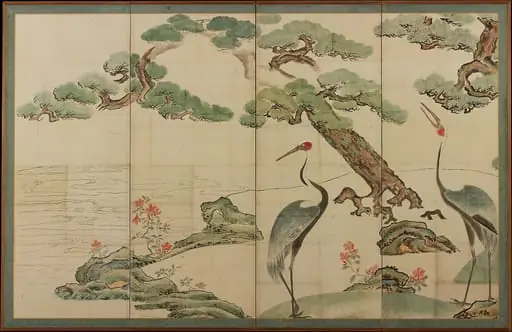 尾形光琳筆 松竹に鶴図屏風|Cranes, Pines, and Bamboo