Artwork
Mr. and Mrs. Alexandre Natanson Invitation
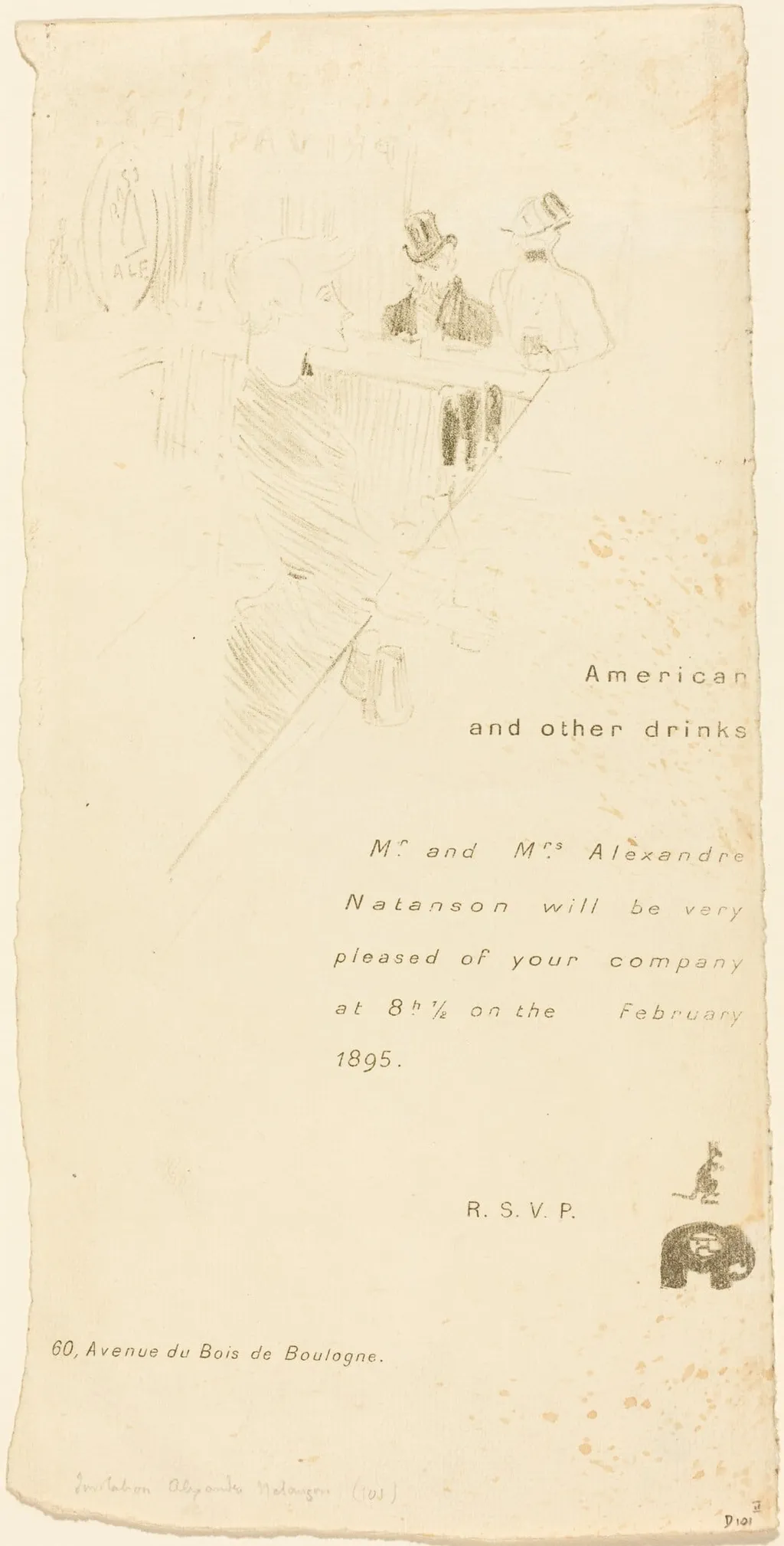
Mr. and Mrs. Alexandre Natanson Invitation is an ink print by the Impressionist artist Henri de Toulouse-Lautrec. It dates from 1895 and is held in the collection of the National Gallery of Art.
About this work
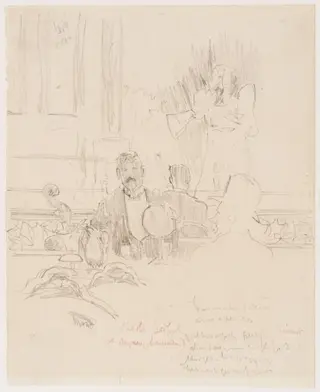
This sketch shows a quick, loose drawing of two people sitting at a table, with a bottle and glasses nearby.
This sketch shows a quick, loose drawing of two people sitting at a table, with a bottle and glasses nearby. The background is simple, a chair and a wall. The text reads "American and other drinks" and invites "Mr. and Mrs. Alexandre Natanson" to an event at 8:30 PM on February 1895.
The drawing looks rushed, almost like a doodle, but it’s signed with "R.S.V.P." and an address in Paris. The artist used a scratchy, sketchy style that feels alive and informal.
Next, check out lithography to see how this print was made.
Overview
Created in 1895, this lithograph by Henri de Toulouse-Lautrec served as a personal invitation to a social gathering. Executed in olive green and gray ink, it was printed from a stone and distributed to the Natansons, prominent figures in Parisian cultural circles. The work blends function with artistic expression, transforming a mundane notice into a record of intimate urban life.
Subject & Meaning
The invitation depicts Mr. and Mrs. Alexandre Natanson seated at a table with a bottle and glasses, suggesting a casual, convivial setting. Their presence signals their role as central figures in the artistic community. The inclusion of 'American and other drinks' hints at the cosmopolitan tastes of the era, while the informal tone and handwritten-style text reflect the relaxed, intimate nature of the event.
Technique & Style
Toulouse-Lautrec employed lithography to achieve a spontaneous, sketch-like quality. The lines are loose and scratchy, with minimal detail in the figures and background, a chair and wall rendered in faint strokes. The restrained palette of olive green and gray enhances the immediacy of the composition, echoing the urgency of a hastily drawn note rather than a polished poster.
History & Provenance
Commissioned for a private gathering in February 1895, the print was likely produced in a small run for distribution among friends. The Natansons, patrons of the arts and collectors of Toulouse-Lautrec’s work, were frequent subjects in his circle. The invitation’s survival suggests it was preserved as a personal artifact, not merely discarded after the event.
Context
In mid-1890s Paris, lithographic invitations were common among bohemian elites, serving as both announcements and artistic statements. Toulouse-Lautrec, immersed in cabarets and salons, often blurred the line between commercial print and personal correspondence. This piece reflects a culture where art was woven into daily social rituals, not confined to galleries.
Legacy
Though not intended for public display, the invitation exemplifies Toulouse-Lautrec’s ability to elevate everyday objects through his distinctive draftsmanship. It stands as a testament to his role in redefining printmaking as a vehicle for personal expression, influencing later artists who saw value in the informal, the ephemeral, and the intimate.
Artist & collection
Artist
Comte Henri Marie Raymond de Toulouse-Lautrec-Montfa (24 November 1864 – 9 September 1901), known as Toulouse-Lautrec (French: ), was a French painter, printmaker, draughtsman, caricaturist, and illustrator.

- Buildings on the Praya Grande, Macau, with two studies of a Westerner
 The Old Bedford
 A Gathering in an Interior; A Curtained Doorway
 Peisaj cu case
 Untitled
 The Clockmakers, Paimpol
 Maunder's Fish Shop, Chelsea
 INTERIOR DIN MĂNĂSTIREA VALADON - SALONIC
 At The House of Gold (A la maison d'or)
 Hôtel Colbert, Windows
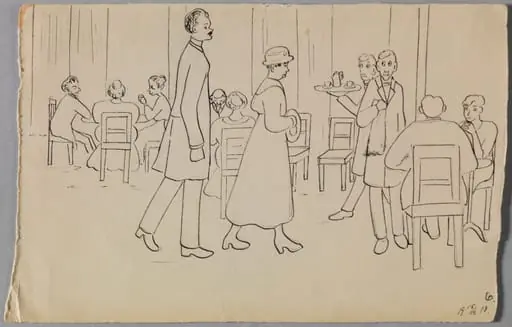 Sisarukset Forslund.
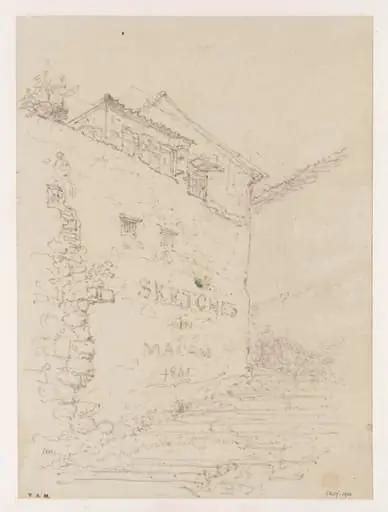 Buildings in Macau