Artwork
Mortlake Terrace
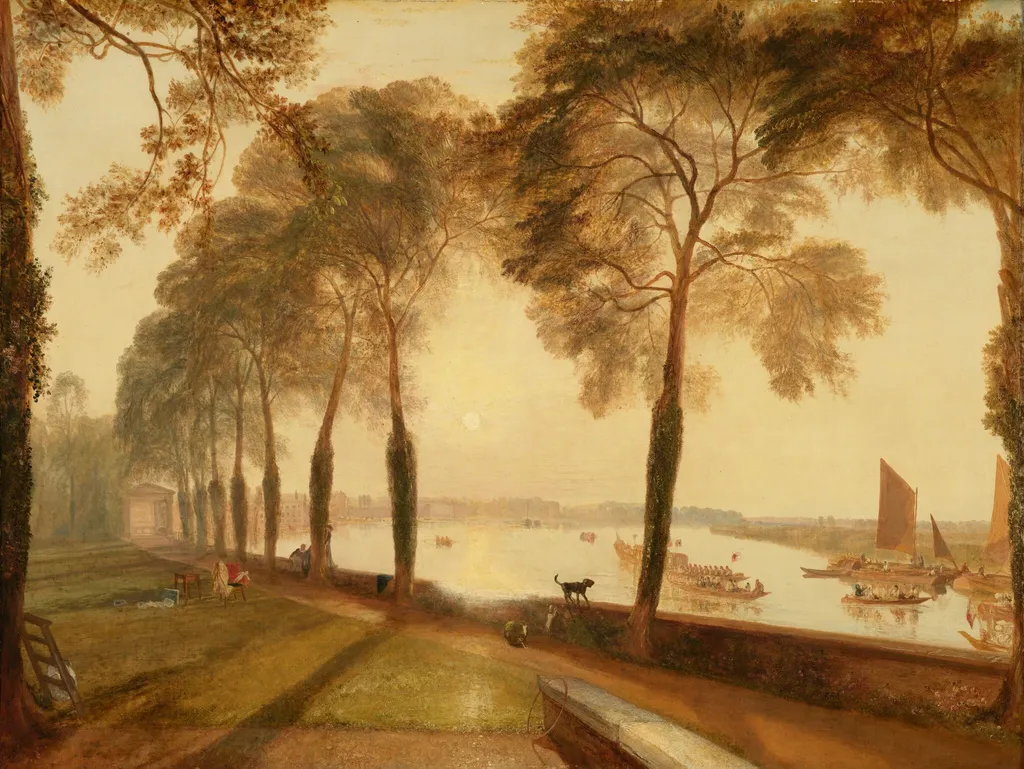
Mortlake Terrace is an oil painting by the Romanticist artist Joseph Mallord William Turner. It dates from 1827 and is held in the collection of the National Gallery of Art.
About this work
Subject & Meaning
It was painted in 1827 for William Moffatt and later passed through several owners before entering the National Gallery of Art in 1937.
The painting depicts Turner's view from the riverside terrace of "The Limes" at Mortlake, with a tall tree rising near the center of the composition as a focal point that organizes the scene. The work belongs to the English landscape tradition and is part of the National Gallery of Art collection in Washington, D.C., from the Andrew W. Mellon bequest. It was painted in 1827 for William Moffatt and later passed through several owners before entering the National Gallery of Art in 1937.
History & Provenance
Mortlake Terrace was painted in 1827 by Joseph Mallord William Turner for William Moffatt [c. 1754/1755–1831] of "The Limes," Mortlake. After Moffatt's death, the painting passed to the engraver William Bernard Cooke around 1831, who held it until about 1838. It then went to a consignor identified as Harriott before being offered at Christie's on 23 June 1838 (lot 111), where it was purchased by John Allnutt, a friend and patron of Turner, Constable, and Lawrence.
The Reverend Edward Thomas Daniell acquired the work, which reappeared at Christie's on 17 March 1843 (lot 160). It subsequently passed to M.E. Creswick and was sold in 1851 through Thomas Agnew & Sons, London, to Samuel Ashton. The painting descended through the Ashton family, first to Elizabeth Gair Ashton in Cheshire, then to Captain Ashton, who jointly consigned it in 1920 to Agnew's and Arthur J. Sulley & Co.
From there it was sold to M. Knoedler & Co., and on 1 December 1920 to Andrew W. Mellon of Pittsburgh and Washington, D.C. Mellon deeded it on 28 December 1934 to the A.W. Mellon Educational and Charitable Trust, which gave it to the National Gallery of Art in 1937.
The painting has a documented exhibition history dating back to the mid-19th century. Samuel Ashton lent the work to the Art Treasures of the United Kingdom exhibition in Manchester in 1857. Later, Elizabeth Gair Ashton exhibited it at the Guildhall in London in 1899 as part of a retrospective dedicated to Turner and his contemporaries.
Context
Mortlake Terrace, painted by Joseph Mallord William Turner in 1827, was commissioned by patron William Moffatt and later passed through several owners including Reverend Edward Thomas Daniell and Samuel Ashton before entering the collection of Andrew W. Mellon; the work was exhibited in Manchester in 1857 and in London in 1899, and today resides at the National Gallery of Art in Washington, D.C.
Scholarship on the piece emphasizes its role within Turner's exploration of light and landscape, situating it amid his broader development of atmospheric effects that influenced later movements such as Romanticism and Impressionism.
Legacy
Mortlake Terrace has been recognized as a notable work in Turner's exploration of light and landscape, influencing later artists who sought to capture atmospheric effects. Its exhibition history, including presentations at the 1857 Manchester Art Treasures exhibition and the 1899 London Guildhall show, reinforced Turner's reputation during the Victorian era. The painting's journey through private collections before its acquisition by Andrew W. Mellon and donation to the National Gallery of Art cemented its status as a cornerstone of American museum holdings, reflecting Turner's enduring legacy in both British and international art narratives.
Overview
Mortlake Terrace, painted by J.M.W. Turner in 1827, depicts a tranquil riverside view along the Thames at Mortlake, London. The composition centers on a large, leafy tree in the immediate foreground, which frames the scene and anchors the viewer's perspective. Beyond the tree, the river flows gently toward the distant shoreline, where architectural structures, including the distinctive Mortlake Terrace buildings, are rendered with atmospheric softness.
Turner employs a warm palette dominated by golden yellows and soft greens to capture the specific quality of late afternoon sunlight filtering through the foliage. The brushwork is characteristic of Turner's mature style, balancing detailed observation with a luminous, almost hazy treatment of light and air. Created during a period when Turner was increasingly exploring the effects of light and atmosphere over strict topographical accuracy, this work exemplifies his ability to elevate a mundane domestic scene into a poetic study of nature.
The painting reflects his ongoing interest in the relationship between the built environment and the natural landscape, showcasing his technical mastery in oil on canvas to convey the ephemeral qualities of a specific moment in time.
Technique & Style
Turner employs a warm palette, layering thin glazes to capture the subtle shifts of light across the tree’s bark and foliage. The handling of shadow reflects a nuanced use of chiaroscuro, creating depth without overt contrast. Brushwork remains delicate, contributing to the overall sense of serenity.
Own this work as a print
Artist & collection
Artist
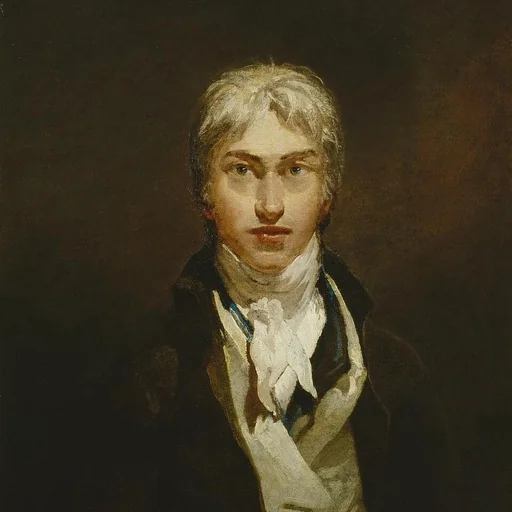
Joseph Mallord William Turner was born in 1775 at Maiden Lane, Covent Garden, where his father kept a barber and wig-making shop.

- View of the Seine at Nogent-sur-Seine
 Saska Kępa – Landscape at sunset
 View of the Albufera in Valencia
 Capriccio with an Obelisk on a Lagoon
 View of the Rijn river near Andernach
 Moonlit landscape
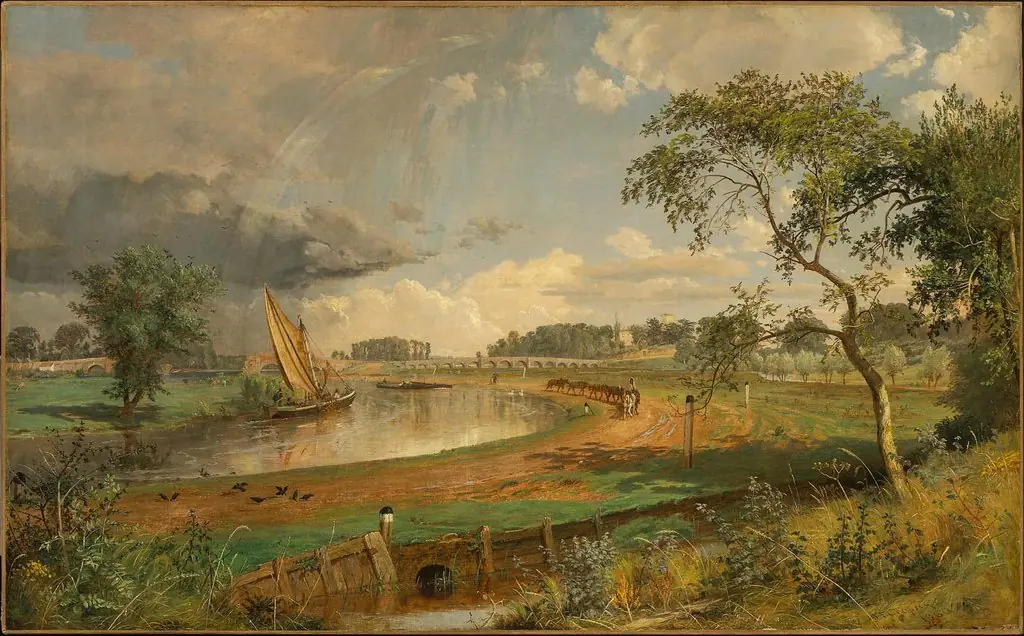 Walton-on-Thames
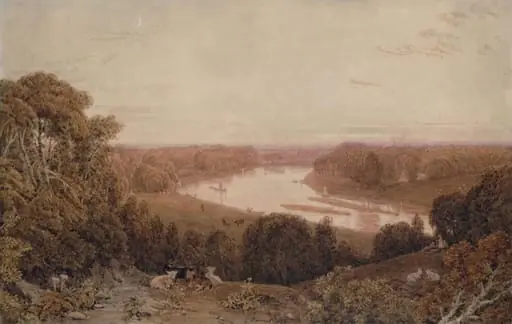 View from Richmond Hill, Surrey
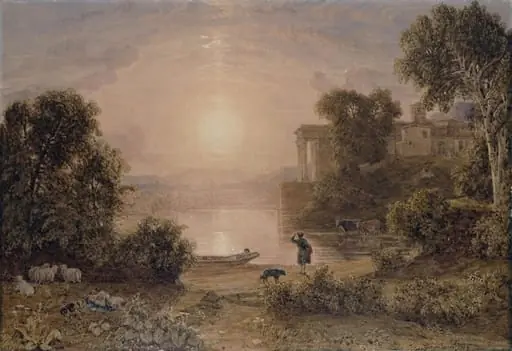 Untitled
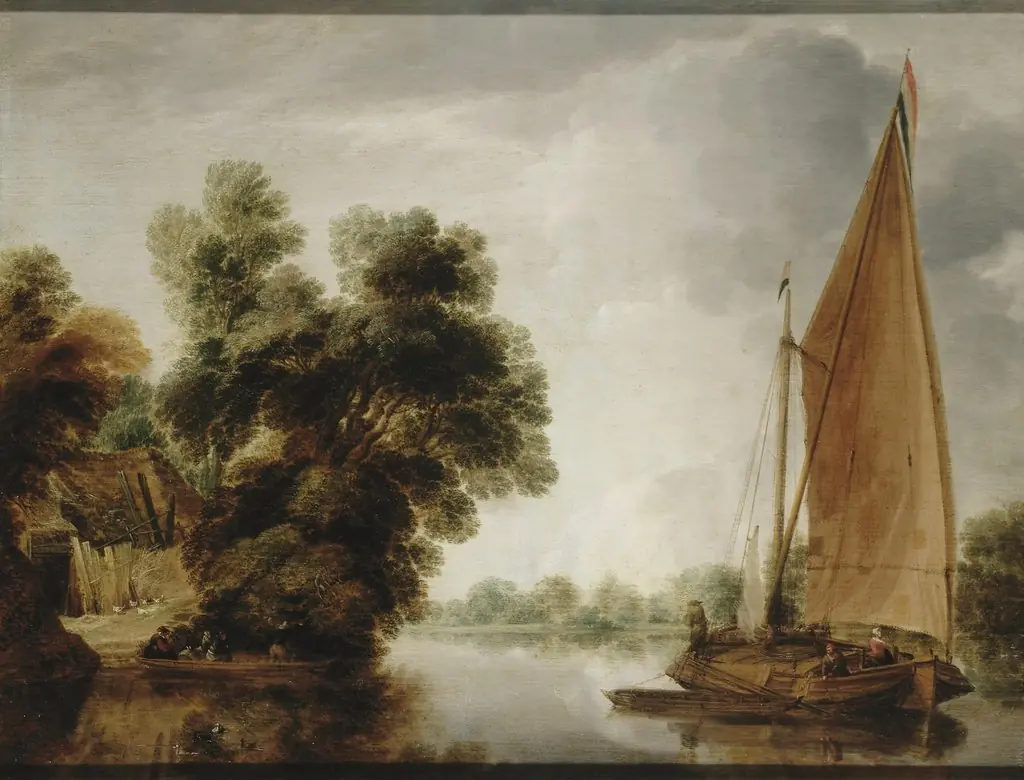 View of a River
 River View near Deventer
 Cheyne Walk, Chelsea