Artwork
Maestà (Madonna and Child with Four Angels)
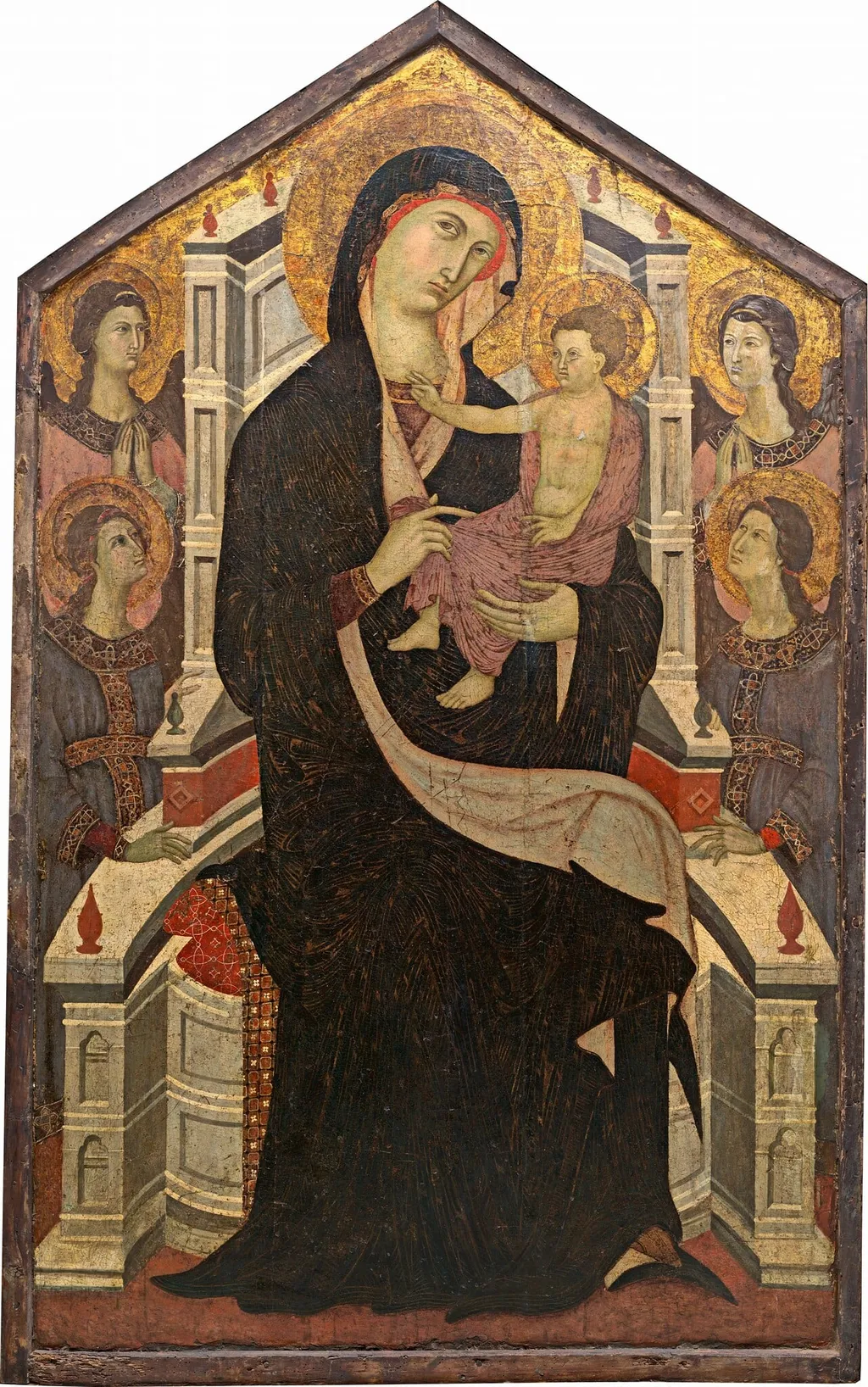
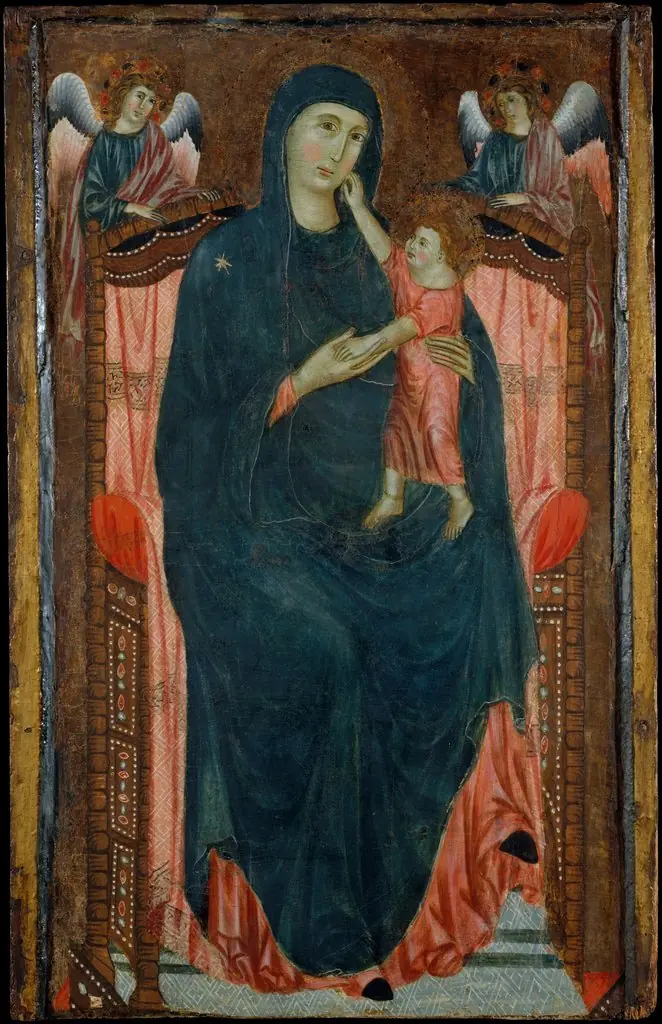
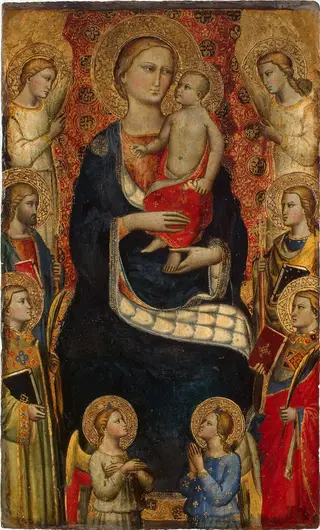
Maestà (Madonna and Child with Four Angels) is a tempera painting by the Byzantine icon painting artist Master of Città di Castello. It dates from 1290 and is held in the collection of the National Gallery of Art.
About this work
Technique & Style
Its substantial scale and medium align with Sienese panel painting conventions of the late thirteenth century.
The Maestà is executed in tempera on panel, measuring 230 × 141.5 cm. Its substantial scale and medium align with Sienese panel painting conventions of the late thirteenth century. The work depicts the Madonna and Child enthroned and accompanied by four angels, a composition typical of the Maestà genre that emphasizes hierarchical scale and frontal solemnity. The Master of Città di Castello's handling reflects the decorative linearity and spiritual formality characteristic of the Sienese school during this period, with drapery patterns and figural arrangements that prioritize symbolic clarity over naturalistic illusionism.
History & Provenance
Attributed to the Master of Città di Castello and dated to 1290, this tempera panel likely originated in the church of San Francesco in San Quirico d'Orcia. Johann Anton Ramboux recorded the work in a cloister at San Quirico between 1833 and 1843. By the early twentieth century, the painting was held by Pompeo Lemmi and subsequently Giacobbe Preziotti in the same town.
It then entered the Italian art market, passing through several private collections, including those of Baron Alberto Fassini in Tivoli and Corinna Uberti Trossi in Livorno by 1949.
The dealer Ettore Sestieri handled the work by 1951, after which it joined the collection of Count Alessandro Contini Bonacossi in Florence by 1953. In 1954, the Samuel H. Kress Foundation purchased the piece, eventually donating it to the National Gallery of Art in Washington, D.C., in 1961, where it forms part of the Samuel H. Kress Collection. The sources do not mention any specific exhibition history.
Context
Scholars view the Maestà as an example of late-thirteenth-century Sienese influence in Umbrian painting, reflecting the Master of Città di Castello's synthesis of Byzantine formalism and emerging naturalism. The work's composition, with the Virgin enthroned among angels, anticipates later devotional imagery while retaining a strict hierarchical arrangement characteristic of the period. Contemporary documentation, notably Ramboux's nineteenth-century record, situates the panel in the cloister of San Quirico, though its precise original location remains debated.
Subsequent ownership through Italian dealers and collectors culminated in acquisition by the Samuel H. Kress Foundation, securing its display at the National Gallery of Art, where it is studied as a key artifact for understanding regional stylistic transitions around 1290.
Overview
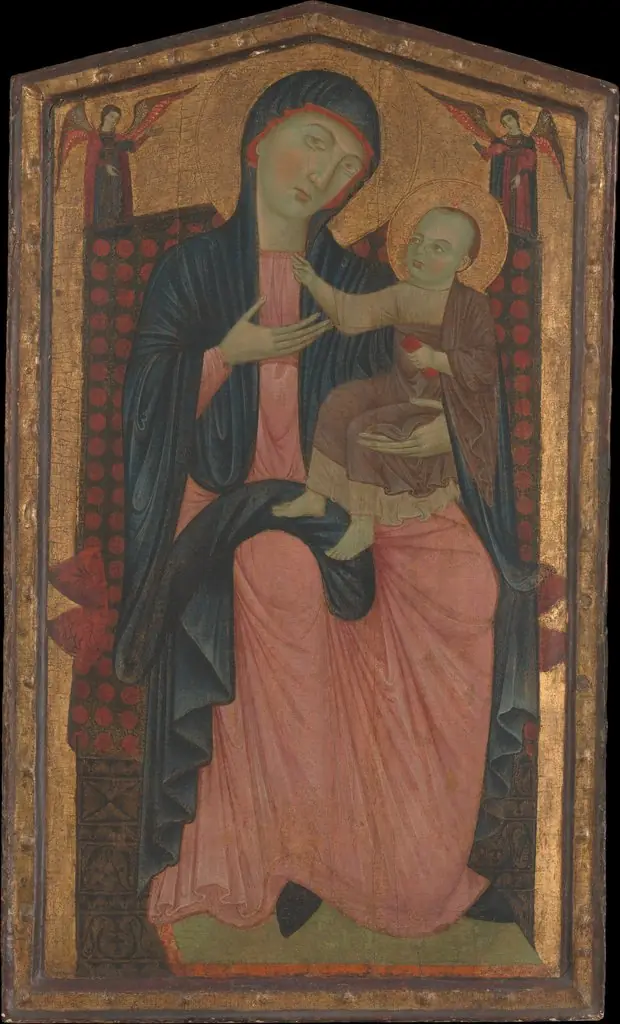
Created around 1290 by the artist known as the Master of Città di Castello, the Maestà (Madonna and Child with Four Angels) is a tempera painting on panel. This religious work centers on the Virgin Mary, enthroned and holding the Christ Child, a common devotional theme in late medieval Italian art. The composition is further enriched by the presence of four attendant angels, contributing to its solemn and reverent character.
Subject & Meaning
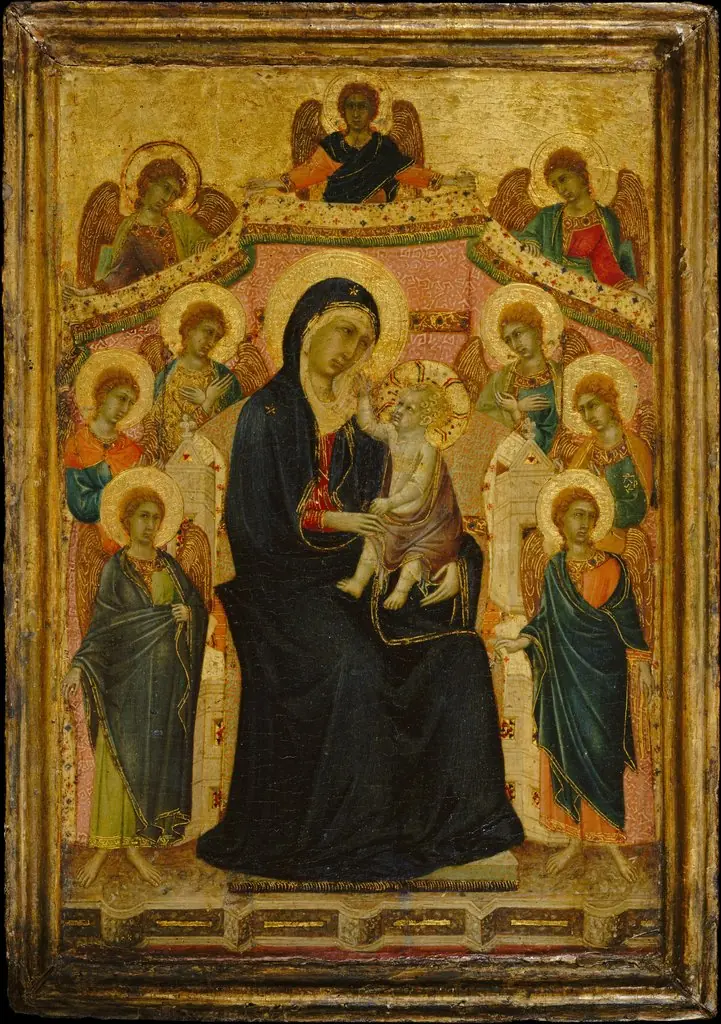
The painting presents the Virgin Mary, clad in a dark robe with a white sash and a red headband, seated regally on a throne. She cradles the Christ Child, who is swathed in pink fabric and reaches tenderly towards her chin. Four winged angels, adorned with halos, flank the throne, two on each side.
A backdrop of architectural elements, including arches and columns, frames the central figures, while a prominent gold halo encircles the Madonna's head, reinforcing the work's devotional intent and serene atmosphere.
Own this work as a print
Artist & collection