Artwork
愛染明王像|Aizen Myōō
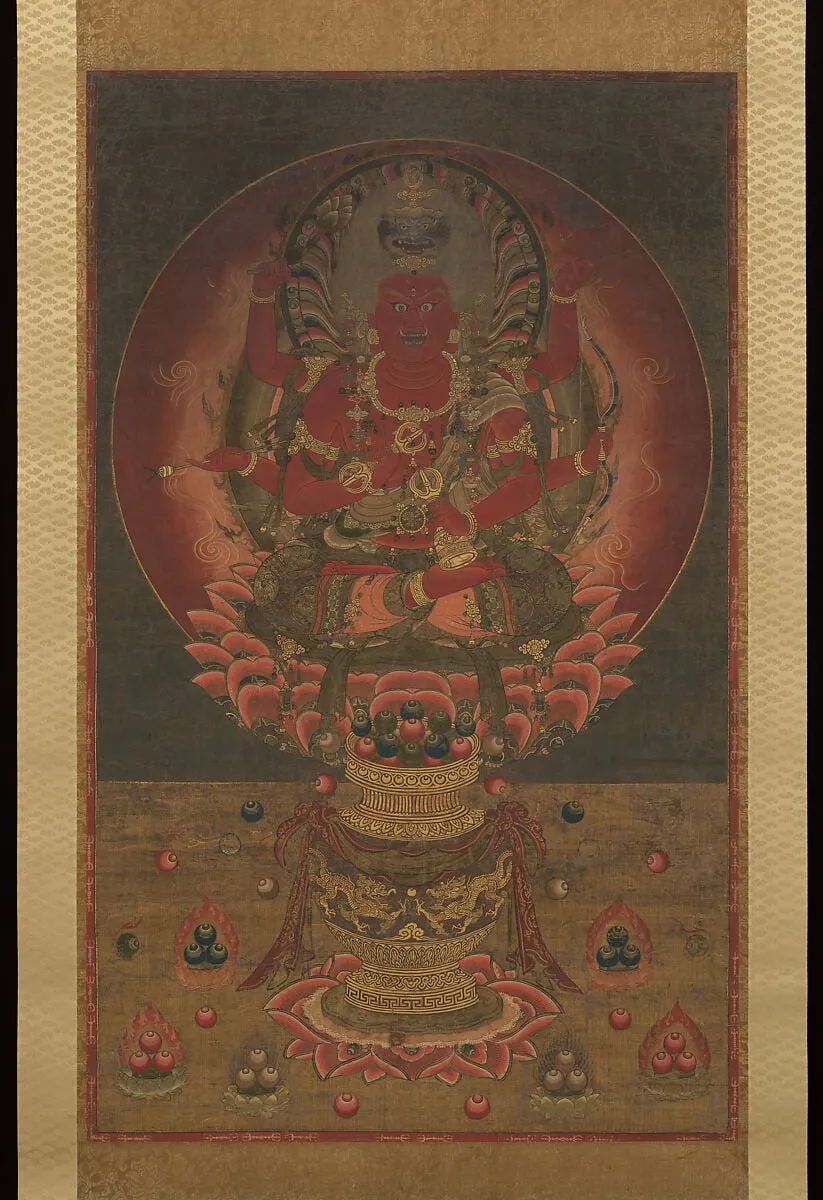
愛染明王像|Aizen Myōō is an ink painting. It dates from 1346 and is held in the collection of the Metropolitan Museum of Art. This hanging scroll presents Aizen Myōō, a significant Buddhist deity, rendered in vibrant ink and color on silk.
About this work
A bright red figure with six arms sits on a lotus, holding a bow and arrow, flames rising behind him and gold leaf glinting on his crown and jewelry. This is Aizen Myoo, the Buddhist deity of love and desire, fierce rather than serene, his third eye staring out. Painted on silk in 1346, the red still seems to pulse.
Subject & Meaning
Such iconography conveys the esoteric teaching that desire, when harnessed through ritual and insight, becomes a vehicle for awakening rather than an obstacle.
The hanging scroll depicts Aizen Myōō (Rāgarāja), a wrathful esoteric Buddhist deity who embodies passionate, transformative love and the subjugation of negative passions. He is shown with a red body, three eyes, and a fierce expression, holding a bow and arrow to symbolize the piercing of ignorance and attachment. A vajra scepter and lasso further signify his power to bind and redirect desire toward enlightenment.
The golden flames surrounding him evoke purification and the burning away of defilements. Such iconography conveys the esoteric teaching that desire, when harnessed through ritual and insight, becomes a vehicle for awakening rather than an obstacle.
Technique & Style
The hanging scroll depicts Aizen Myōō in ink, color, and gold against a silk support, with areas of cut gold leaf applied to highlight details such as the deity’s nimbus and jewelry. The painting is executed in a refined line-and-wash manner typical of fourteenth-century Japanese Buddhist icon painting, combining mineral pigments with delicate gold applications to articulate form and sacred presence. The figure’s dynamic posture, rendered with subtle ink modeling, and the inclusion of a bow and arrow, are stylistic conventions that emphasize the deity’s martial aspect within Esoteric Buddhist iconography.
The scroll’s dimensions (135.4 cm × 82.4 cm) and the use of silk as a support align with standard formats for hanging scrolls of this period.
History & Provenance
The hanging scroll depicting Aizen Myōō was created in Japan in 1346 by an anonymous artist. The work, executed in ink, color, and gold on silk with cut gold leaf, dates specifically to the year 1346. While the specific commissioning patron and the initial ownership history prior to modern times are not detailed in the available records, the painting is currently held in the collection of the Metropolitan Museum of Art.
The artwork remains attributed to an unknown painter, reflecting the common practice of religious art production in medieval Japan where individual artists often remained uncredited. The piece serves as a significant example of 14th-century Japanese Buddhist painting, preserving the iconography of the deity with a bow and arrow.
Aizen Myōō is housed in the Metropolitan Museum of Art in New York. The painting is recorded in the museum’s collection inventory, though no specific accession number is supplied in the documentation. Its creation is dated to 1346, with dimensions of 135.4 cm by 82.4 cm, and it was produced in Japan. The available records do not mention any documented exhibition history for this work.
Context
The 1346 hanging scroll titled 愛染明王像|Aizen Myōō, executed in ink, color, gold and cut‑gold leaf on silk, belongs to the religious painting genre and portrays the Buddhist deity Aizen Myōō with a bow and arrow. Its creation in Japan is confirmed by the metadata, which also records its presence in the Metropolitan Museum of Art collection. The work’s anonymous authorship and technical use of gold leaf illustrate the stylistic conventions of 14th‑century Japanese Buddhist art, situating it within the broader tradition of Muromachi‑period religious imagery.
Contemporary scholarly assessments highlight its significance for understanding anonymous Buddhist painting practices and the diffusion of devotional iconography in East Asian art circles.
Overview
This hanging scroll presents Aizen Myōō, a significant Buddhist deity, rendered in vibrant ink and color on silk. The artwork, which incorporates gold and intricate cut gold leaf, retains its luminosity centuries after its creation. It depicts a powerful, multi-armed figure seated on a lotus, surrounded by flames, embodying a fierce yet revered presence within the Buddhist pantheon.
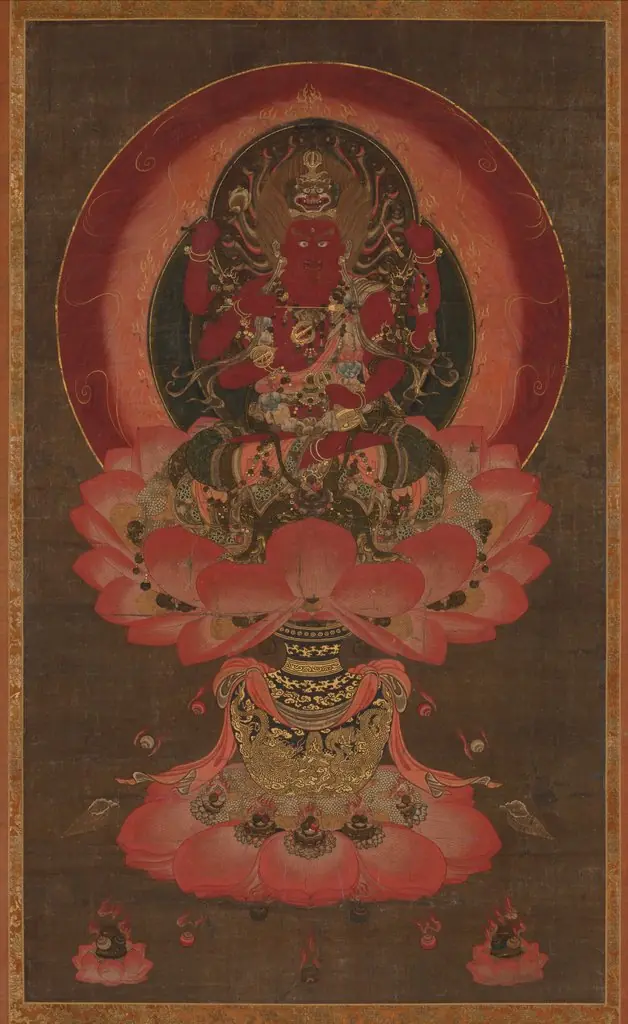
Artist & collection

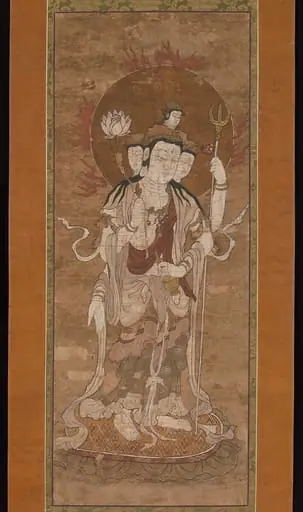 十二天像(梵天)|One of the Twelve Devas: Bonten
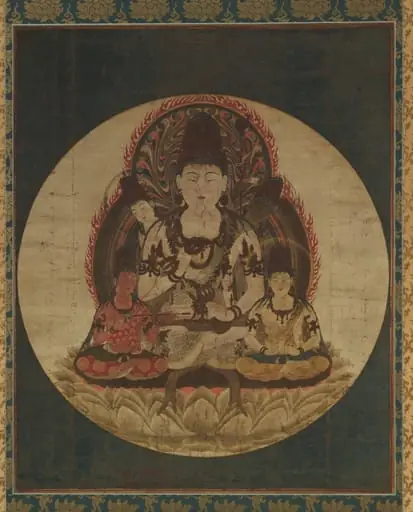 The Secret Five Bodhisattvas (Gohimitsu Bosatsu)
 The Goddess Kurukulla
 Red Amida
 Avalokiteshvara (Guanyin), the Bodhisattva of Compassion
 Eleven-Headed, Thousand-Armed Bodhisattva of Compassion (Avalokiteshvara)
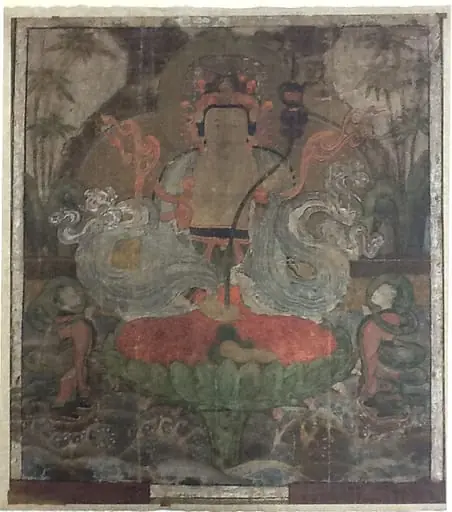 Untitled
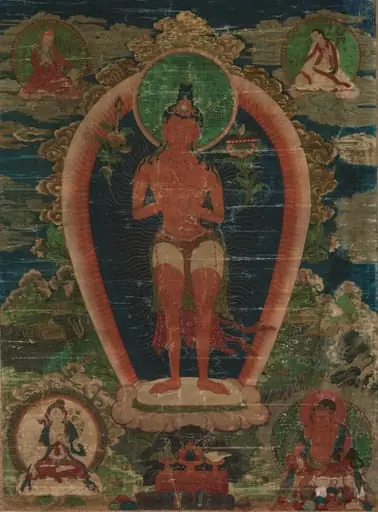 Bodhisattva Padmapani
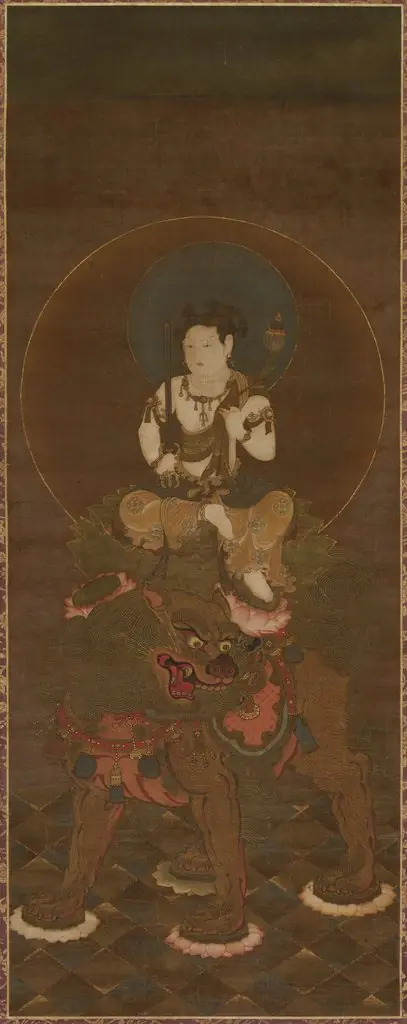 Monju with Five Hair Knots
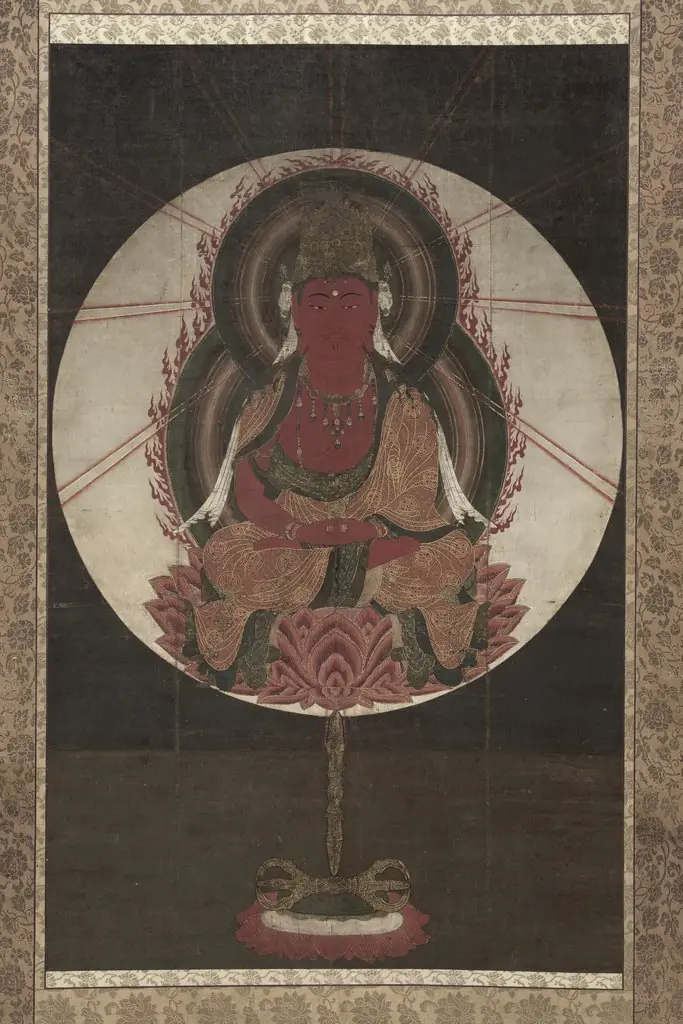 Red Amida