Artwork
寛文美人図|Beauty of the Kanbun Era
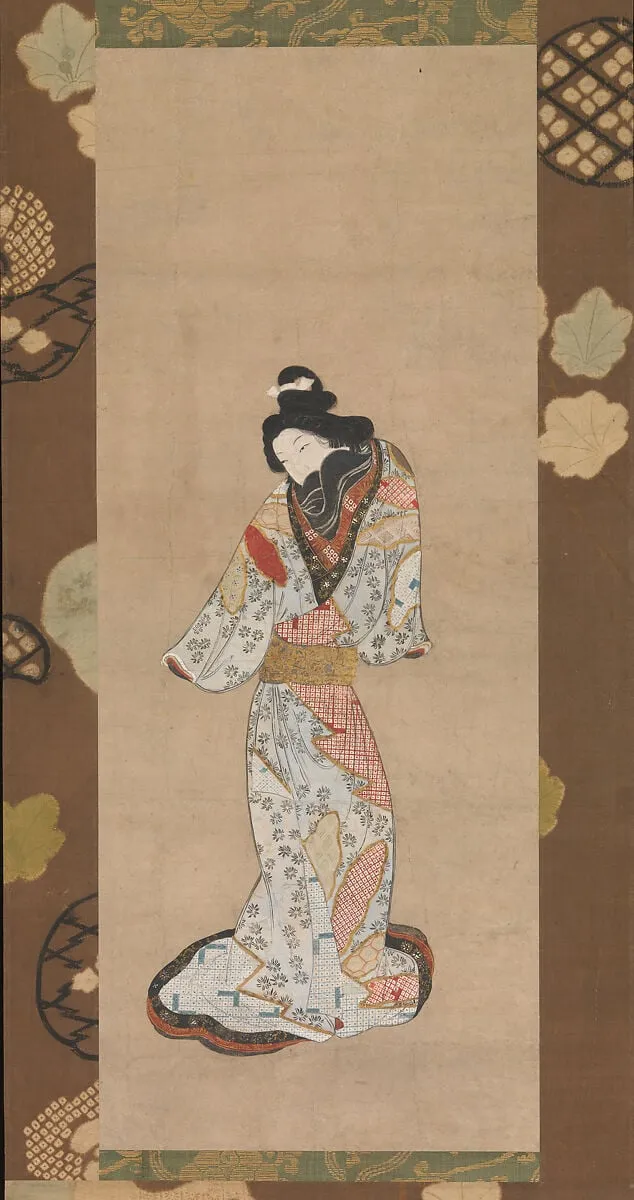
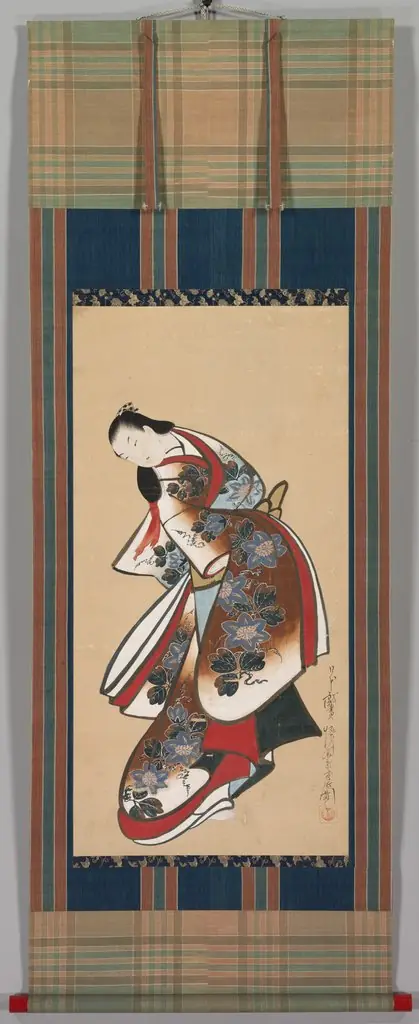
寛文美人図|Beauty of the Kanbun Era is an ink painting. It dates from 1670 and is held in the collection of the Metropolitan Museum of Art. The hanging scroll, titled Beauty of the Kanbun Era, depicts a woman dressed in a vivid red kimono set against a luminous gold background.
About this work
Subject & Meaning
The painting functions primarily as a genre study of feminine beauty rather than a depiction of a specific identifiable individual or mythological scene.
Created in 1670 by an anonymous Japanese artist, this hanging scroll portrays a solitary woman, serving as a defining example of the genre that would later be known as Kanbun-era beauty portraits. The work utilizes ink, color, and gold on paper to render the figure, focusing entirely on the depiction of a female subject without additional narrative context or symbolic attributes specified in available records. As a portrait from this specific historical period, the image represents the emerging aesthetic ideals of women during the early Edo period, characterized by the distinct fashion and demeanor captured in the composition.
The painting functions primarily as a genre study of feminine beauty rather than a depiction of a specific identifiable individual or mythological scene.
Technique & Style
Created in 1670, Beauty of the Kanbun Era is executed as a hanging scroll using ink, color, and gold applied to a paper support. The work functions as a portrait depicting a woman, adhering to the formal conventions of Edo-period Japanese painting. Its stylistic approach combines monochrome ink lines with selective polychrome and metallic accents to define the figure's features and attire. The medium of paper on a hanging scroll format facilitates the delicate rendering characteristic of the genre.
History & Provenance
寛文美人図|Beauty of the Kanbun Era is a hanging scroll painted in ink, color and gold on paper. The work was produced in Japan in 1670 by an anonymous artist, as recorded in its internal catalogue and in the Metropolitan Museum of Art’s Wikidata entry. Its date is given as 1670, and the scroll depicts a woman.
The piece belongs to the Metropolitan Museum of Art’s collection, which provides its current ownership and display location.
The painting titled 寛文美人図 (Beauty of the Kanbun Era) is part of the Metropolitan Museum of Art’s collection in New York. The work is recorded as a hanging scroll of ink, color, and gold on paper, dated to 1670 and attributed to an anonymous Japanese painter. No accession or inventory number is disclosed in the sources examined, and the museum’s catalogue simply lists the piece under its generic collection entry.
Exhibition information is likewise absent from the available documentation; there is no mention of prior loans, special displays, or public exhibitions of the work in the referenced materials.
Overview
The hanging scroll, titled Beauty of the Kanbun Era, depicts a woman dressed in a vivid red kimono set against a luminous gold background. She holds a fan, her hair styled in a high piled fashion, and her complexion is rendered in a pale, powdered tone. Executed with ink, color, and gold on paper, the work exemplifies the decorative aesthetic of early 17th‑century Japan.
Context
During the Kanbun years, Japan experienced a flourishing of visual culture that celebrated idealized forms, especially in depictions of women. The combination of vivid color, gold leaf, and refined line work mirrors the tastes of the emerging merchant class, who favored artworks that combined elegance with decorative brilliance.
Artist & collection

- Untitled
 Untitled
 Elegantly Garbed Male Youth
 Untitled
 Courtesan
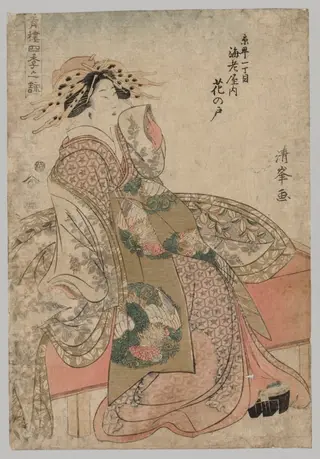 Hananoto of the Ebiya in Kyōmachi 1-chome, from the series Songs of the Four Seasons in the Pleasure Quarters
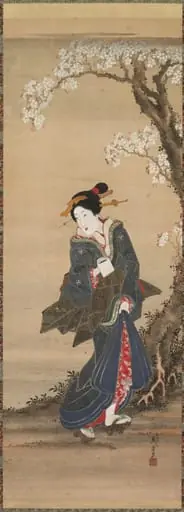 Courtesan
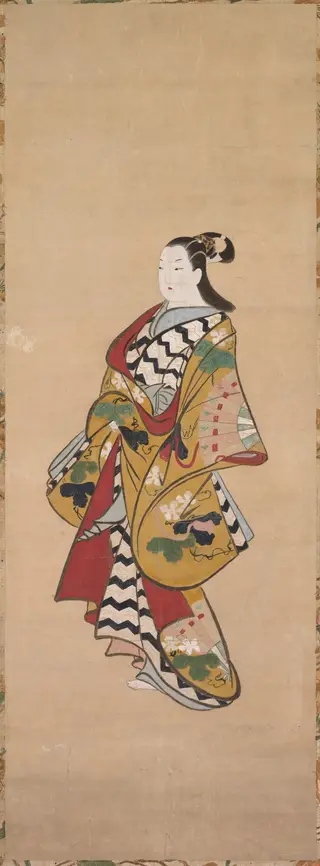 Courtesan
 『春雨集』 摺物帖歌川国直画 元禄美人|Spring Rain Collection (Harusame shū), vol. 1: Genroku-style Courtesan
 Sanjo Kantaro II in the Role of Urashima Taro
 Untitled
 Female Dancer