Artwork
Birds and Flowers
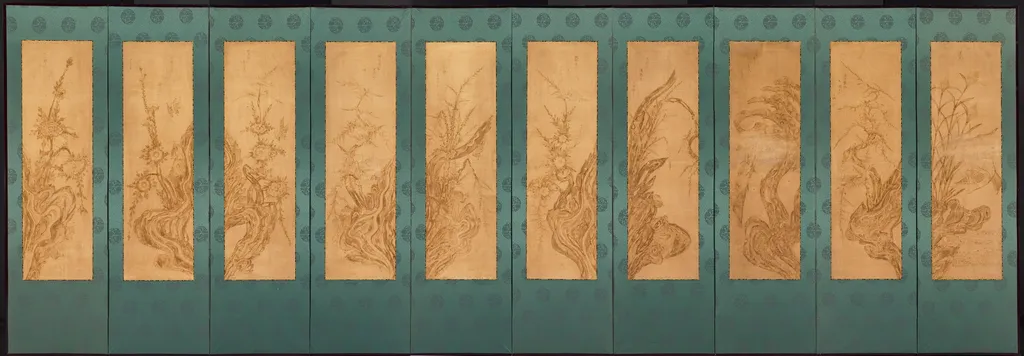
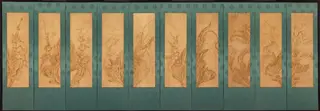
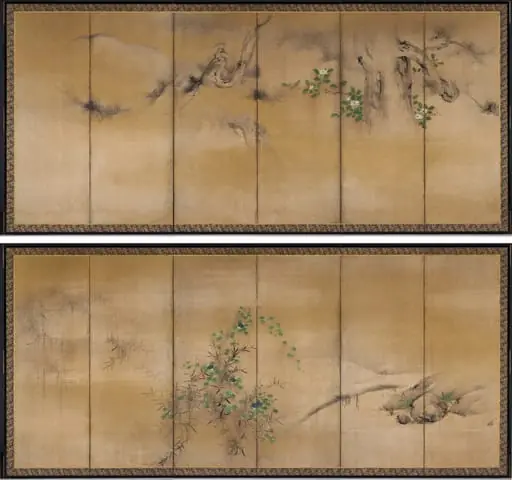
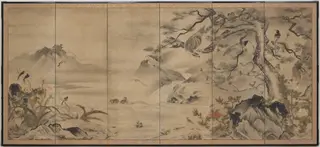
Birds and Flowers is an unspecified painting. It dates from 1849 and is held in the collection of the Cleveland Museum of Art. The work consists of a long, narrow composition divided into eight adjoining panels.
About this work
History & Provenance
The work has not been documented in major exhibition histories beyond its inclusion in the museum's collection.
Birds and Flowers is a painting dated to 1849, created in Korea by an unidentified artist. The work’s classification as a painting is recorded in, while its place of origin is given as Korea in. No records of earlier ownership, commission, or exhibition history appear in the provided sources. The painting entered the Cleveland Museum of Art’s collection in 1991, receiving the accession number 1991.80, and has remained in the museum’s holdings since that acquisition. Its provenance prior to 1991 is therefore unknown.
The work is held by the Cleveland Museum of Art under its accession number 1991.80. It was created in 1849 in Korea and is classified as a painting. The work has not been documented in major exhibition histories beyond its inclusion in the museum's collection.
Legacy
The work Birds and Flowers by an unknown Korean artist, created in 1849, entered the Cleveland Museum of Art collection and has been part of its holdings since 1991. Although attributed to an anonymous hand, its composition of avian and floral motifs has informed scholarly discussions of 19th-century Korean painting and contributed to broader narratives of transnational East Asian artistic exchange.
Overview
The work consists of a long, narrow composition divided into eight adjoining panels. Each segment portrays slender, winding branches adorned with a modest number of leaves or blossoms against a uniform green field punctuated by tiny blue specks. The overall effect is that of a continuous decorative frieze designed to be displayed as a single unit.
Subject & Meaning
The painting focuses on botanical elements, delicate vines and occasional flowers, rendered with a sense of gentle motion. The repetitive, flowing lines suggest growth and natural rhythm, while the sparse coloration emphasizes the simplicity and elegance of the plant forms rather than narrative content.
Technique & Style
Executed in a light, almost golden hue, the branches are outlined with clean, fluid strokes that convey movement. The flat green background and the minimal blue dots provide a subtle contrast, allowing the linear quality of the vines to dominate. The style balances decorative patterning with a restrained naturalism.
Context
The format of segmented panels aligns with decorative traditions where elongated friezes were used to embellish interior spaces. The emphasis on stylized foliage reflects a broader interest in botanical motifs that appeared in various artistic movements seeking to merge ornamentation with fine art.
Artist & collection