Artwork
Composite Elephant - Deccan Painting Early 17th Century
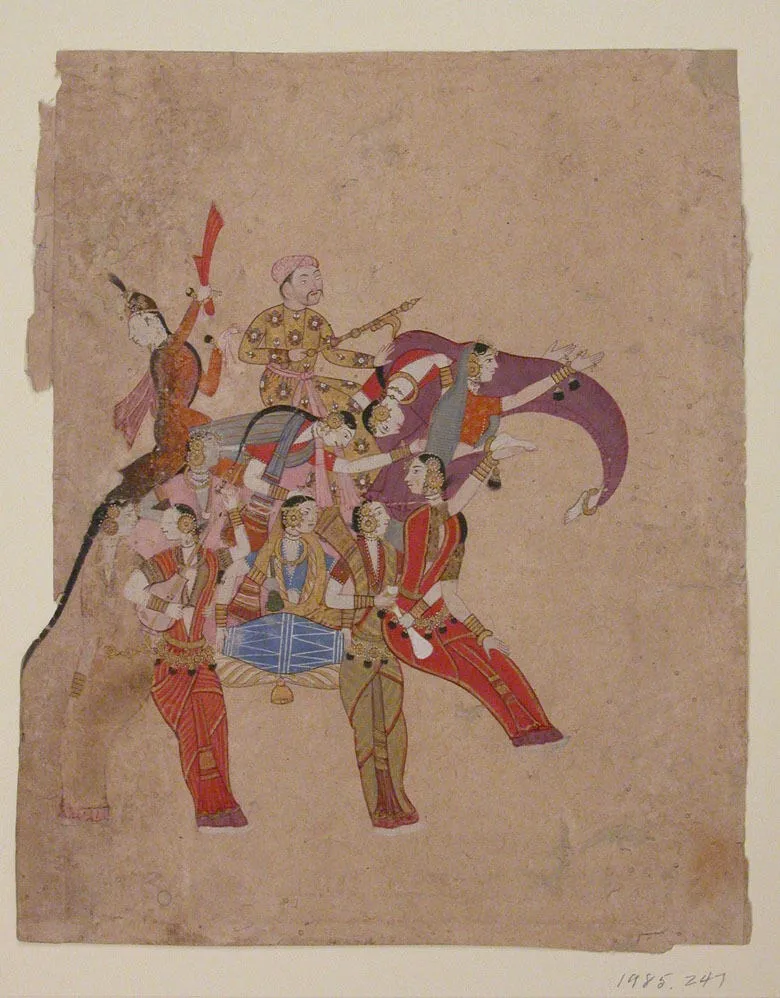
Composite Elephant - Deccan Painting Early 17th Century is an unspecified painting by Unknown. It dates from 9 and is held in the collection of the Metropolitan Museum of Art. The early‑seventeenth‑century Deccan work portrays a massive elephant rendered in deep violet, bearing a procession of figures.
About this work
Subject & Meaning
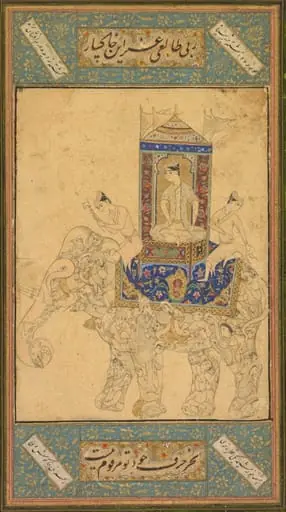
The painting is a composite or "concealed" image in which a group of women playing musical instruments together form the body of a large purple elephant, while a noble couple rides atop the assembled creature. The depicted figures include women, a prince, and a princess, along with instruments such as the dholak and tanpura, all of which merge into the elephant's silhouette.
This visual conceit is a hallmark of Deccan courtly painting, where the surprise of discovering human figures within an animal form was prized as a display of wit and artistic ingenuity. The pairing of music-making women with a royal rider suggests themes of courtly entertainment, harmony, and the union of prince and princess, while the elephant itself carries long-standing associations with royalty, strength, and auspiciousness in South Asian iconography.
History & Provenance
The painting’s creation date is placed in the early seventeenth century, aligning stylistically with Deccan ateliers of that period.
The painting’s creation date is placed in the early seventeenth century, aligning stylistically with Deccan ateliers of that period. It entered the collection of the Los Angeles County Museum of Art, where it is currently held. No record links the work to a named patron or a documented commission, and the artist remains unattributed, consistent with the anonymity typical of Deccan courtly manuscript and album traditions.
Composite Elephant, a Deccan painting from the early 17th century, is held in the collections of the Los Angeles County Museum of Art and the Metropolitan Museum of Art. The work measures 24.6 cm in height and 20.3 cm in width. It has been exhibited at the Los Angeles County Museum of Art.
Overview
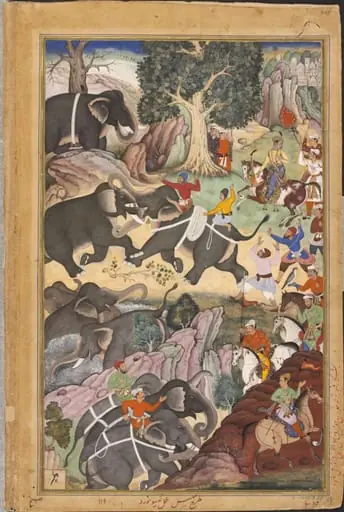
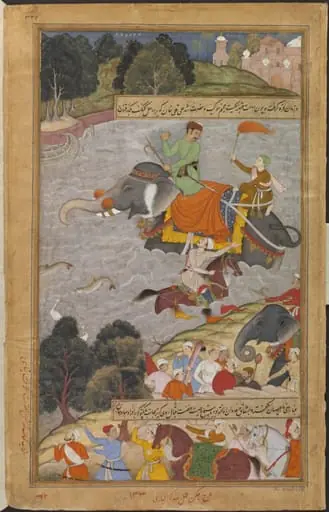
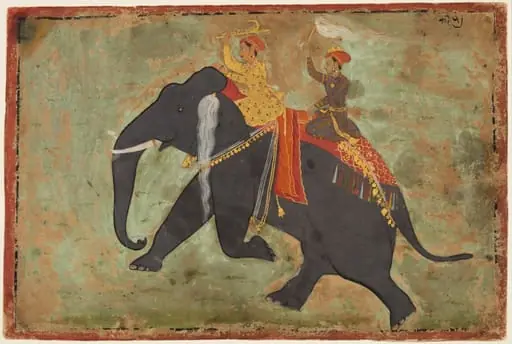
The early‑seventeenth‑century Deccan work portrays a massive elephant rendered in deep violet, bearing a procession of figures. The animal’s trunk is lifted, suggesting movement, while a rider in a scarlet garment clutches a small hand‑drum. Surrounding participants are dressed in vivid yellows, blues and reds, many topped with ornamental headgear, against an unadorned backdrop that concentrates attention on the central spectacle.
Technique & Style
Executed with flat areas of saturated pigment, the painting employs a stylised, almost schematic rendering of forms typical of Deccan court art. Linear outlines define the figures, and the lack of perspective keeps the scene two‑dimensional. The use of bold, contrasting colours and minimal background detail emphasizes the decorative quality of the work.
Context
In the early 1600s the Deccan region hosted a vibrant court culture that blended indigenous Indian motifs with influences from Persianate artistic conventions. Composite scenes featuring animals, musicians and processional crowds were common in manuscripts and wall paintings, reflecting both courtly spectacle and the cosmopolitan character of the princely states.
Artist & collection