Artwork
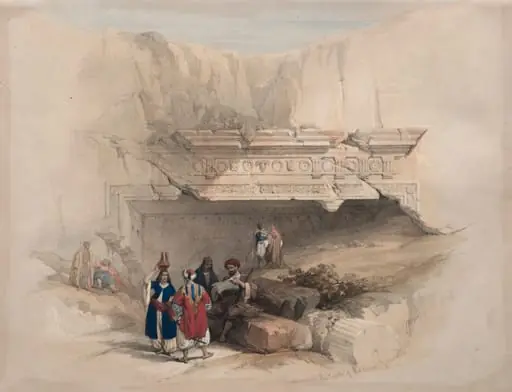
Front view of the Khasné, Petra
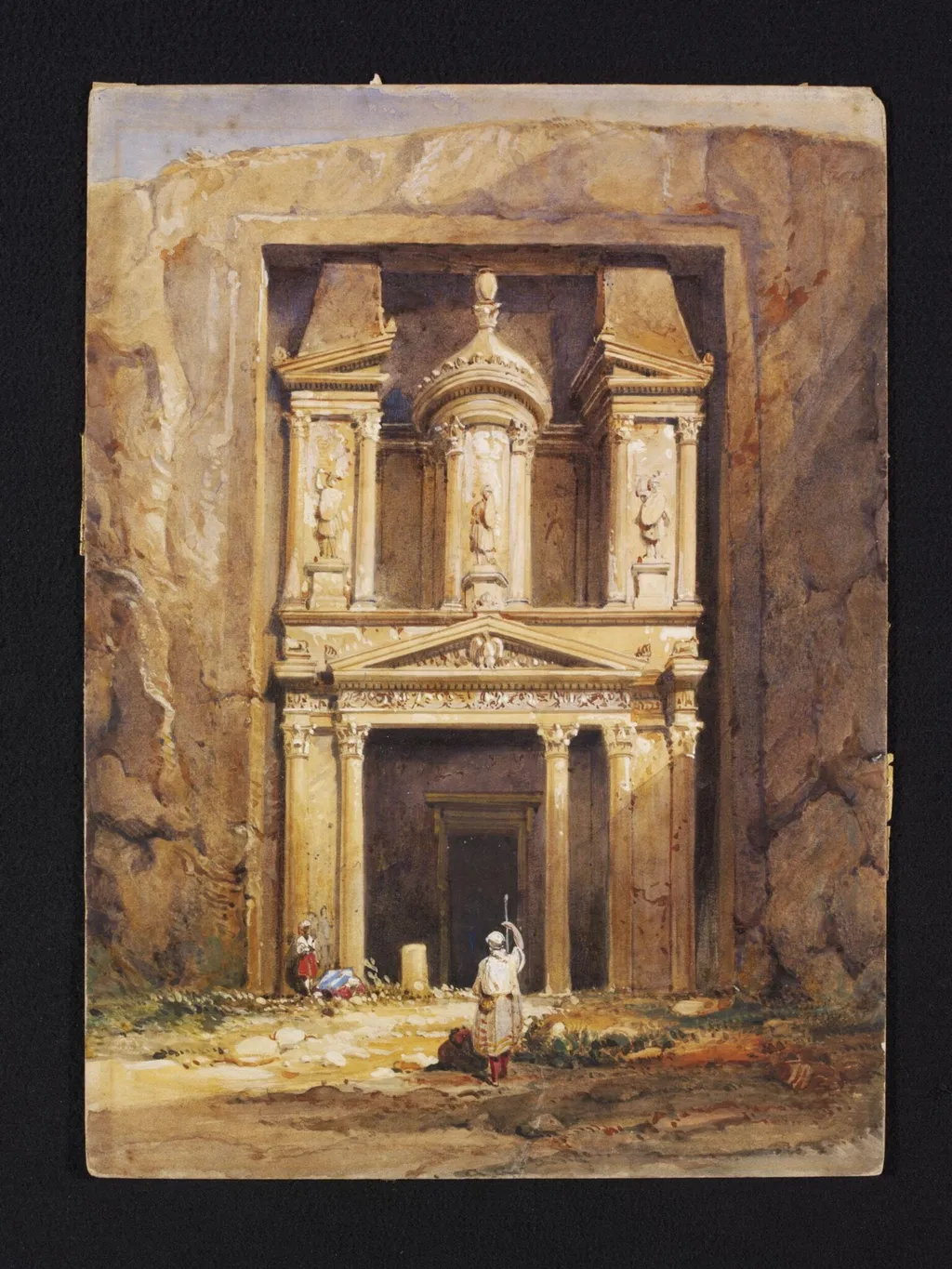
Front view of the Khasné, Petra is a watercolor work on paper by the Impressionist artist Unknown. It dates from 1850 and is held in the collection of the Victoria and Albert Museum.
About this work
Overview
Acquired at Bonhams in 1976, the piece remains a quiet testament to 19th-century travel and visual record-keeping in the Near East.
This watercolour, dated circa 1850, presents a frontal view of the Khazneh in Petra, capturing its monumental façade with careful attention to architectural detail. The work is grounded in an earlier 1830 lithograph by Léon de Laborde, reflecting a tradition of topographical documentation. Though once attributed to W. Clerihew, its authorship has since been reevaluated.
Acquired at Bonhams in 1976, the piece remains a quiet testament to 19th-century travel and visual record-keeping in the Near East.
Subject & Meaning
The Khazneh, or Treasury, is rendered as a solitary, imposing structure carved into sandstone cliffs, its ornate façade dominating the composition. Two small figures in traditional attire stand before it, offering scale and a hint of human presence without narrative intrusion. The focus remains on the monument’s endurance and craftsmanship, emphasizing its architectural grandeur rather than myth or history.
The scene conveys quiet reverence, aligning with the era’s fascination with ancient ruins as silent witnesses to lost civilizations.
Technique & Style
The artist employs transparent watercolour washes to suggest the texture of weathered stone and the play of natural light across the façade. Subtle gradations in tone model the columns and reliefs, while the foreground figures are rendered with minimal detail, contrasting the building’s complexity. The background, sparse trees and rugged terrain, is rendered with loose, atmospheric strokes, enhancing depth without distraction. The technique reflects a topographical tradition, prioritizing accuracy over expressive flourish.
History & Provenance
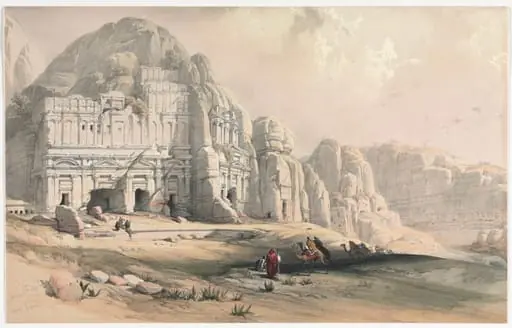
The watercolour derives from a published lithograph by Léon de Laborde, who documented Petra during an 1828 expedition. Its creation likely followed European scholarly interest in the site after its re-introduction to Western audiences. The work was misattributed to W. Clerihew before being reassessed.
It entered modern collections after being purchased at Bonhams in 1976, its origins preserved through stylistic and documentary links to 19th-century travel art.
Context
In the mid-19th century, European artists and explorers increasingly visited the Levant, producing visual records of ancient sites like Petra. This watercolour belongs to a genre of topographical drawings made for scholarly and private audiences, distinct from later romanticized depictions. It reflects a period when accurate representation was valued over dramatic interpretation, aligning with archaeological and geographic surveys emerging from colonial and academic institutions.
Legacy
Though not widely exhibited, the watercolour contributes to a broader archive of visual documentation that shaped Western perceptions of Petra. Its fidelity to Laborde’s lithograph underscores the transmission of visual knowledge across media and decades. It stands as an example of how early photographic alternatives, drawings and watercolours, helped preserve the appearance of sites before modern conservation efforts, offering a baseline for later study.
Artist & collection