Artwork
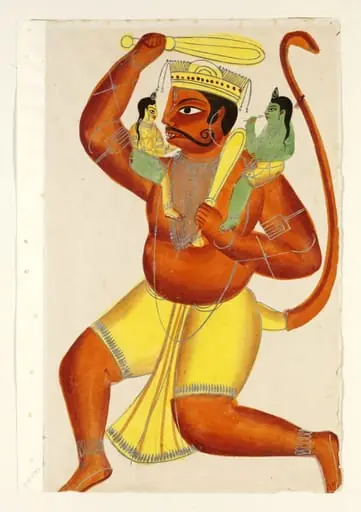
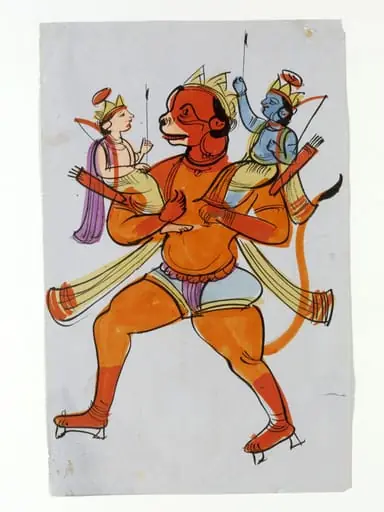
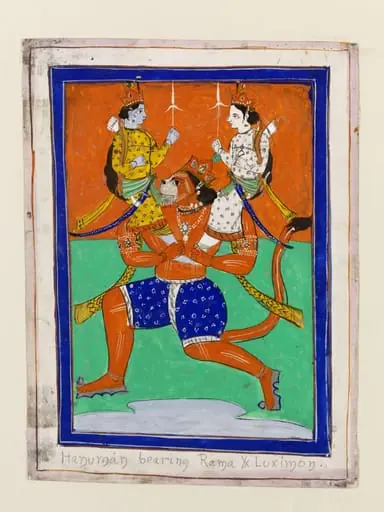
Hanuman with Rama and Lakshmana on his shoulders, from a Kalighat album
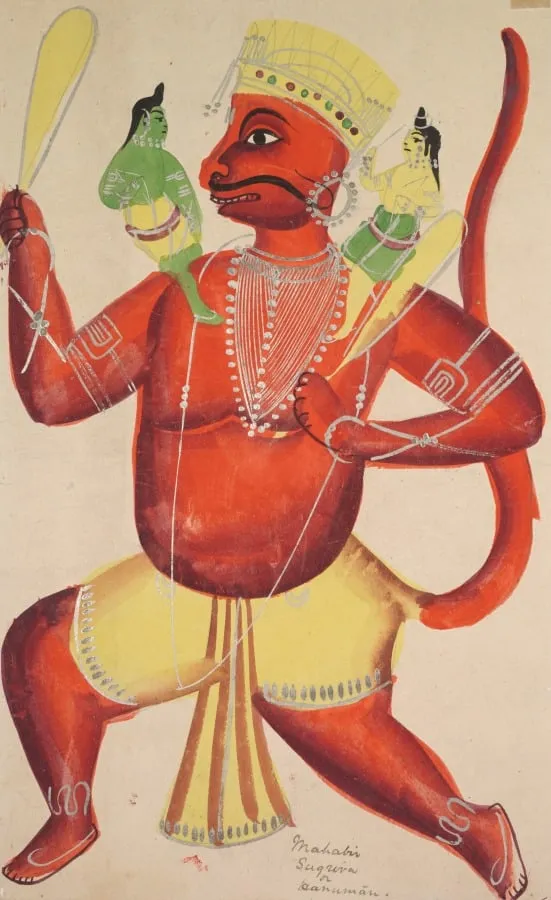
Hanuman with Rama and Lakshmana on his shoulders, from a Kalighat album is an unspecified painting by the Impressionist artist Unknown. It dates from 1890 and is held in the collection of the Cleveland Museum of Art. The work depicts the Hindu deity Hanuman bearing the brothers Rama and Lakshmana on his shoulders as they search for Sita.
- Accession no.
- 2003.120
About this work
Overview
Rendered in a vivid palette of orange, yellow, green and touches of silver, the composition conveys movement and immediacy.
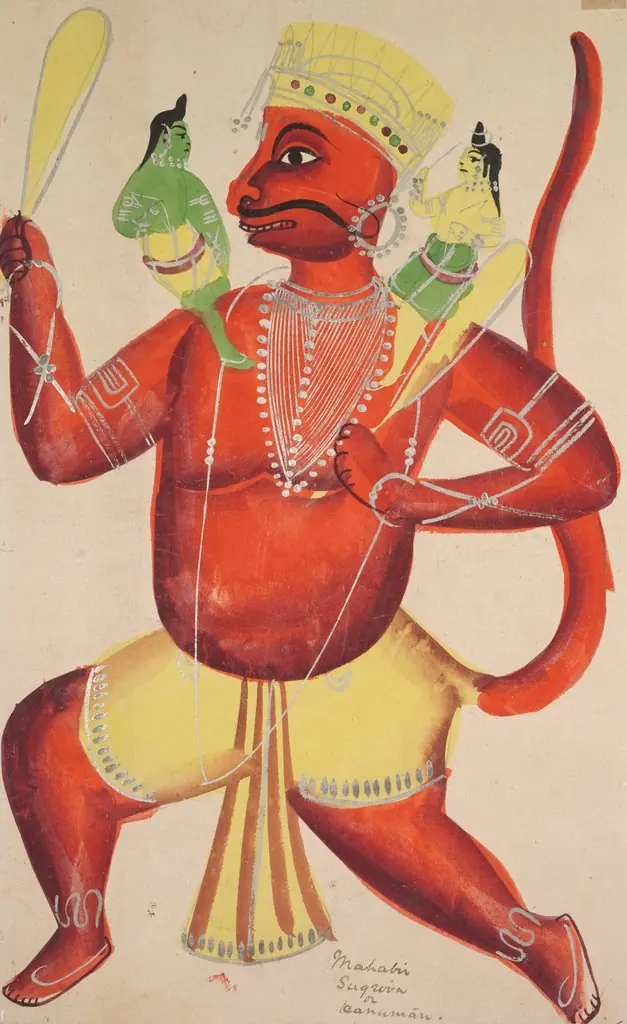
The work depicts the Hindu deity Hanuman bearing the brothers Rama and Lakshmana on his shoulders as they search for Sita. Rendered in a vivid palette of orange, yellow, green and touches of silver, the composition conveys movement and immediacy. A handwritten note at the bottom debates whether the towering figure is Hanuman or Sugriva, but the visual cues, particularly the tawny monkey supporting the two princes, identify the carrier as Hanuman, Rama’s devoted companion.
Subject & Meaning
The scene draws from the Ramayana episode in which Hanuman assists the exiled princes in their quest to rescue Sita. By placing Rama and Lakshmana atop the monkey god, the image emphasizes Hanuman’s role as a loyal servant and the divine partnership that drives the narrative. The informal inscription reflects popular engagement with the story, inviting viewers to contemplate the heroism of both the human and the animal protagonists.
Technique & Style
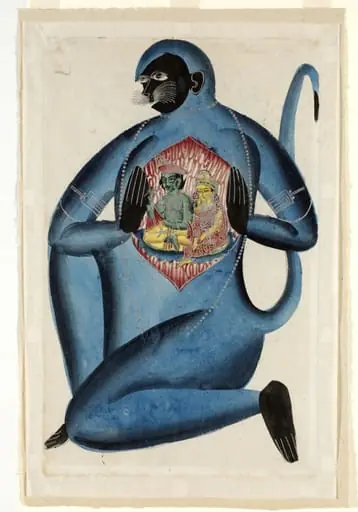
Executed with flat, bold outlines and minimal shading, the painting employs a limited yet striking color scheme. The figures appear stylized rather than naturalistic, a hallmark of the Kalighat school, where quick brushwork and clear contours facilitated rapid production. Silver accents punctuate the composition, adding a decorative sheen without disrupting the overall graphic simplicity.
History & Provenance
Originating from the Kalighat district of Kolkata, the piece belongs to a tradition of inexpensive, mass‑produced prints sold to pilgrims and travelers in the 19th and early 20th centuries. Such works were typically created by itinerant artisans who catered to devotional demand, making religious imagery accessible to a broad public.
Context
Kalighat art emerged as a vernacular response to the bustling pilgrimage site of the Kalighat Temple, blending folk motifs with contemporary urban influences. The painting’s brisk execution and vivid colors reflect the commercial environment in which artists needed to produce eye‑catching images quickly, while still conveying recognizable mythological content for a largely literate‑aided audience.
Artist & collection