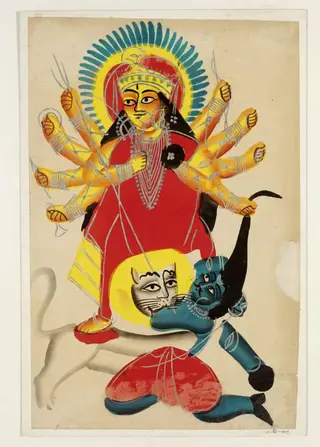
Artwork
Leaf from a Kalighat album: The Goddess Kali (recto); Kali Standing on Shiva (verso)
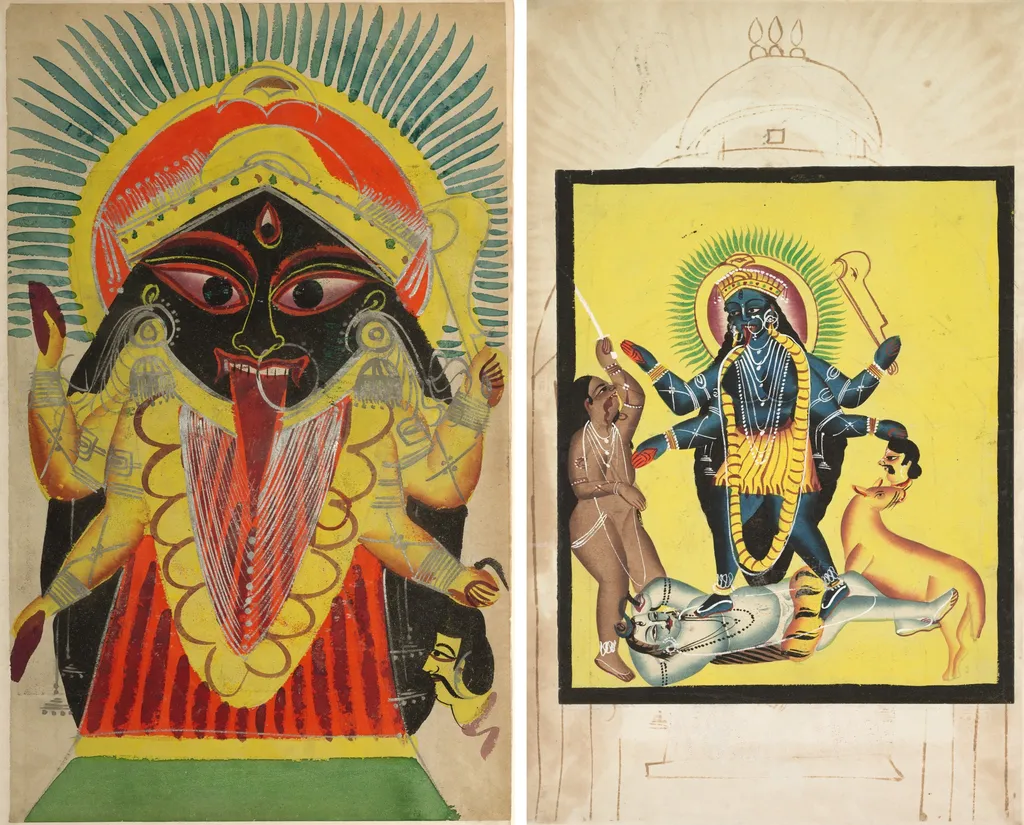
Leaf from a Kalighat album: The Goddess Kali (recto); Kali Standing on Shiva (verso) is an unspecified painting. It dates from 1896 and is held in the collection of the Cleveland Museum of Art. The work consists of a double‑sided leaf from a Kalighat album, presenting two distinct yet related images of the Hindu goddess Kali.
About this work
History & Provenance
Created in Kolkata in 1890, this Kalighat album leaf depicts the Goddess Kali on its recto and Kali standing on Shiva on its verso.
Created in Kolkata in 1890, this Kalighat album leaf depicts the Goddess Kali on its recto and Kali standing on Shiva on its verso. The work was produced by an unknown artist during the late nineteenth century. It eventually entered the collection of the Cleveland Museum of Art, where it is cataloged under the accession number 2003.110.
The specific circumstances of its original commission and the intermediate ownership history prior to its museum acquisition remain unrecorded in the available documentation.
Context
The leaf originates from a Kalighat album produced in Kolkata around 1890, reflecting the popular print tradition of 19th-century Bengal. It depicts the Goddess Kali in recto and Kali standing on Shiva in verso, illustrating devotional subjects characteristic of the school. The work is attributed to an anonymous artist within the Cleveland Museum of Art collection and was created in the same year as other documented Kalighat pieces, situating it within the broader emergence of narrative religious prints in colonial India.
Legacy
The work's legacy is anchored in its presence within the Cleveland Museum of Art's collection and its role in scholarly discourse on Bengal folk art. Its dual-sided imagery exemplifies Kalighat traditions and influenced modern interpretations of mythic narratives. The piece is cataloged under the artist's Wikidata entry, reflecting ongoing research into anonymous practitioners.
Overview
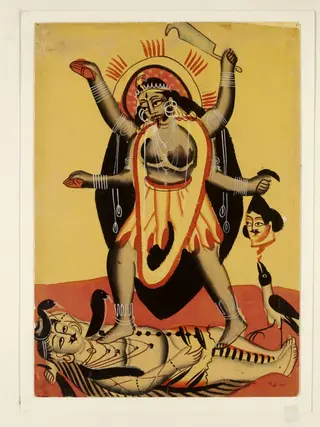
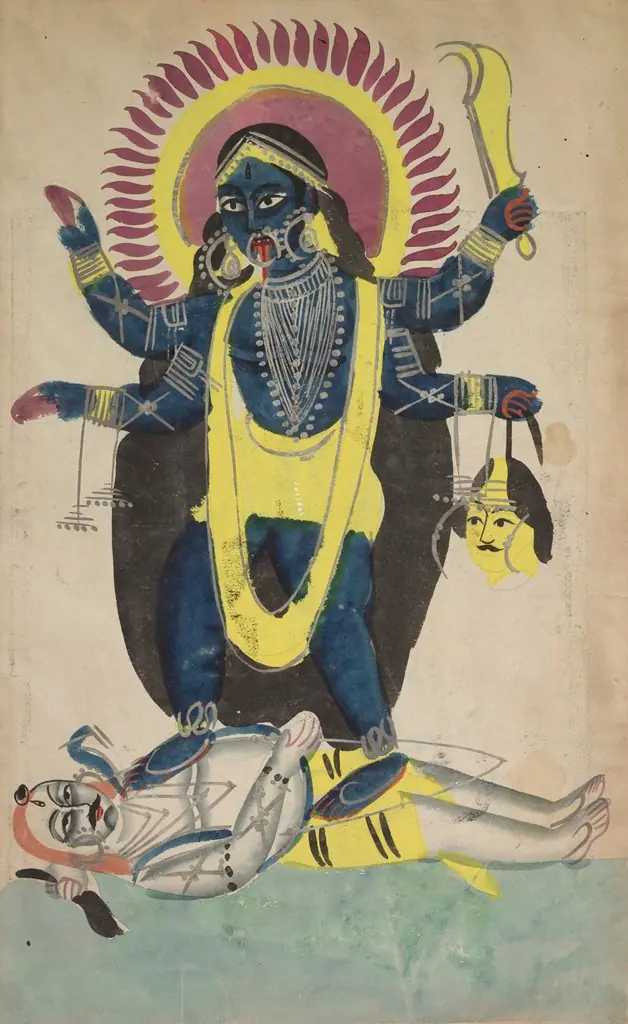
The work consists of a double‑sided leaf from a Kalighat album, presenting two distinct yet related images of the Hindu goddess Kali. The recto depicts Kali seated in a cross‑legged pose, her dark form accentuated by a vivid red tongue, large eyes and a garland of skulls, while the verso shows her standing triumphantly atop a smaller, blue‑toned figure representing Shiva, his third eye visible.
Subject & Meaning
Both scenes emphasize Kali’s dual nature as a fierce destroyer and a protective mother. In the seated portrayal, the weapon and skull necklace highlight her role as a vanquisher of evil, whereas the standing image, with Kali dominating Shiva, underscores her supreme power and the mythic theme of the goddess subduing the male principle to maintain cosmic balance.
Technique & Style
The images employ the characteristic Kalighat aesthetic of flat, saturated colors and bold outlines, with no attempt at chiaroscuro or three‑dimensional modeling. The background on the recto is a bright yellow field intersected by green and red swirls, while the verso uses a contrasting blue for the subordinate figure. Sharp black borders frame each composition, reinforcing the graphic, folk‑art quality of the piece.
Artist & collection

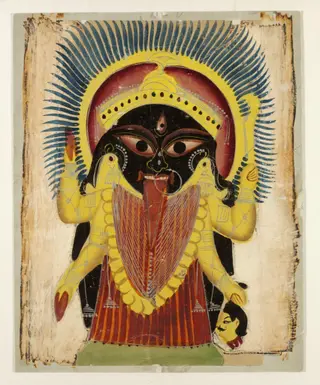
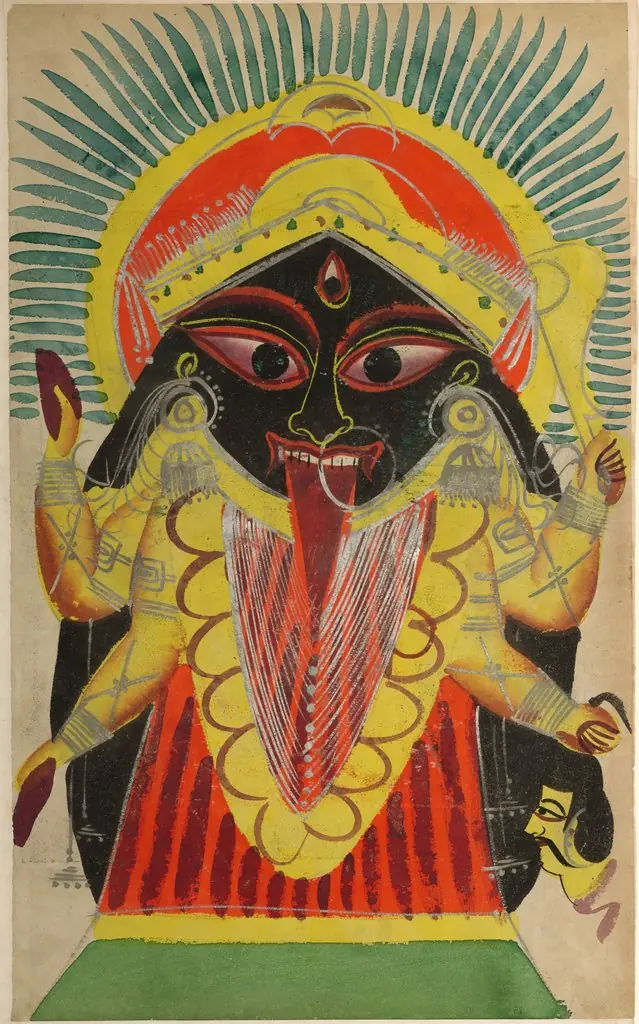
- The Goddess Kali (recto), from a Kalighat album
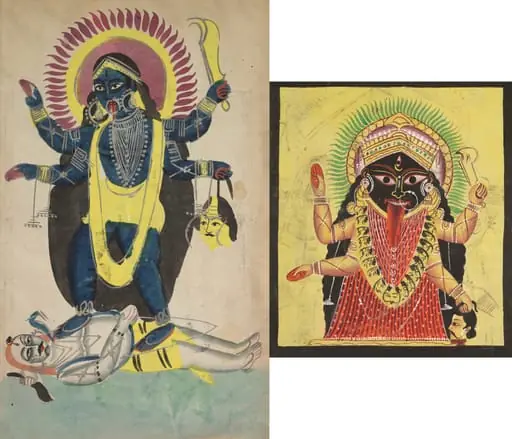 Leaf from a Kalighat album: Two Aspects of Kali
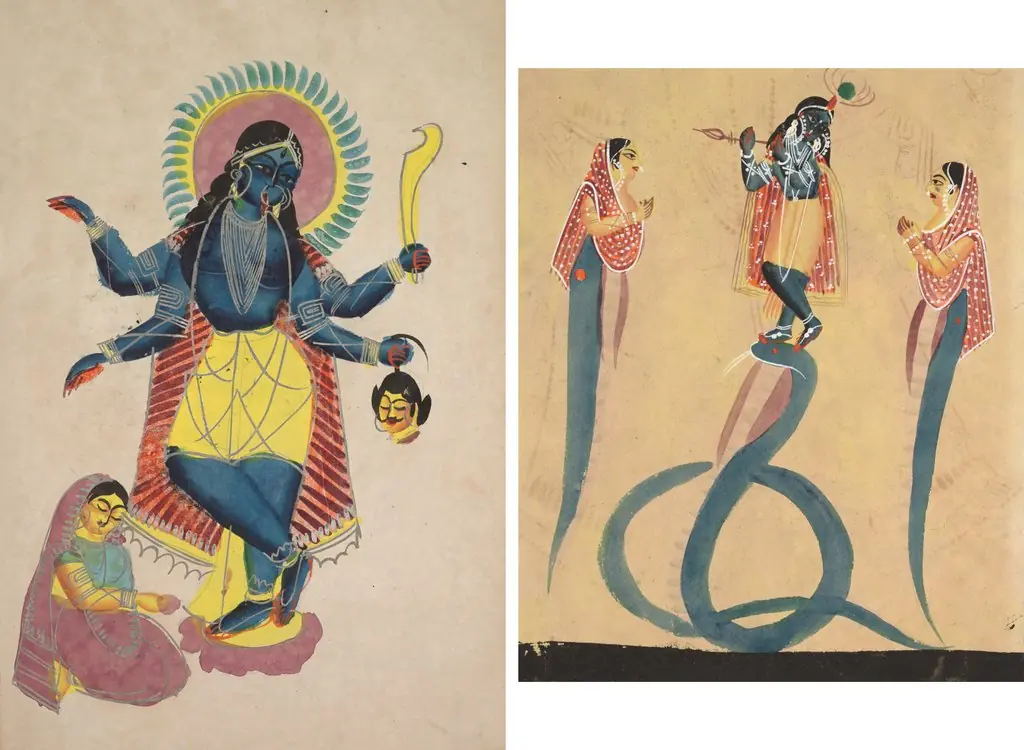 Leaf from a Kalighat album: Krishna as Kali worshipped by Radha (recto); Krishna quells the serpent Kaliya (verso)
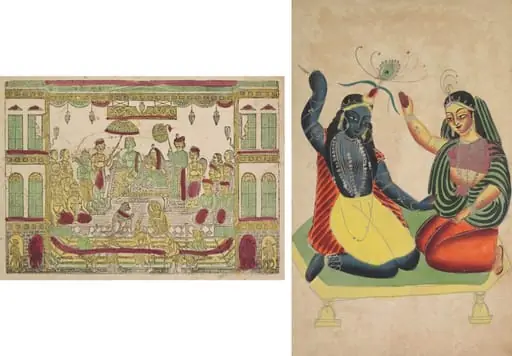 Leaf from a Kalighat album: Rama and Sita in the Royal Palace (recto); Radha and Krishna (verso)
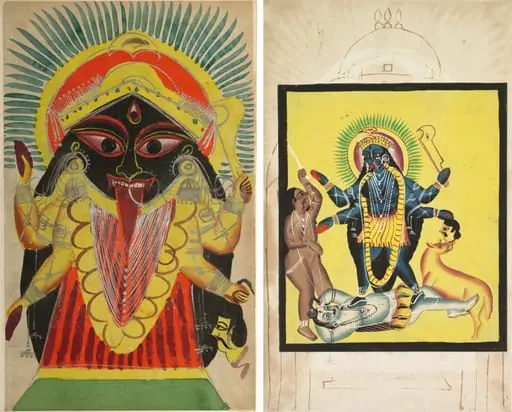 Leaf from a Kalighat album: The Goddess Kali (recto); Kali Standing on Shiva (verso)
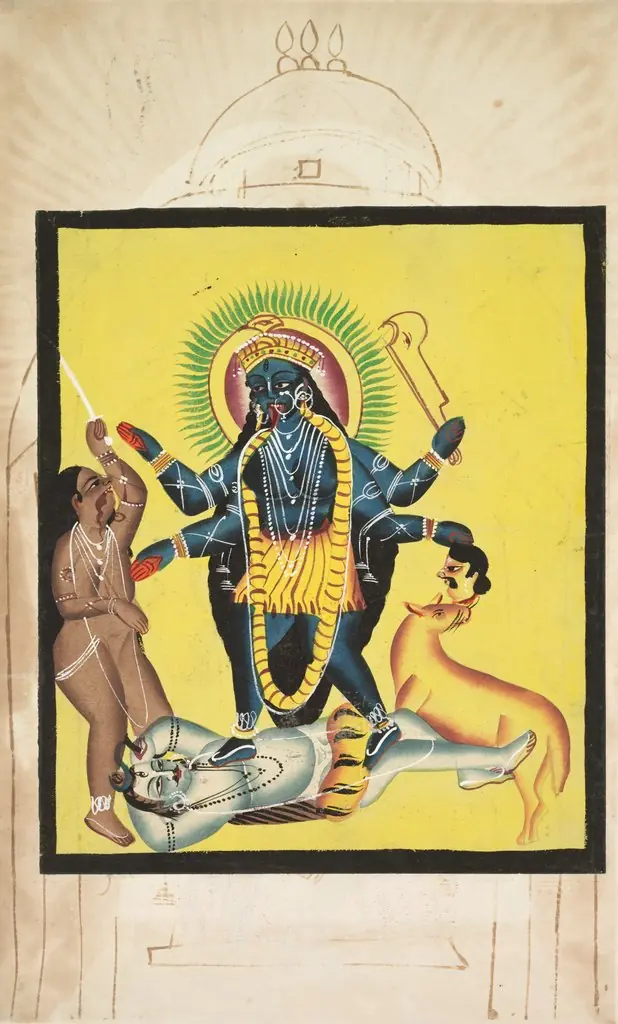 Kali Standing on Shiva (verso), from a Kalighat album
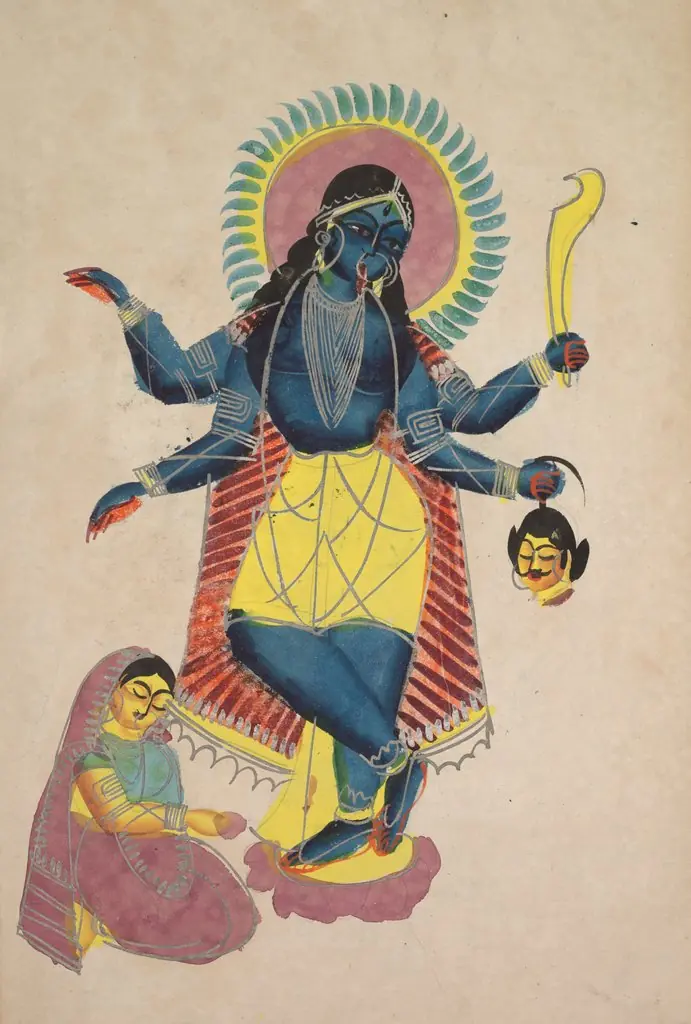 Krishna as Kali worshipped by Radha (recto), from a Kalighat album
 Leaf from a Kalighat album: Two Aspects of Kali
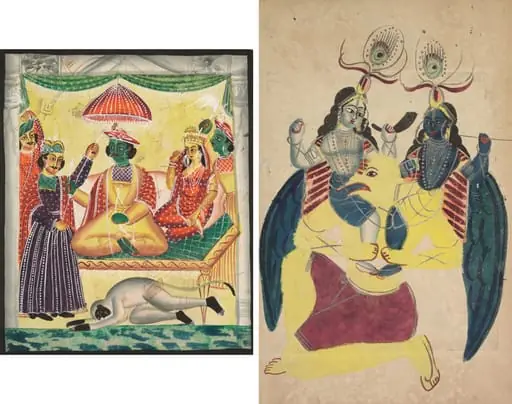 Leaf from a Kalighat album: Rama and Sita enthroned (recto); Garuda carrying Balarama and Krishna (verso)
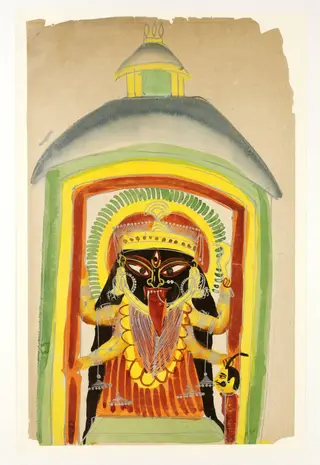
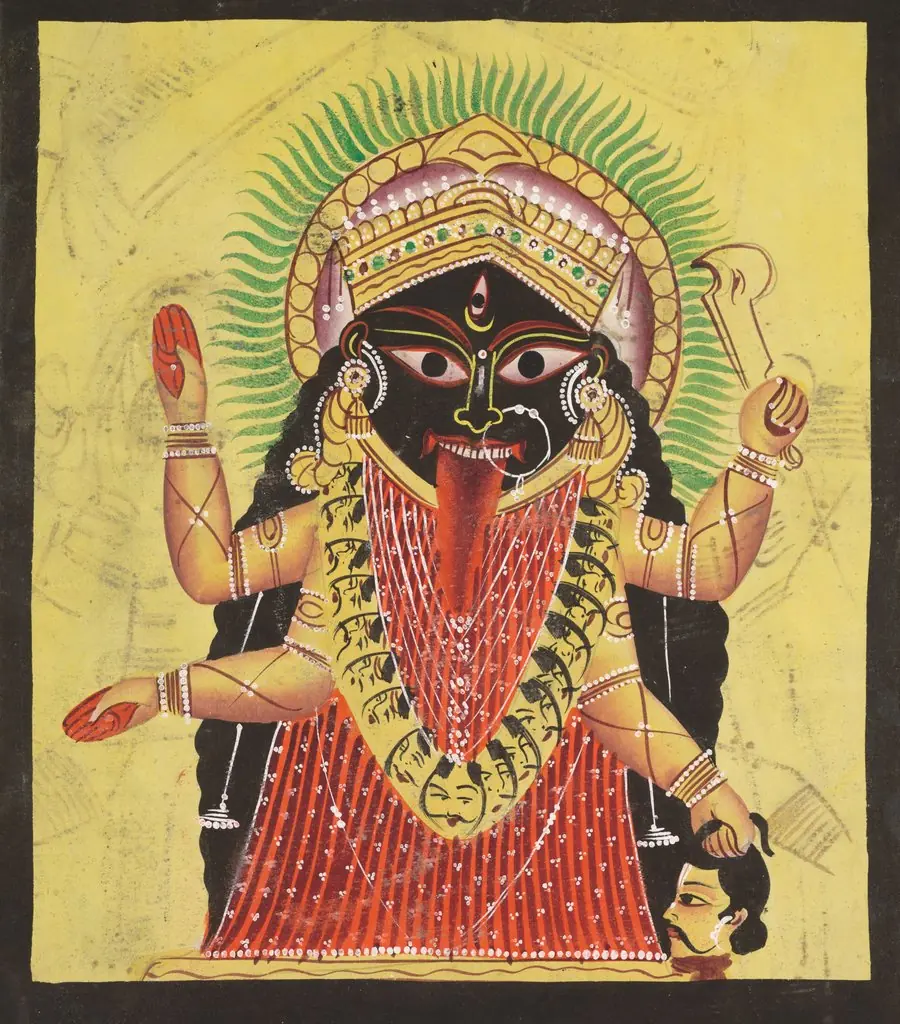 Kali Enshrined (verso), from a Kalighat album
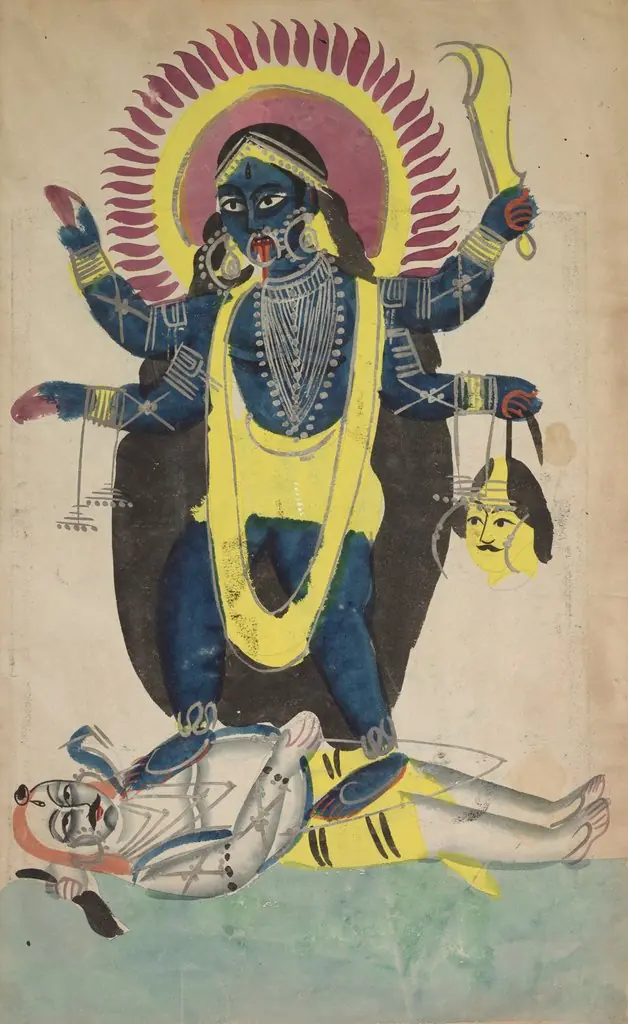 Kali Dancing on Shiva (recto), from a Kalighat album
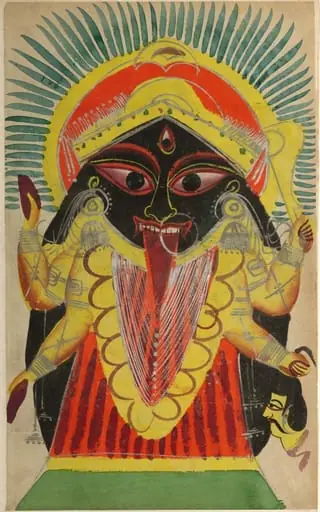 The Goddess Kali (recto), from a Kalighat album