Artwork
Liberty
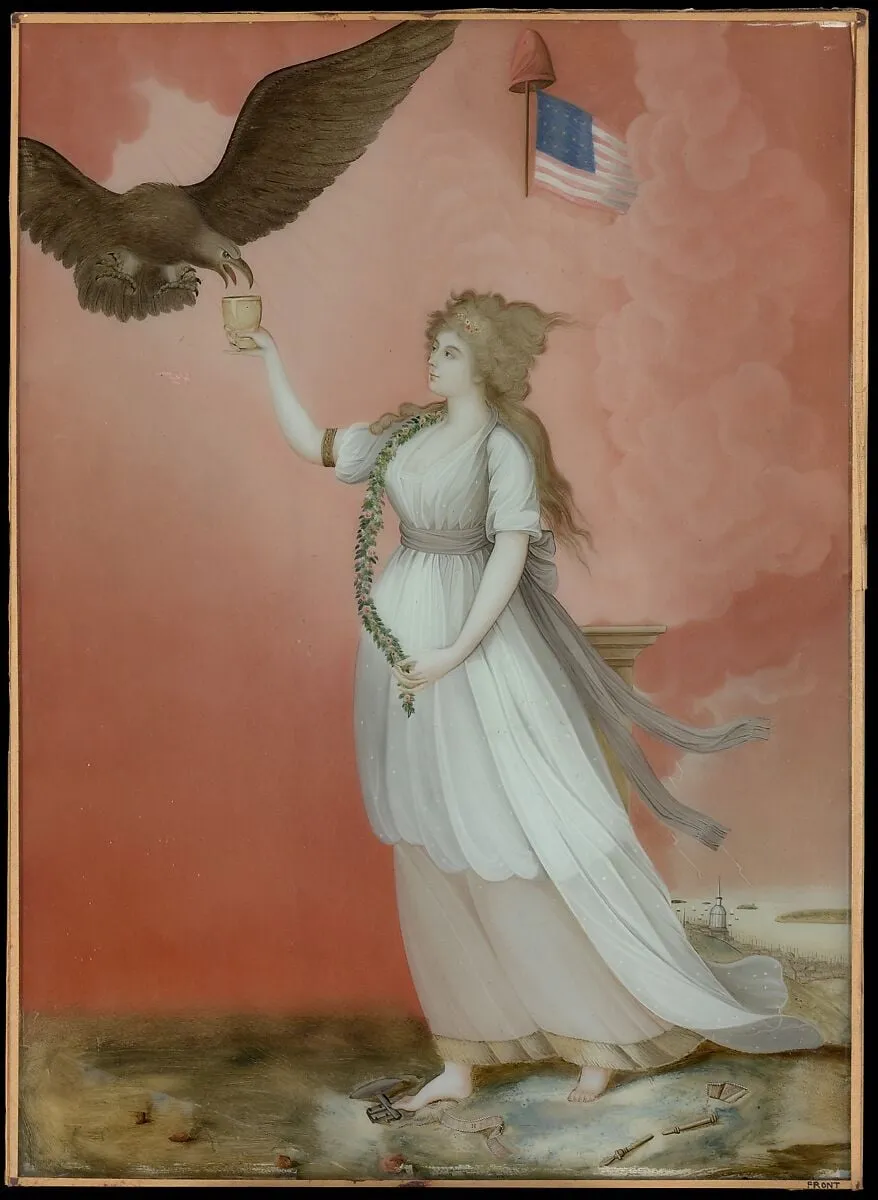
Liberty is an unspecified painting. It dates from 1800 and is held in the collection of the Metropolitan Museum of Art.
About this work
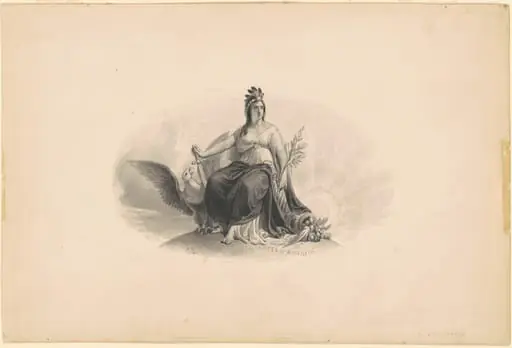
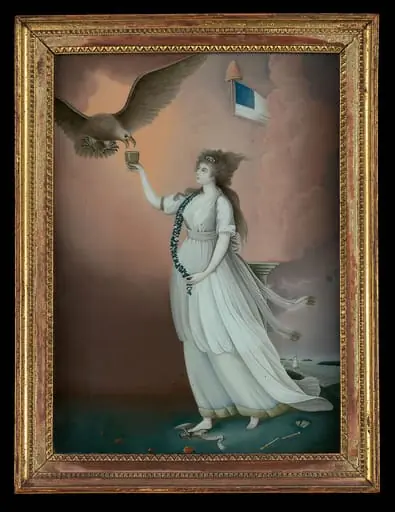
A woman in a red cap holds a flag and a sword, standing on a broken chain with an eagle behind her. The reverse-glass painting, or verre eglomise, dates to about 1800, when such figures stood for freedom and revolution. The eagle and pose feel familiar, though the Chinese-style clouds are unexpected.
Subject & Meaning
The presence of the eagle and flag alongside the woman establishes the piece as a patriotic emblem, despite its foreign manufacture.
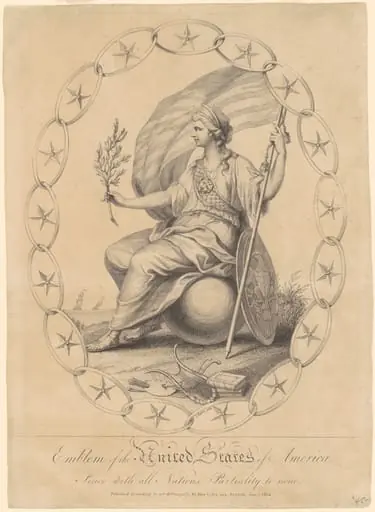
Created in China in 1798 specifically for the American market, this work functions as an allegory of Liberty. The composition features a female figure, a standard personification of the concept, accompanied by an eagle and a flag. These visual elements combine to symbolize American independence and national identity.
The presence of the eagle and flag alongside the woman establishes the piece as a patriotic emblem, despite its foreign manufacture. By utilizing these recognized symbols, the artwork communicates a clear political message celebrating the young nation's freedom, serving as a decorative yet meaningful object for American consumers during the late eighteenth century.
Technique & Style
Executed in verre églomisé, the work consists of a glass panel backed with gold leaf and engraved to render a draped female allegory holding a flag, an eagle, and a liberty cap. The reverse gilding is selectively scraped away to create tonal contrasts, emphasizing the figure’s smooth modeling and the crisp folds of drapery. The allegorical woman’s classical attire and the inclusion of an eagle align with neoclassical conventions popular in Sino–American export art of the period.
Dimensions are approximately 52.7 cm in height and 39.4 cm in width. No evidence of later restoration or significant damage is recorded in the cited records.
History & Provenance
Created in 1798, this verre églomisé painting was manufactured in China specifically for the American market. The work, which depicts an allegorical female figure alongside an eagle and a flag, eventually entered the collection of the Metropolitan Museum of Art. It is currently held by the institution under the accession number 46.67.85 within its American Wing.
While the specific individual who commissioned the piece or the details of its ownership prior to museum acquisition are not detailed in the available records, its origin as a Chinese export object intended for American consumers is well-established. The artwork measures approximately 52.7 by 39.4 centimeters and serves as an example of cross-cultural artistic production during the late eighteenth century.
Liberty is held in the Metropolitan Museum of Art in New York, where it is catalogued under accession number 46.67.85 and listed in the museum’s The American Wing department. The work, a 1798 verre églomisé allegory depicting an eagle, flag, and woman, was produced in China for the American market. Its dimensions are 52.7 cm by 39.4 cm. Since entering the collection, the painting has been shown in the museum’s American decorative arts galleries, allowing visitors to view it within the broader context of early American artistic exchange.
Overview
This verre églomisé artwork, titled "Liberty," dates to approximately 1800 and is characterized by its vivid, smooth surface. The reverse-glass painting depicts a female figure, often understood as an embodiment of liberty, holding a flag and a sword while standing upon a broken chain. An eagle positioned behind her further reinforces the symbolic message.
This piece exemplifies the allegorical tradition prevalent in art of its era, conveying ideals of freedom and revolution through carefully chosen imagery.
Context
Created around 1800, "Liberty" emerged during a historical moment defined by widespread calls for independence and the formation of new republics. Allegorical representations, such as this personification of freedom, served as a crucial visual language. They enabled artists and the public to engage with complex political and social concepts indirectly, offering a powerful yet accessible means to discuss revolutionary ideals and national identity without explicit declarations.
Artist & collection