Artwork
Painting, Rolling Painting
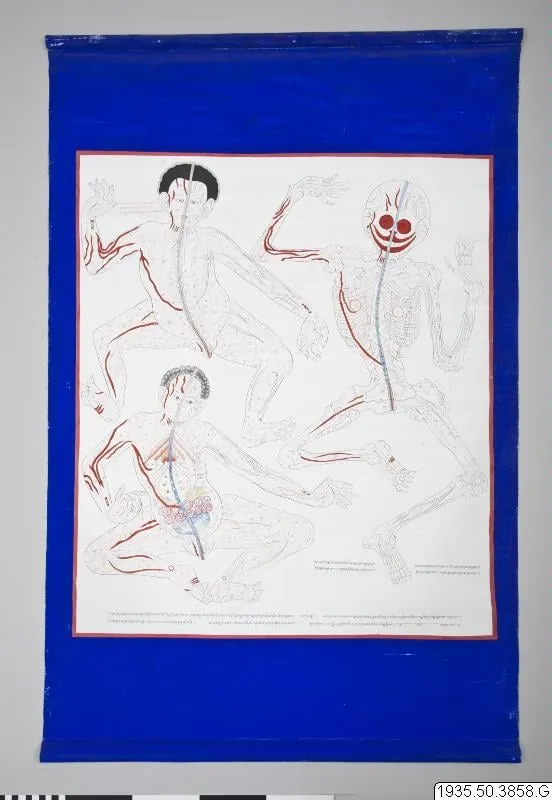
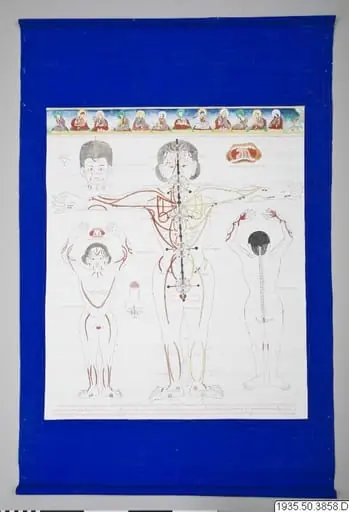
Painting, Rolling Painting is a paint painting by the Art Brut artist Unknown. It dates from 1933 and is held in the collection of the ethnographic museum. This work is a figurative study composed of three human forms rendered with minimal color and linear emphasis.
About this work
Overview
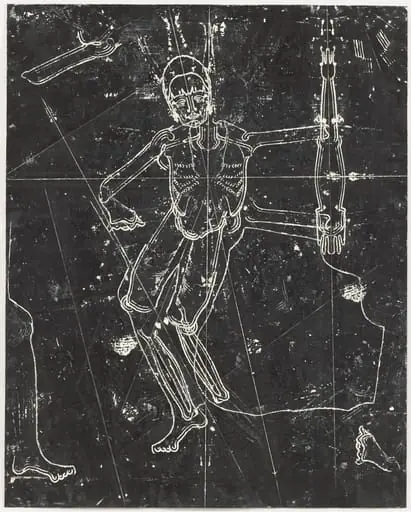
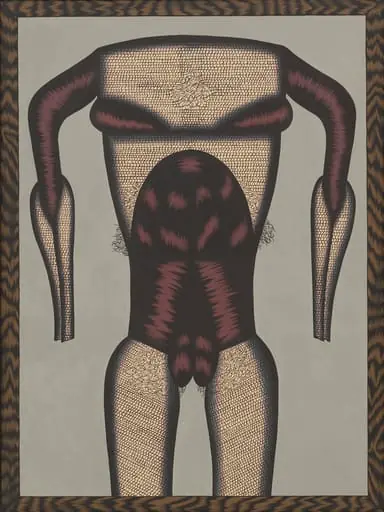
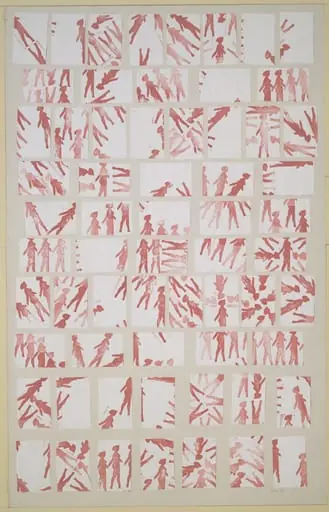
This work is a figurative study composed of three human forms rendered with minimal color and linear emphasis. Red outlines trace anatomical contours, while a single blue line runs vertically through the central figure. The figures are arranged against a white field, enclosed by a narrow blue border, suggesting a deliberate framing that isolates the body as the sole subject.
Subject & Meaning
The three figures, standing, seated, and arms raised, appear to explore variations of posture and physical presence. The red lines may indicate musculature or skeletal structure, implying an interest in corporeal mechanics rather than narrative or emotion. The absence of facial detail beyond the central figure’s red face suggests a focus on form over identity.
Technique & Style
The painting employs a restrained palette of red and blue on white, using thin, precise lines to define anatomy. The lines do not blend or shade but instead delineate, creating a schematic representation of the body. This method reduces the figure to its structural essence, aligning with observational or pedagogical intent rather than expressive rendering.
History & Provenance
Held by the Museum of Ethnography, the painting is likely part of a collection focused on cultural or anthropological studies of the human form. Its origin and creator remain undocumented, but its stylistic simplicity and systematic approach suggest it may have been produced as a teaching aid or ethnographic record.
Context
In early 20th-century ethnographic practice, visual documentation often prioritized typological clarity over artistic expression. This work fits within that tradition, where the human body was recorded as a subject of scientific interest, stripped of ornamentation to emphasize physical structure across diverse populations.
Legacy
Though unsigned and unattributed, the painting contributes to a broader archive of anatomical studies used in ethnographic museums. Its stripped-down aesthetic anticipates modernist reductions of the figure, offering a quiet counterpoint to more emotive or decorative traditions in 20th-century art.
Artist & collection