Artwork
Placă
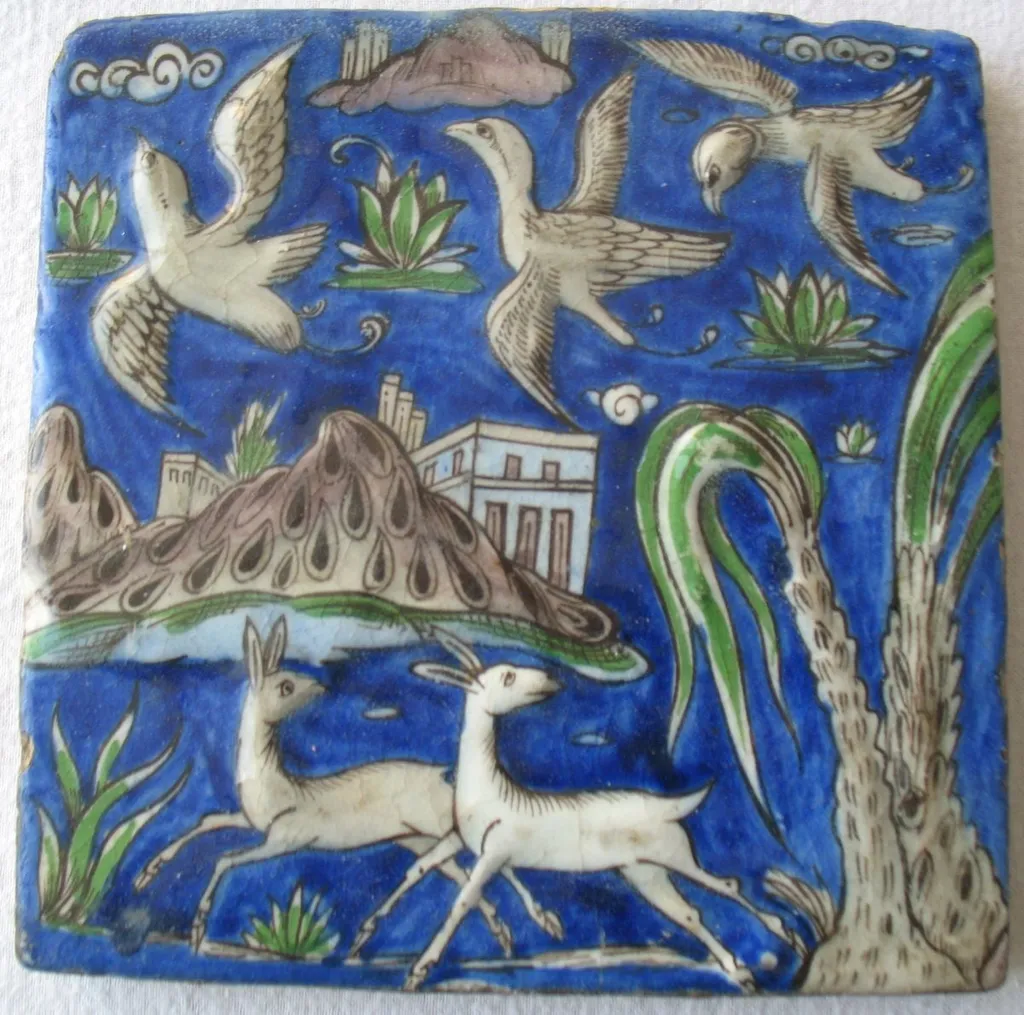
Placă is a photography by Unknown. It dates from 1850 and is held in the collection of the National Museum of Art of Romania.
About this work
Overview
This flat, brightly colored panel features a stylized composition of white birds in flight, green vegetation, and two white quadrupeds resembling deer or goats.
This flat, brightly colored panel features a stylized composition of white birds in flight, green vegetation, and two white quadrupeds resembling deer or goats. Above them, a crown rests on a leafy branch, while a distant structure with columns suggests architectural presence. The absence of shading and the use of unmodulated hues point to a decorative, non-naturalistic approach common in certain cultural art traditions.
Subject & Meaning
The crown positioned above the animals and birds may indicate royal or sacred symbolism, possibly referencing lineage, authority, or mythological narrative. The animals, though ambiguous in species, likely hold cultural significance, perhaps as emblems or spirit guides. The building in the background could denote a sacred or ancestral site. Together, the elements may convey a story tied to identity, power, or cosmology.
Technique & Style
The work employs bold, unshaded colors and simplified forms, rejecting perspective and chiaroscuro. Figures and objects are outlined clearly against a uniform blue field, emphasizing pattern over realism. This stylistic choice aligns with traditions that prioritize symbolic clarity and visual rhythm, often found in textile, mural, or ceremonial art where clarity of iconography is paramount.
History & Provenance
The object is held by the Museum of Ethnography, suggesting it originates from a non-Western cultural context where such decorative panels serve ritual or communal functions. Its materials and construction imply it was likely created for display in a domestic, ceremonial, or public setting, possibly as part of a larger series or architectural element.
Context
This piece reflects artistic conventions found in regions where vibrant color, symbolic imagery, and flat composition are central to visual expression, such as parts of West Africa, Southeast Asia, or the Pacific. Similar motifs appear in ceremonial textiles, wall paintings, and ritual objects, where narrative and status are communicated through stylized forms rather than naturalism.
Legacy
As a preserved artifact in an ethnographic collection, it contributes to the understanding of how non-Western cultures encode meaning through visual symbols. Its continued display supports scholarly and public engagement with artistic traditions that prioritize symbolic representation, offering insight into worldviews where art and belief are deeply intertwined.
Artist & collection









 platou mic
 Deep Dish
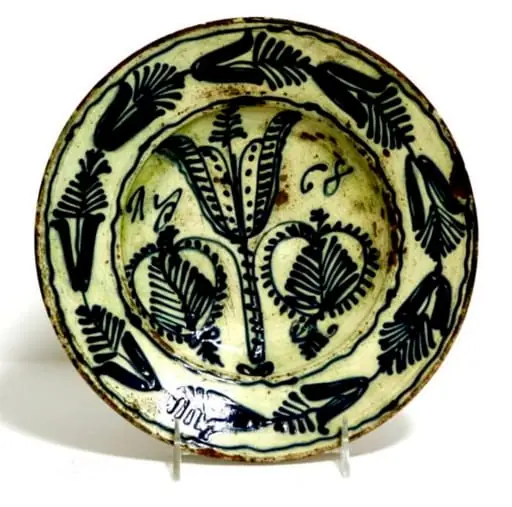 farfurie
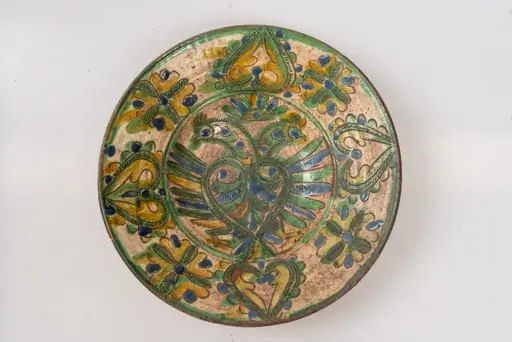 Farfurie adâncă, cu buza lată evazată; este angobată pe fața interioară cu un strat de humă albă peste care este realizat prin sgrafitare și prin pictare cu pensula decorul format dintr-un motiv avimorf și din motive florale și vegetale stilizate: registrul decorativ central de pe fundul farfuriei conține un vultur bicefal iar buza este decorată cu patru motive vegetale în formă de inimă intercalate de patru flori. Bordura interioară a farfuriei și muchia buzei sunt marcate cu câte o linie verde. Suprafața ornamentată a farfuriei este acoperită cu un strat de smalț transparent. Cromatica: alb, verde, galben, albastru.
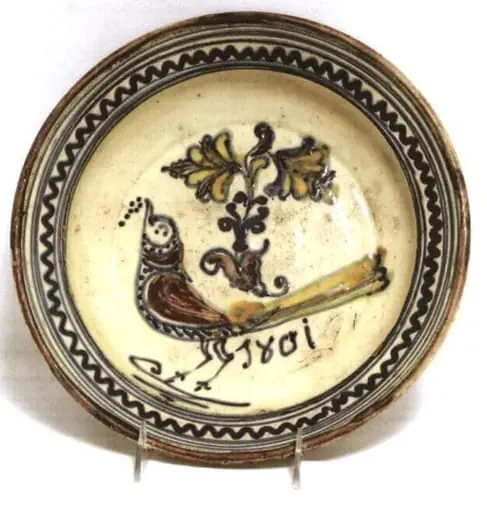 farfurie
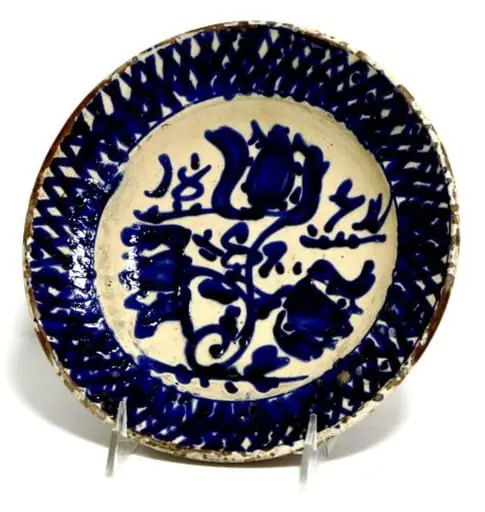 blid
blid