Artwork
Raga Suramananda, page from a Ragamala series
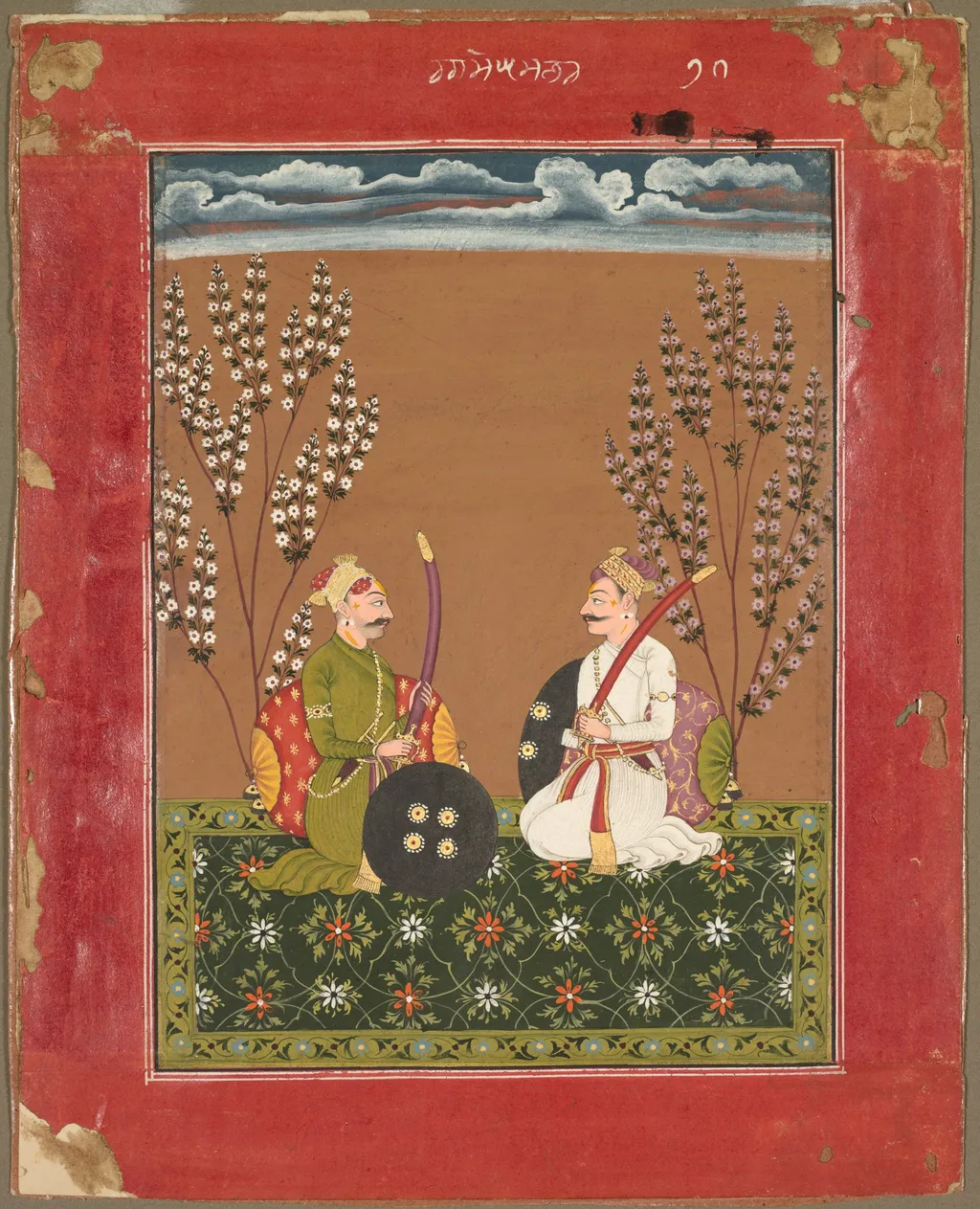
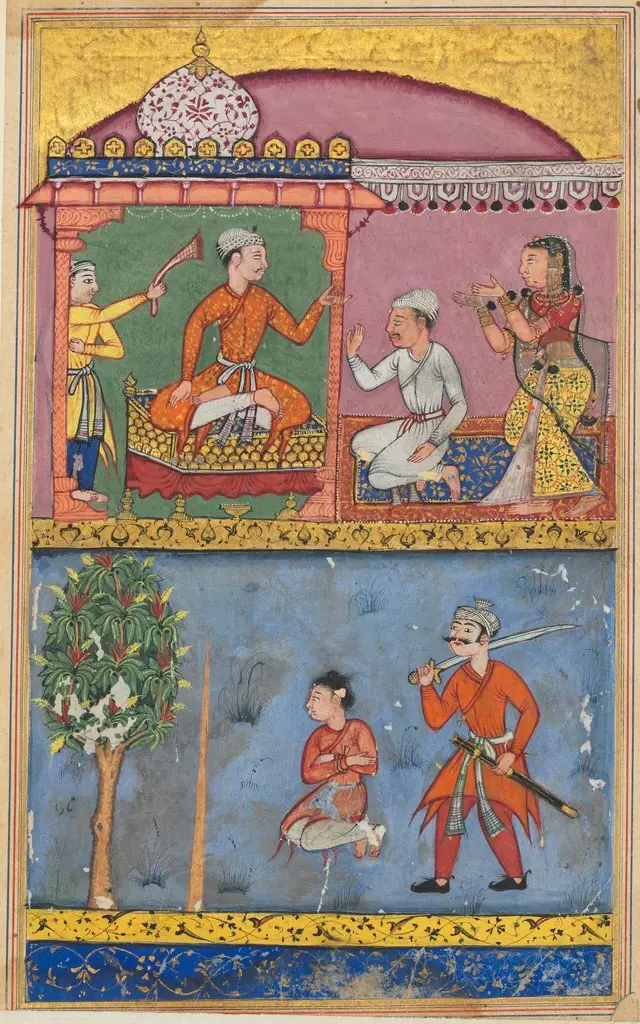
Raga Suramananda, page from a Ragamala series is an unspecified painting. It dates from 1750 and is held in the collection of the Cleveland Museum of Art. Raga Suramananda is a mid‑18th‑century Indian painting that forms part of a ragamala series, visual representations of musical modes.
About this work
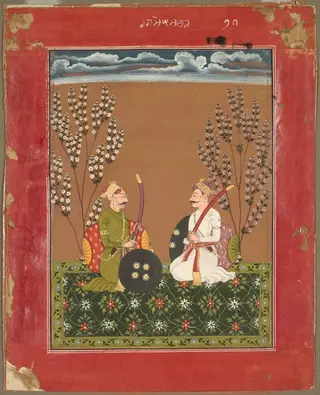
The man on the right is wearing a white outfit with a purple and gold patterned blanket draped over his shoulder.
This painting shows two men sitting on a green floral patterned rug. They are wearing traditional Indian clothing and headpieces, and each is holding a bow and arrow. The man on the left is wearing a green outfit with a red and gold patterned blanket draped over his shoulder.
The man on the right is wearing a white outfit with a purple and gold patterned blanket draped over his shoulder. The background of the painting is a brown wall with white flowers growing up the sides. Above the wall is a blue sky with white clouds.
The painting is called Raga Suramananda, page from a Ragamala series. It was made in 1750 and is held at The Cleveland Museum of Art.
History & Provenance
The page from a Ragamala series depicting Raga Suramananda is dated to circa 1750 and attributed to an unknown artist. It entered the Cleveland Museum of Art's collection in 2002, bearing the accession number 2002.116. Prior to its acquisition by the museum, the work's ownership history and any possible commission are not documented in the available sources.
The painting Raga Suramananda, created in 1750, is held in the collection of the Cleveland Museum of Art. The institution assigns the work the accession number 2002.116. While the artwork's creation date and current location are documented, the provided records do not contain specific details regarding its exhibition history or prior provenance.
Context
Raga Suramananda, a page from a Ragamala series painted around 1750, situates itself within the broader tradition of Indian miniature painting, reflecting the stylistic conventions of 18th-century Rajput artistic circles. The work is attributed to an anonymous artist and is part of the Cleveland Museum of Art's collection, underscoring its significance in the study of cross-cultural artistic exchange and devotional themes in pre-colonial Indian art. Scholarship highlights its role in documenting musical modes through visual metaphor, contributing to ongoing discussions about the interplay between sound and sight in early modern Indian visual culture.
Overview
Raga Suramananda is a mid‑18th‑century Indian painting that forms part of a ragamala series, visual representations of musical modes. Executed around 1750, the work measures roughly a page‑size panel and is currently in the collection of the Cleveland Museum of Art. The composition combines figural narrative with decorative landscape elements, typical of ragamala conventions.
Subject & Meaning
The scene depicts two male figures seated on a richly patterned green rug, each attired in traditional court dress and bearing a bow and arrow. Their garments are complemented by draped blankets, one green with red‑gold motifs, the other white with purple‑gold designs, suggesting a symbolic pairing of contrasting yet harmonious qualities associated with the raga Suramananda.
Technique & Style
Rendered in opaque water‑based pigments on paper, the painting displays fine brushwork for the intricate textile patterns and delicate rendering of foliage. The background features a muted brown wall overgrown with white blossoms, while a blue sky with fluffy clouds rises above, creating a layered spatial depth that balances figural detail with ornamental scenery.
Artist & collection

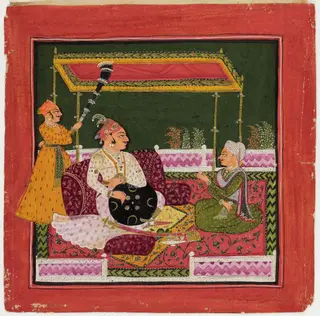 Raja and Courtiers Seated Beneath a Canopy
 Surmananda Ragaputra of Hindol, from a Ragamala
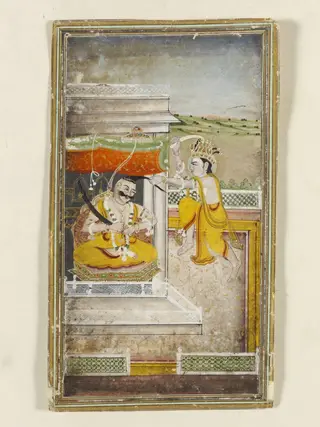 Krishna and Kansa
 Raja Hira Singh
 Emperor Farrukhsiyar
 Maru Ragini, from a Ragamala (Garland of Melodies)
 Untitled
 The handmaiden appeals for justice and the prince is taken to the execution site for the fourth time, from a Tuti-nama (Tales of a Parrot): Eighth Night