Artwork
Untitled
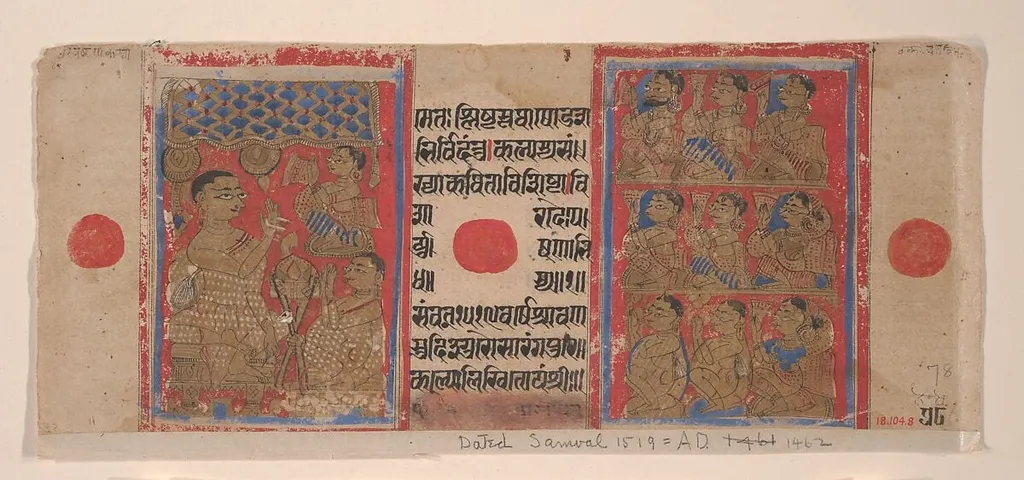
Untitled is a watercolor painting. It dates from 1461 and is held in the collection of the Metropolitan Museum of Art.
- Accession no.
- 18.104.8
- Credit line
- Rogers Fund, 1918
About this work
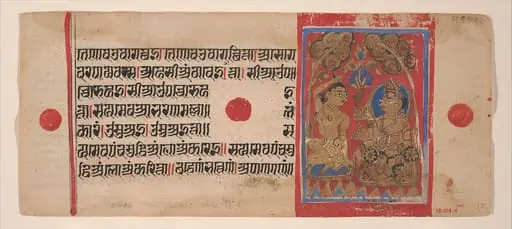
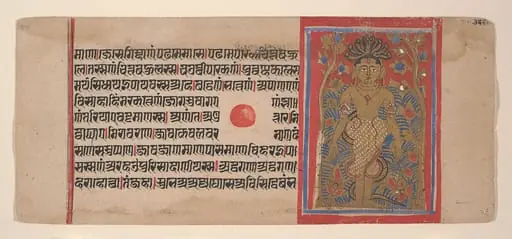
You see two monks in orange robes sitting under a tree, one holding a book, the other a long staff.
This painting comes from a Jain manuscript made in Gujarat, India, in 1461. The gold leaf and bright colors were meant to honor sacred texts. The artist left no name, but the care in every leaf and fold shows deep respect.
To see more works like this, look up monks, india (gujarat), monk.
Subject & Meaning
The work, titled Untitled, is a religious painting from 1461 executed in ink, opaque watercolor and gold on paper.
The work, titled Untitled, is a religious painting from 1461 executed in ink, opaque watercolor and gold on paper. It portrays a monk, a common subject in devotional art that conveys contemplative devotion. The piece is attributed to an anonymous Indian painter and is part of the Metropolitan Museum of Art collection.
Its dimensions measure 11.1 cm by 25.7 cm, and the composition reflects the stylistic conventions of early Indian religious illustration.
Technique & Style
Created in 1461, this religious painting employs ink, opaque watercolor, and gold applied to a paper support. The work measures 11.1 cm in height and 25.7 cm in width. Produced in India, the composition features a monk as its central subject, rendered through the application of these pigments and metallic leaf.
The combination of materials suggests a manuscript illumination or a small-scale devotional image typical of the region and period.
History & Provenance
Untitled is a 15th‑century religious painting executed in ink, opaque watercolor and gold on paper. The work is dated to 1461, with an exact inception record of 20 October 1461, and was produced in India by an anonymous artist. Its iconography shows a monk, aligning it with contemporary devotional imagery.
The piece entered the collection of the Metropolitan Museum of Art, where it remains on view, and the museum’s records list it as part of their holdings. No documentation indicates a specific commission or prior private ownership before acquisition by the museum.
Overview
Created in 1461 in Gujarat, India, this untitled work is a page from a Jain manuscript executed in ink, opaque watercolor, and gold on paper. The composition depicts two monks clad in orange robes seated beneath a tree, a setting typical of ascetic narratives in Jain art. One figure holds a book, signifying the transmission of sacred knowledge, while the other grasps a long staff, an attribute of the mendicant life.
The application of gold leaf and vibrant pigments reflects the devotional intent to honor the text, treating the manuscript itself as a sacred object. This piece exemplifies the distinctive style of 15th-century Gujarati Jain painting, characterized by bold outlines, flat planes of color, and stylized natural elements. Although the artist remains anonymous, the meticulous rendering of the figures and foliage demonstrates the high level of craftsmanship associated with this regional tradition.
The work serves as a visual complement to the religious scriptures it accompanied, illustrating the spiritual discipline and reverence central to Jain practice during the medieval period.
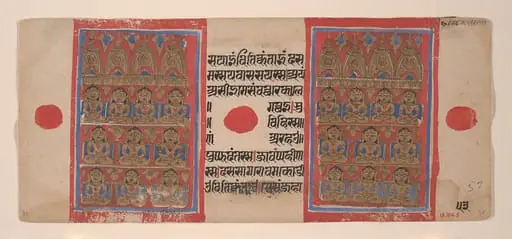
Artist & collection

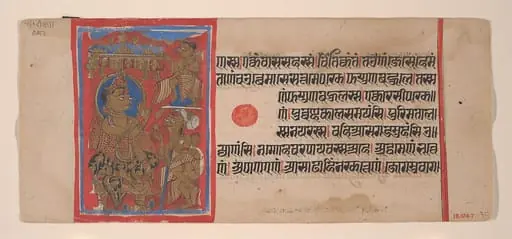 Untitled
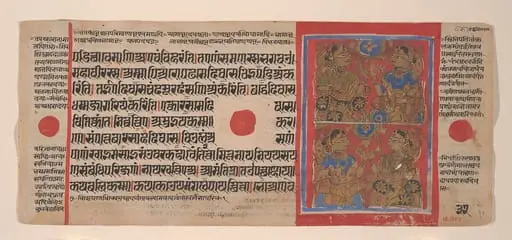 Untitled
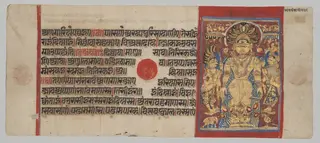 Parshva Undergoes Physical Trials, Folio 46 (recto), from a Kalpa-sutra
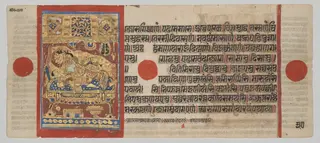 Birth of Mahavira, folio 30 (verso), from a Kalpa-sutra
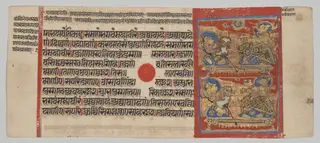 Transfer of the Embryo of Mahavira, Folio 12 (recto), from a Kalpa-sutra
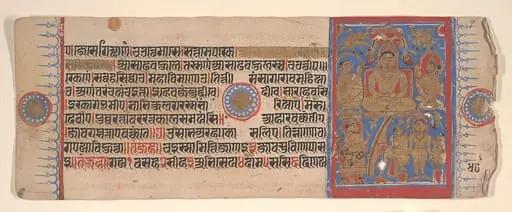 Untitled
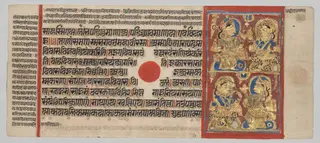 Vigil on the Sixth Night After Mahavira's Birth, Folio 33 (recto), from a Kalpa-sutra
 Untitled