Artwork
Untitled
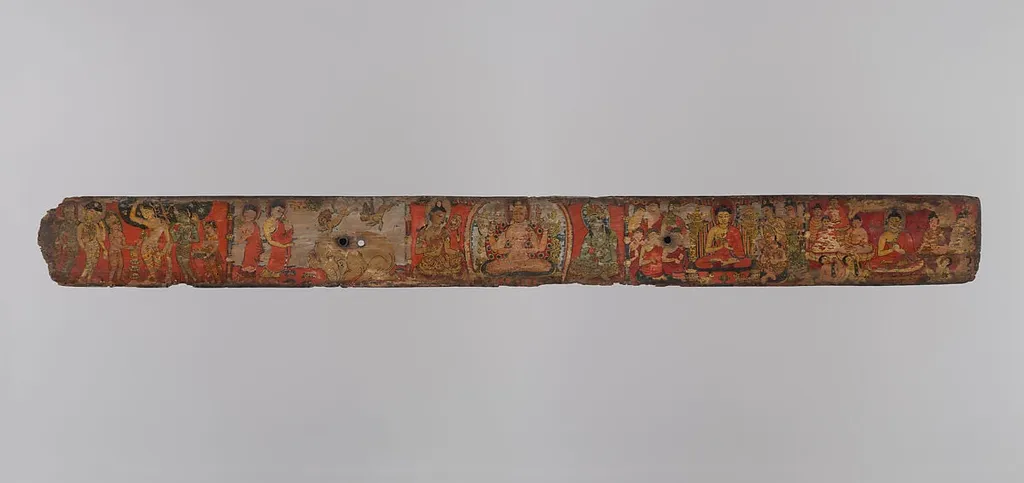
Untitled is an ink painting. It dates from 1000 and is held in the collection of the Metropolitan Museum of Art.
About this work
Subject & Meaning
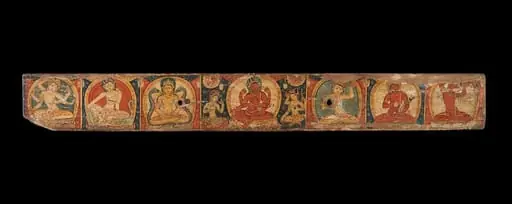
This untitled religious painting centers on Buddhist sacred figures, specifically a Buddha and a Bodhisattva as its principal subjects.
This untitled religious painting centers on Buddhist sacred figures, specifically a Buddha and a Bodhisattva as its principal subjects. The pairing of these two iconographic types reflects a devotional program rooted in the Mahayana Buddhist tradition, in which bodhisattvas serve as enlightened intermediaries alongside the historical Buddha. Produced in Nepal during the 10th–11th century, the work belongs to a regional tradition of Buddhist painting in which the depiction of buddhas and bodhisattvas functioned as objects of veneration and visual aids for meditation and ritual practice.
The narrow horizontal format, executed in ink and color on wood with metal insets, is characteristic of devotional panels or shrine-related imagery from this period, where the luminous qualities of pigment and metal would have enhanced the sacred presence of the depicted deities.
Technique & Style
The work is a 10th–11th-century Buddhist painting executed in ink and color on a wooden panel, with metal insets integrated into the surface. It portrays a Bodhisattva and Buddha in a religious composition typical of Himalayan art. The panel measures about 5.7 cm in height and 56.8 cm in width, indicating a narrow, horizontal format.
The piece originates from Nepal and is presently held in the Metropolitan Museum of Art. The condition of the artwork is not detailed in the available documentation.
History & Provenance
The work titled Untitled is an anonymous Buddhist painting dated to the 10th–11th century and executed in ink and color on wood with metal insets. Depicting a Bodhisattva and Buddha, it was produced in Nepal, and the identity of its creator remains unknown. The piece is held in the collection of the Metropolitan Museum of Art, classified as a religious painting within the museum's Asian art holdings; specific acquisition details and accession numbers are not publicly documented in the available sources.
Overview
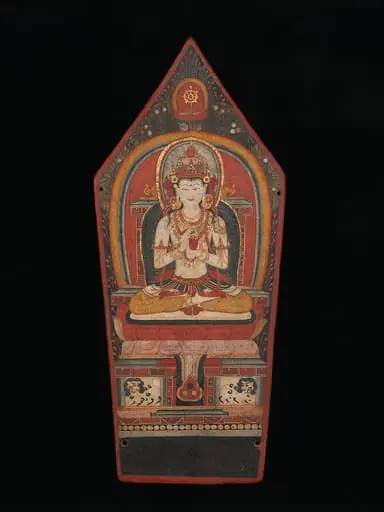
This untitled painting features a serene figure depicted in red robes, encircled by a golden halo. Rendered with ink and color on a wooden panel, the artwork is further embellished with small, reflective metal insets. These elements are integrated into the wood surface, creating a subtle interplay of light and texture. The piece exemplifies a historical painting tradition that combined diverse materials.
Context
Originating from Nepal's Kathmandu Valley around a thousand years ago, this artwork represents a significant, yet scarcely preserved, artistic tradition. While the combination of painted wood and metal inlays was a common practice in the region during that period, very few examples have endured over time. Its survival offers valuable insight into the visual culture and craftsmanship of the era.
Artist & collection

 Untitled
 Untitled
 Untitled
 Manuscript of the Perfection of Wisdom in Eight Thousand Lines (Ashtasahasrika Prajnaparamita-sutra)
 Untitled
 Untitled
 Perfection of Wisdom in Eight Thousand Lines: Ashtasahasrika Prajnaparamita: Back Cover
 Perfection of Wisdom in Eight Thousand Lines: Ashtasahasrika Prajnaparamita: Top Cover
 Untitled
 Untitled
 Untitled
- Untitled