Artwork
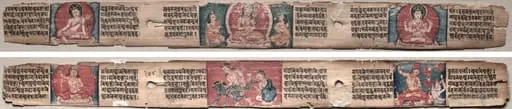
Folio 348 from a Gandavyuha-sutra (Scripture of the Supreme Array): Bodhisattva Manjushri with two forms of Avalokiteshvara (recto); Bodhisattva Samantabhadra purifies the path to enlightenment, with Manjushri (verso)

Folio 348 from a Gandavyuha-sutra (Scripture of the Supreme Array): Bodhisattva Manjushri with two forms of Avalokiteshvara (recto); Bodhisattva Samantabhadra purifies the path to enlightenment, with Manjushri (verso) is an unspecified painting. It dates from 1100 and is held in the collection of the Cleveland Museum of Art. This painting, Folio 348 from a Gandavyuha-sutra, depicts significant Buddhist figures across its recto and verso.
About this work
Overview
Despite the passage of time, which has faded the pigments, the artwork retains its vibrant color palette and the serene expressions of its subjects.
This painting, Folio 348 from a Gandavyuha-sutra, depicts significant Buddhist figures across its recto and verso. The rectangular panel presents four distinct scenes, each featuring figures in red robes with golden halos. Despite the passage of time, which has faded the pigments, the artwork retains its vibrant color palette and the serene expressions of its subjects. It serves as an illustrative component of a larger religious manuscript.
Subject & Meaning
The folio illustrates key Bodhisattvas from the Gandavyuha-sutra. The recto side features Manjushri alongside two manifestations of Avalokiteshvara, figures revered for their wisdom and compassion. On the verso, Samantabhadra is depicted purifying the path to enlightenment, accompanied by Manjushri.
These portrayals visually reinforce the sutra's teachings on spiritual journeys and the roles of these enlightened beings in guiding practitioners.
Technique & Style
The artwork is characterized by its small, colorful scenes set against a predominantly dark background. Figures are rendered with calm countenances, adorned in red robes, and distinguished by gold halos. While the paint shows signs of wear and fading, the original brightness of the clothing remains discernible.
The presence of an ancient script, likely Sanskrit, integrated into the composition further identifies the piece as a painted manuscript page.
Context
This painted folio originates from the Gandavyuha-sutra, also known as the "Scripture of the Supreme Array," a foundational text within Mahayana Buddhism. Such illustrated manuscripts were crucial for disseminating and understanding complex religious narratives. The integration of painted imagery with an ancient script, possibly Sanskrit, underscores its function as both a devotional object and a textual aid for Buddhist teachings, providing visual interpretations of sacred narratives.

Artist & collection

- Folio 73 from a Gandavyuha-sutra (Scripture of the Supreme Array): Sudhana and an antelope (recto); text (verso)
 Folio 22 from a Gandavyuha-sutra (Scripture of the Supreme Array): Samantabhadra spinning clouds of things (recto); Text (verso)
 Bodhisattva Manjushri with two forms of Avalokiteshvara, folio 348 (recto) from a Gandavyuha-sutra (Scripture of the Supreme Array)
 Sudhana and an antelope, folio 73 (recto) from a Gandavyuha-sutra (Scripture of the Supreme Array)
 Bodhisattva Manjushri with two forms of Avalokiteshvara, folio 348 (recto) from a Gandavyuha-sutra (Scripture of the Supreme Array)
 Samantabhadra spinning clouds of things, folio 22 (recto) from a Gandavyuha-sutra (Scripture of the Supreme Array)
 Folio 20 from a Gandavyuha-sutra (Scripture of the Supreme Array): Sudhana and a parrot (recto); Text (verso)
 Sudhana and a parrot, folio 20 (recto) from a Gandavyuha-sutra (Scripture of the Supreme Array)
 Folio 37 from a Gandavyuha-sutra (Scripture of the Supreme Array): Sudhana and a pair of antelopes (recto); text (verso)
 Folio 94 from a Gandavyuha-sutra (Scripture of the Supreme Array): Sudhana and the rishi Bhishmottaranirgosha (recto); text (verso)
 Folio 348 from a Gandavyuha-sutra (Scripture of the Supreme Array): Bodhisattva Manjushri with two forms of Avalokiteshvara (recto); Bodhisattva Samantabhadra purifies the path to enlightenment, with Manjushri (verso)
 Sudhana and a pair of antelopes, folio 37 (recto) from a Gandavyuha-sutra (Scripture of the Supreme Array)
 Four bodhisattvas and two attendants flanking Vajrasattva, bottom cover, from a Manuscript of the Perfection of Wisdom in Eight Thousand Lines (Ashtasahasrika Prajnaparamita-sutra)
 Prajnaparamita flanked by a white female figure and a white bodhisattva, folio 90 (recto), from a Manuscript of the Perfection of Wisdom in Eight Thousand Lines (Ashtasahasrika Prajnaparamita-sutra)
 Manuscript of the Perfection of Wisdom in Eight Thousand Lines (Ashtasahasrika Prajnaparamita-sutra)
 Perfection of Wisdom in Eight Thousand Lines: Ashtasahasrika Prajnaparamita: Back Cover
 Three female figures, folio 89 (verso), from a Manuscript of the Perfection of Wisdom in Eight Thousand Lines (Ashtasahasrika Prajnaparamita-sutra)