Artwork
Vaishnava Devotee with Two Women
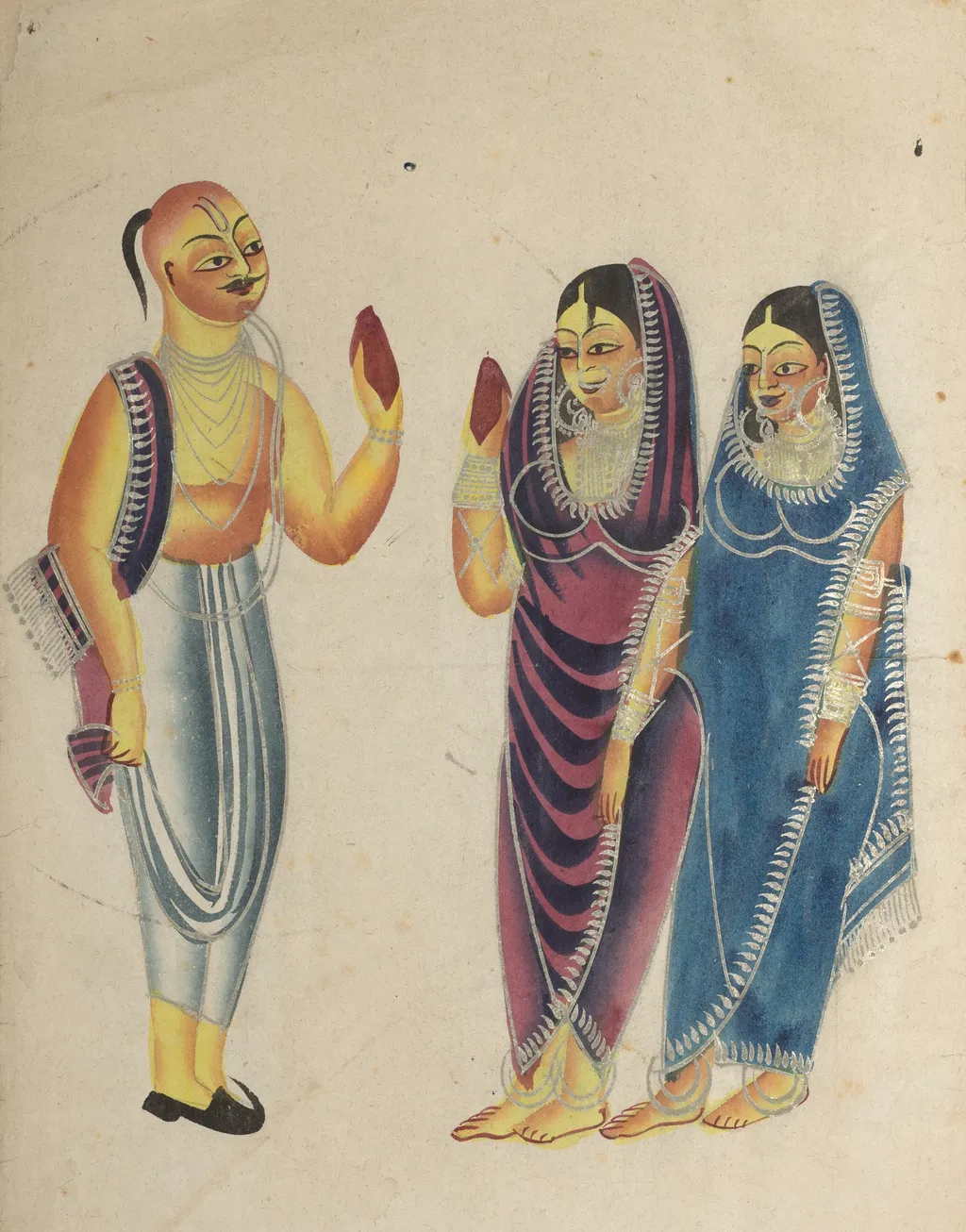
Vaishnava Devotee with Two Women is an unspecified painting. It dates from 1896 and is held in the collection of the Cleveland Museum of Art. The work depicts three figures arranged side by side.
About this work
Subject & Meaning
The iconography reflects devotional Hindu traditions, emphasizing personal surrender to Vishnu through the figure's posture and attire.
The painting depicts a Vaishnava devotee accompanied by two women, rendered in the Bengal school style during 1890 in Kolkata. The iconography reflects devotional Hindu traditions, emphasizing personal surrender to Vishnu through the figure's posture and attire. Symbolic elements suggest spiritual companionship, with the two women possibly representing divine energy or bhakti personified.
The work holds significance as an early example of Indian artistic engagement with devotional themes amid colonial modernity.
Technique & Style
The work is an oil painting on canvas created circa 1890 in Kolkata, depicting a Vaishnava devotee alongside two women. The composition emphasizes devotional intimacy through close grouping of figures and muted earth tones, reflecting Bengali school stylistic traits of the period. The handling of drapery and facial expression conveys emotional nuance characteristic of late 19th-century devotional art.
The surface condition shows typical craquelure associated with age, though no structural damage is noted in the provenance. The painting’s formal qualities include flattened spatial depth and stylized contours, aligning with regional academic traditions rather than European naturalism.
History & Provenance
The painting Vaishnava Devotee with Two Women was created in 1890, likely in Kolkata, though the artist remains unidentified. Its inception aligns with the late 19th-century Bengal School or related colonial-era Indian artistic traditions, though no specific commissioning details have been documented.
The work entered the collection of the Cleveland Museum of Art in 2003, where it is cataloged under accession number 2003.101. No earlier ownership history or intermediary collectors have been sourced for this piece.
The painting Vaishnava Devotee with Two Women is held in the collection of the Cleveland Museum of Art, located in Cleveland. The work entered the museum's holdings under the accession number 2003.101. Created in 1890, the piece was produced in Kolkata by an artist who remains unidentified in the museum's records.
Context
Scholarship situates Vaishnava Devotee with Two Women within the late 19th-century Kalighat painting tradition of Kolkata, a genre that emerged as a commercial response to urban pilgrimage at the Kalighat temple. While unsigned, the work’s stylistic traits, bold outlines, flat color planes, and minimal shading, align it with the anonymous artists of this school, who catered to both devotional and tourist markets. Its inclusion in the Cleveland Museum of Art’s collection underscores the global recognition of Kalighat painting as a distinct folk-modernist hybrid, bridging sacred narrative and mass production.
Critical reception has centered on the painting’s dual role as religious icon and secular commodity. Art historians highlight its departure from Mughal-influenced courtly miniatures, emphasizing instead its populist immediacy and narrative clarity. The work’s depiction of Vaishnava devotion, juxtaposed with the women’s quotidian presence, reflects the Kalighat school’s fusion of piety and everyday life, a hallmark of its appeal to diverse audiences.
Overview
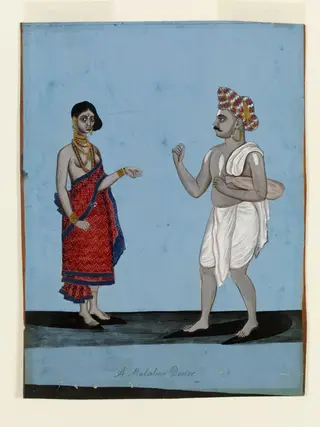
The work depicts three figures arranged side by side. A partially nude male figure stands on the left, adorned with a gold necklace and a striped lower garment, while clutching a red object in his right hand. To his right, two women are shown in richly colored, patterned robes, each heavily ornamented with necklaces, bracelets, and elaborate headpieces. The composition is flat, with little suggestion of a surrounding environment.
Legacy
The painting contributes to the broader understanding of devotional iconography in South Asian art, illustrating how material splendor and simplified human forms were employed to convey religious devotion. It serves as a reference point for scholars examining the visual conventions of Vaishnava representation and the role of gendered participants in ritual imagery.
Artist & collection

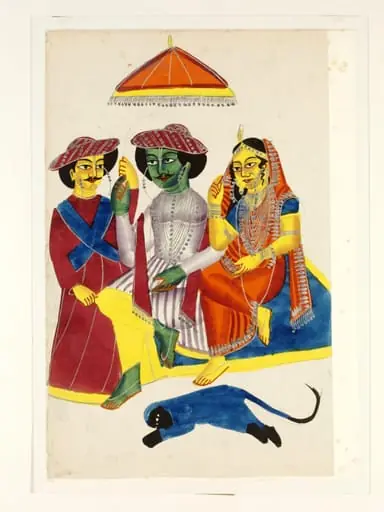 Hanuman before Rama, Sita and Lakshmana
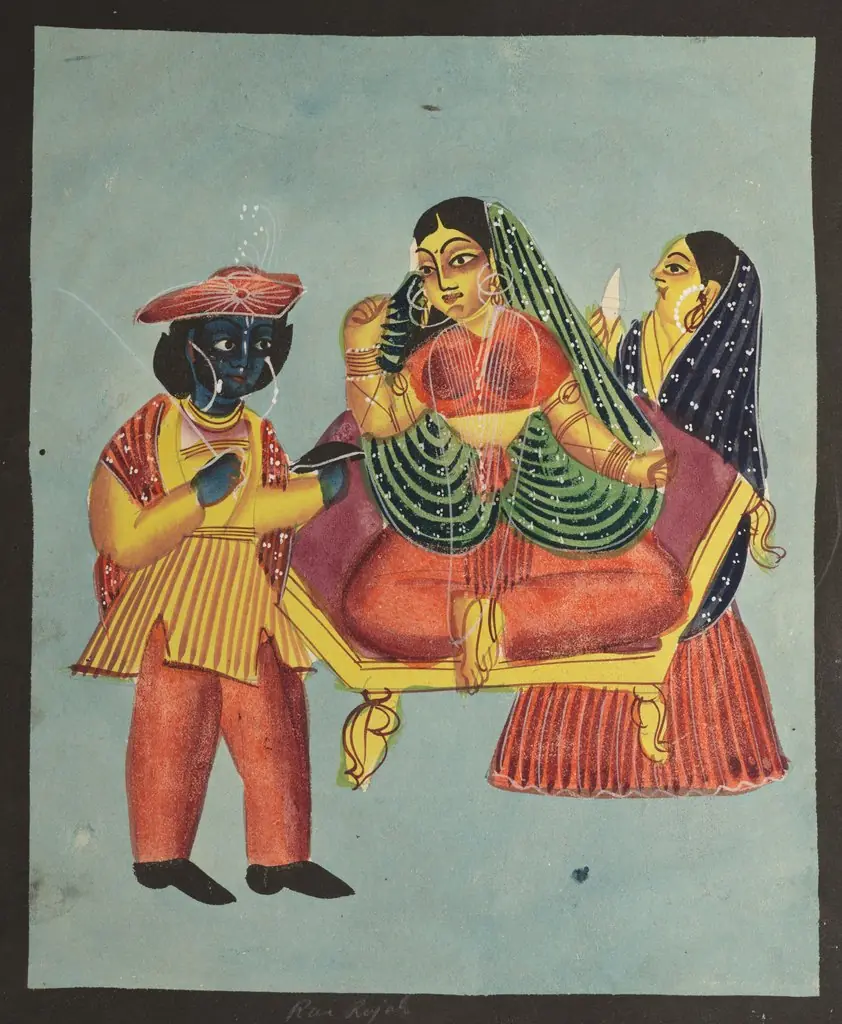 Rai Raja, from a Kalighat album
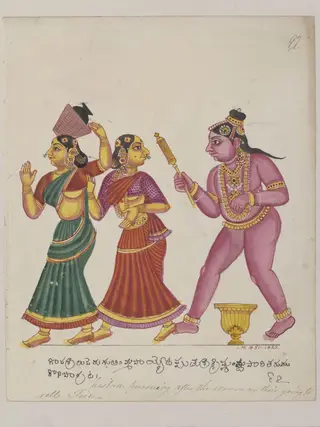 Krishna pursuing the gopis
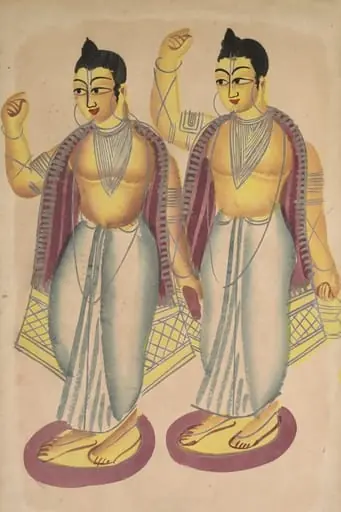 Nitai and Gaur
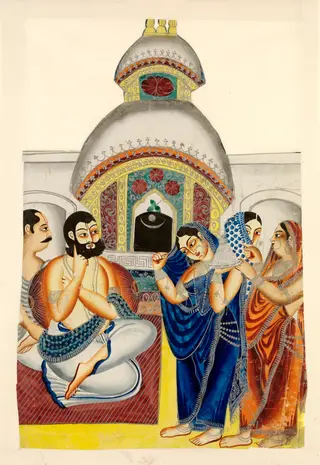 Elokeshi and the Mahant
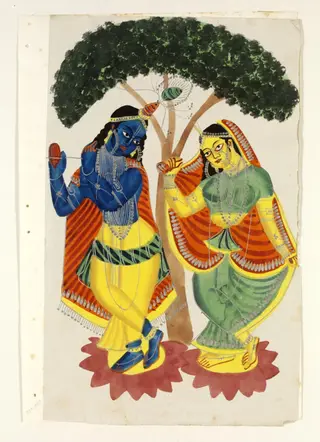 Krishna and Radha
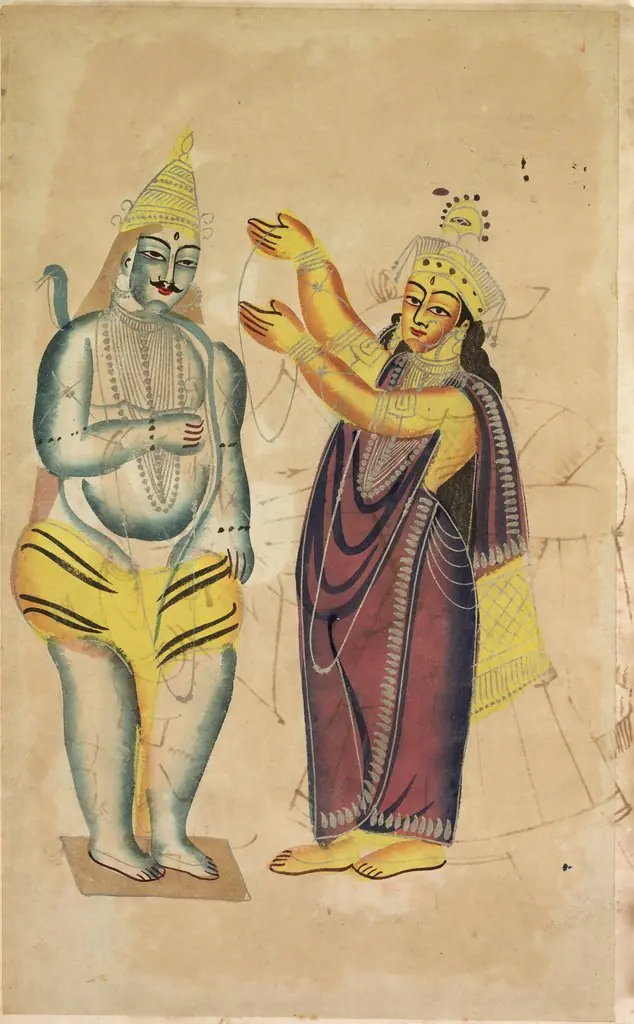 Parvati Placing a Wedding Garland on Shiva (recto), from a Kalighat album
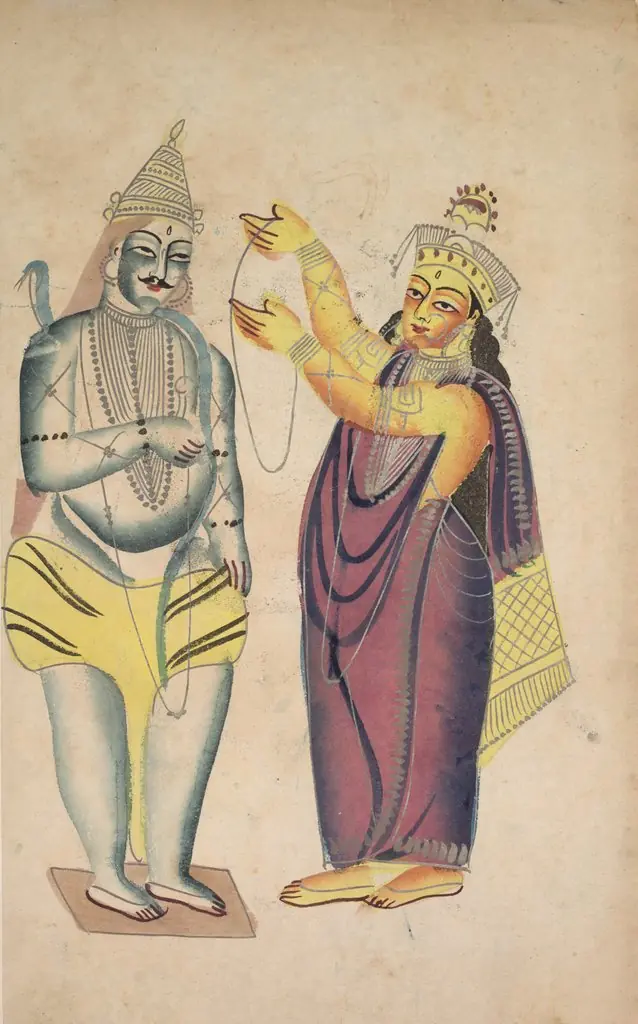 Parivati Placing a Wedding Garland on Shiva (verso)
 A Malabar doctor and his wife