Artwork
The Wife of Hasdrubal and Her Children
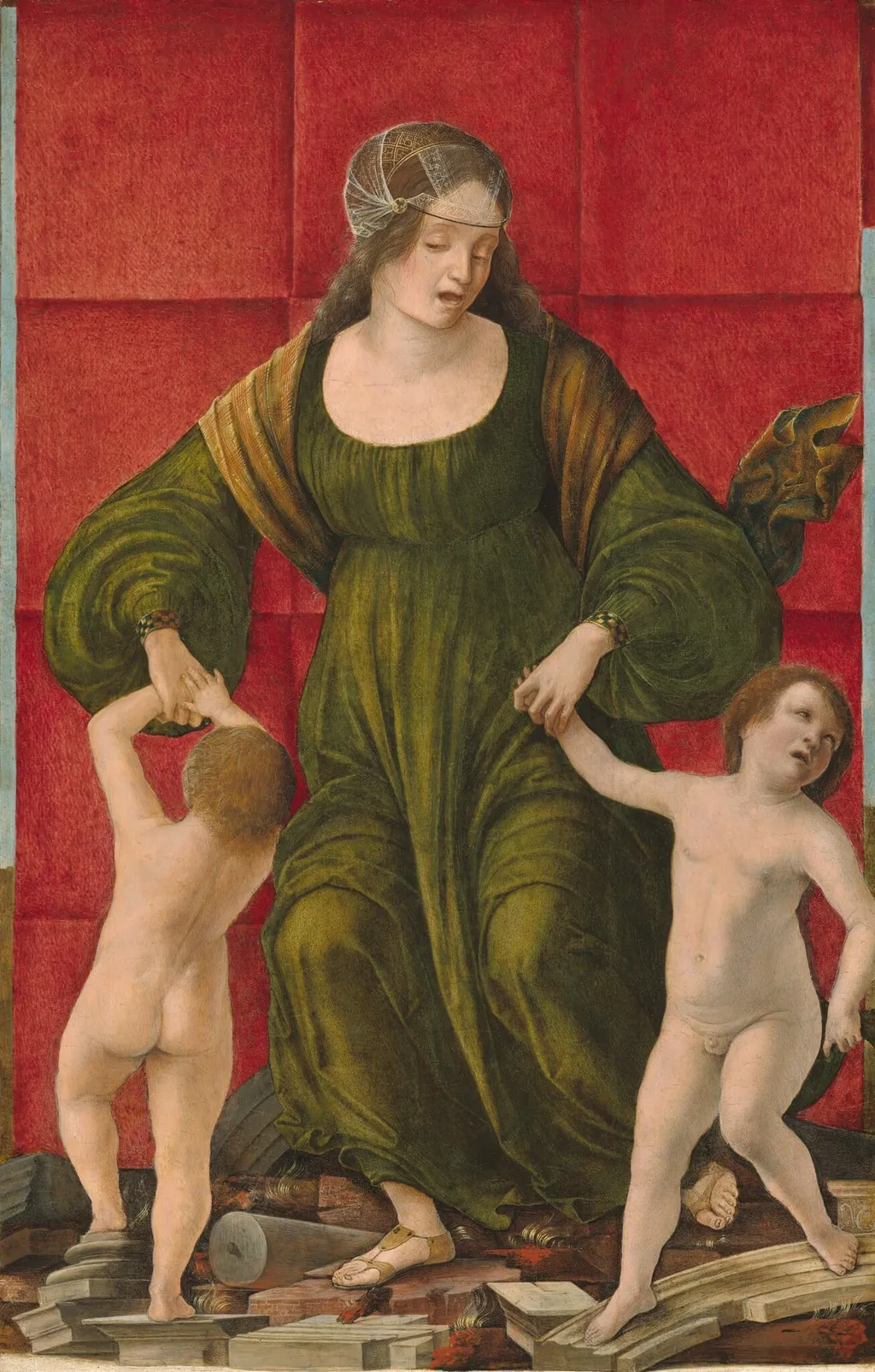
The Wife of Hasdrubal and Her Children is a tempera painting by the Early Renaissance artist Ercole de'Roberti. It dates from 1492 and is held in the collection of the National Gallery of Art.
About this work
Ercole de' Roberti's panel shows her flinging her children and herself into the temple flames, a story drawn from Appian.
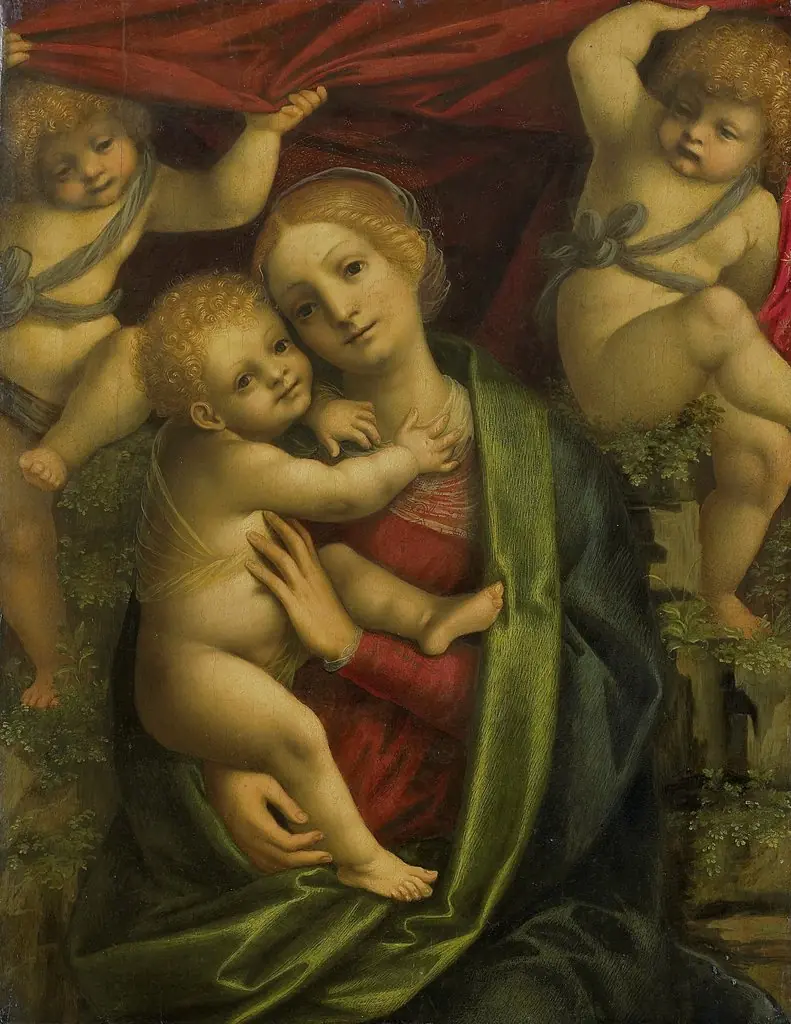
When Carthage fell in 146 BC, Hasdrubal's wife chose death over Roman captivity. Ercole de' Roberti's panel shows her flinging her children and herself into the temple flames, a story drawn from Appian. Painted around 1490 to 1493 in tempera on poplar for the court of Ferrara, the small panel downplays gore for decorative brilliance: nude children twisting like putti against a crimson curtain while their mother wears emerald green. It now hangs at the National Gallery of Art in Washington.
Subject & Meaning
The painting depicts the wife of Hasdrubal the Boetharch, the Carthaginian commander who surrendered to Scipio Aemilianus during the Siege of Carthage. According to Valerius Maximus, she sacrificed her sons in a burning temple and then threw herself into the flames, cursing her husband's cowardice. The scene shows her standing amid ruins, gripping two contorted children, with a red cloth backdrop echoing works by Giovanni Bellini.
The subject belongs to a series of famous women of antiquity commissioned for Eleonora of Aragon, referencing her father Ferdinand I's motto: 'I prefer death to dishonor.' The work thus symbolizes resistance to tyranny and the choice of honorable death over shameful submission.
Technique & Style
The painting is executed in tempera on a poplar panel, measuring 47.3 × 30.6 cm. The medium and support are typical of Italian Renaissance panel paintings. The scene is set against a bright red cloth suspended from a pole, a motif that echoes the work of Giovanni Bellini, demonstrating the artist's refined use of luminous color. Characteristic of Ercole de' Roberti's style are the intense facial expressions and the agitated, twisting movements of the figures, the mother gripping her two sons as they writhe amid architectural ruins.
This dynamic handling conveys emotional urgency and aligns with the artist's known emphasis on dramatic narrative and expressive figuration.
History & Provenance
The painting was probably commissioned by Eleonora of Aragon, duchess of Ferrara, as part of a series depicting famous women of antiquity, alluding to her father's motto about preferring death to dishonor. It is dated to about 1490–1493. Its provenance traces from Count Étienne Méjan in Milan by 1812, through Count d'Arache in Turin by 1849, and was bequeathed to Count Castellani in 1857.
It entered Sir John Charles Robinson's collection by 1861, passed to Robert Napier by 1865, and was sold at auction in 1877, after being repurchased by Robinson. Sir Francis Cook acquired it in 1878, and it descended through the Cook family until 1964, when it was sold to S. & R. Rosenberg and then to Rosenberg & Stiebel, from whom the National Gallery of Art purchased it in 1965.
The painting is held in the collection of the National Gallery of Art, Washington, D.C. It was purchased by the museum on 27 May 1965 from the dealers Rosenberg & Stiebel, New York, after passing through a succession of European collections including the Cook collection at Doughty House, Richmond. No exhibition history is provided in the available sources.
Context
This painting belongs to a series of famous women of antiquity, likely commissioned by Eleonora of Aragon, wife of Ercole I d'Este, reflecting her father's motto 'I prefer death to dishonor.' Its subject, drawn from Valerius Maximus, depicts a Carthaginian wife choosing suicide over surrender, a rare theme in Renaissance art. The work underscores the Ferrarese school's engagement with humanist ideals and classical exempla.
Its provenance reveals it was once misattributed to Mantegna, indicating shifts in scholarly attribution. Its dramatic intensity and refined handling of color exemplify Ercole de' Roberti's expressive style and secure its significance in early Renaissance narrative painting.
Overview
Ercole de' Roberti's small panel, The Wife of Hasdrubal and Her Children, painted in tempera on poplar around 1490-1493, depicts a dramatic moment from ancient history. Measuring 47.3 by 30.6 centimeters, the work portrays the Carthaginian commander's wife choosing self-immolation with her children rather than Roman capture. Roberti renders this grim narrative with a distinctive courtly elegance, characteristic of the Ferrarese school, rather than focusing on the horror of the event. It is now housed at the National Gallery of Art.
Own this work as a print
Artist & collection
Artist
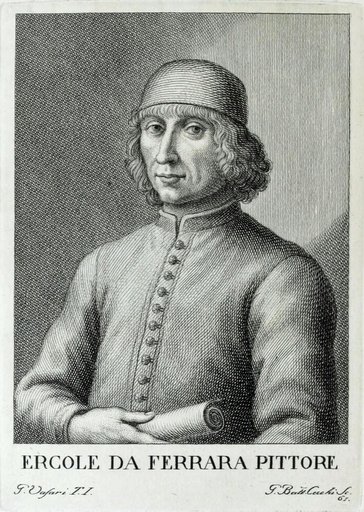
Ercole de' Roberti, also known as Ercole Ferrarese or Ercole da Ferrara, was an Italian artist of the Early Renaissance and the School of Ferrara. He was profiled in Vasari's Le Vite delle più eccellenti pittori, scultori, ed architettori.