Artwork
Woman with a Parrot
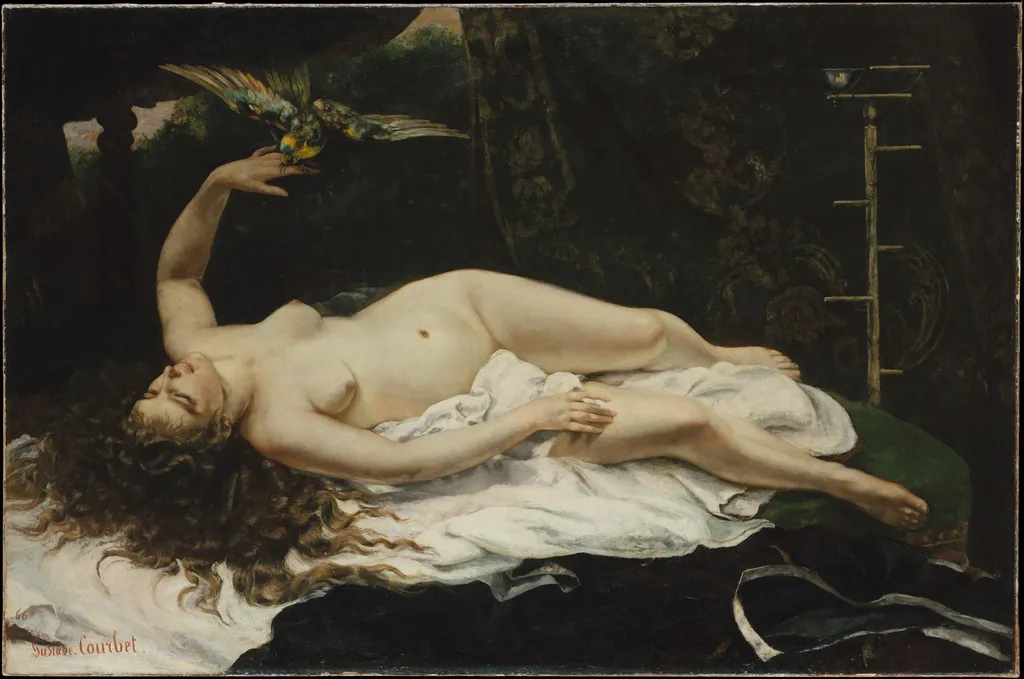
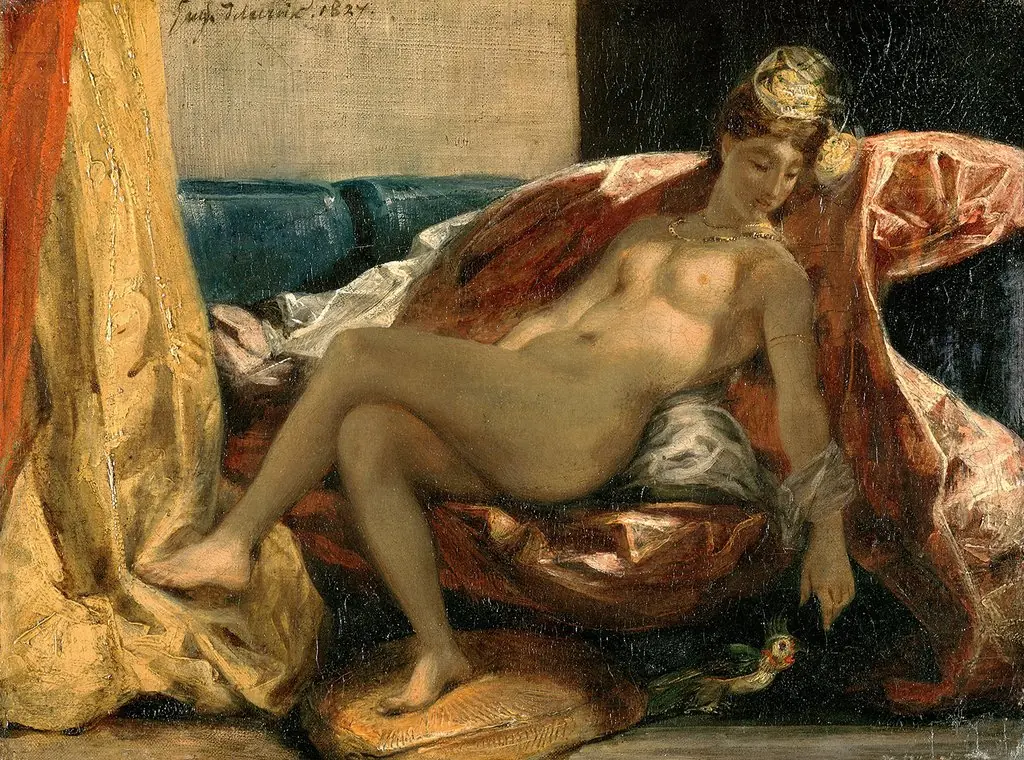
Woman with a Parrot is an oil painting by the Academic Art artist Gustave Courbet. It dates from 1866 and is held in the collection of the Metropolitan Museum of Art.
About this work
The Metropolitan Museum of Art now holds the work through the H.
A nude woman reclines on white drapery at the edge of a dark wood, her hair undone and her clothes cast aside, while a blue-fronted Amazon parrot alights on her outstretched hand. When Gustave Courbet exhibited this canvas at the Paris Salon of 1866, critics bristled at the model's disheveled intimacy, yet younger artists like Paul Cézanne and Édouard Manet took careful note. The Metropolitan Museum of Art now holds the work through the H.O. Havemeyer bequest.
Technique & Style
The work is an oil painting on canvas, measuring 129.5 × 195.6 cm. Courbet employed a polished academic style with smooth, subtle flesh tones and a classical reclining pose to gain Salon acceptance, yet the discarded clothes and disheveled hair introduce contemporary realism. X-ray analysis reveals a pentimento: a nude male figure originally occupied the right side, later overpainted with the empty perch. The handling combines meticulous flesh modeling with broader, looser brushwork in the drapery and parrot.
The composition is signed and dated '66 at lower left. Overall, the technique reflects a strategic compromise between academic finish and Courbet's naturalist approach.
History & Provenance
Painted in 1866, Woman with a Parrot was Courbet's first nude accepted by the Paris Salon that year, after a earlier submission had been rejected in 1864. The model is believed to be Joanna Hiffernan. X‑ray analysis has revealed that Courbet originally depicted a nude man on the right, later replaced by a bird perch.
The painting remained with Courbet until spring 1870, when it was sold to Jules Bordet of Dijon for 15,000 francs. On 30 April 1898 it was acquired by Durand‑Ruel, who on the same day sold it to Henry Osborne Havemeyer and his wife Louisine Waldron Elder for $12,000. The Havemeyers bequeathed the work to the Metropolitan Museum of Art in 1929.
The painting is held in the collection of the Metropolitan Museum of Art in New York, where it entered in 1929 as a bequest from Henry Osborne Havemeyer. Its exhibition history includes a showing at the Paris Salon of 1866, where it was listed as number 463.
Context
Exhibited at the 1866 Salon, Woman with a Parrot provoked mixed criticism: its non-academic pose and disheveled hair were condemned as lacking taste, yet some, like Théophile Gautier, saw a return to tradition, while Émile Zola lamented Courbet’s concession to popular taste. Scholars such as Camille Gronkowski (1929) linked the composition to Pierre-Paul Prud’hon. The painting marks a key moment in Courbet’s career: after his mythological Venus and Psyche was rejected in 1864, he deliberately adapted academic codes but substituted a contemporary nude, which Jules-Antoine Castagnary praised as “a woman of our time.”
It was his first nude accepted by the Salon and a pointed response to Manet’s scandalous Olympia; Manet soon began his own Woman with a Parrot. The work also impressed Cézanne, who reportedly carried a photograph of it. Now at the Metropolitan Museum of Art, it exemplifies Courbet’s negotiation between Realism and academic convention.
Legacy
The painting's legacy includes its influence on contemporaries: Manet responded by creating his own version later in 1866, and Cézanne was reportedly so struck that he kept a photograph of it. In 1929, art historian Camille Gronkowski drew a comparison to compositions by Pierre-Paul Prud'hon. More recently, in 2001, Kathleen Gilje created a reinterpretation titled Woman with a Parrot, Restored, which incorporates an X-ray image of a hidden male figure, commenting on the male gaze in art history.
The work entered the Metropolitan Museum of Art in 1929 and remains a notable example of Courbet's strategic engagement with academic conventions.
Overview
Gustave Courbet's Woman with a Parrot, painted in 1866, marked a significant moment in his career. This oil on canvas depicts a reclining female nude accompanied by an exotic bird. Measuring 129.5 by 195.6 cm, the work was Courbet's first nude to gain acceptance at the prestigious Paris Salon, a notable achievement after a previous submission had been rejected for perceived indecency.
Subject & Meaning
The painting features a woman, widely identified as Joanna Hiffernan, posed on white drapery. While her skin tones recall academic ideals, Courbet incorporated realist elements such as her disheveled hair and casually discarded clothing, presenting an unidealized form. A vibrant blue-fronted Amazon parrot hovers towards her outstretched hand, its presence adding a sensual note and reflecting 19th-century associations of exotic birds with feminine charm.
Own this work as a print
Artist & collection
Artist
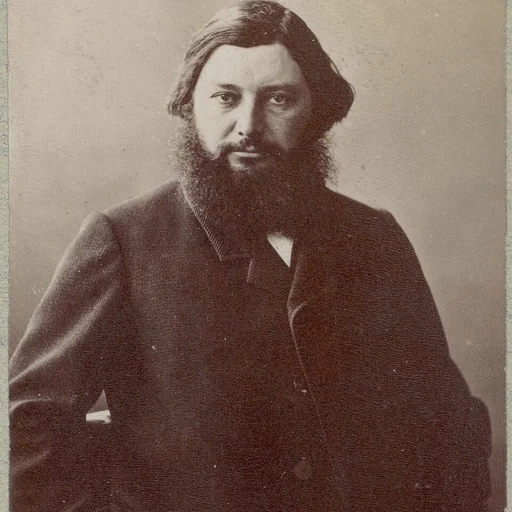
Jean Désiré Gustave Courbet (UK: KOOR-bay; US: koor-BAY; French:; 10 June 1819 – 31 December 1877) was a French painter who led the Realism movement in 19th-century French painting.