Artwork
The Source
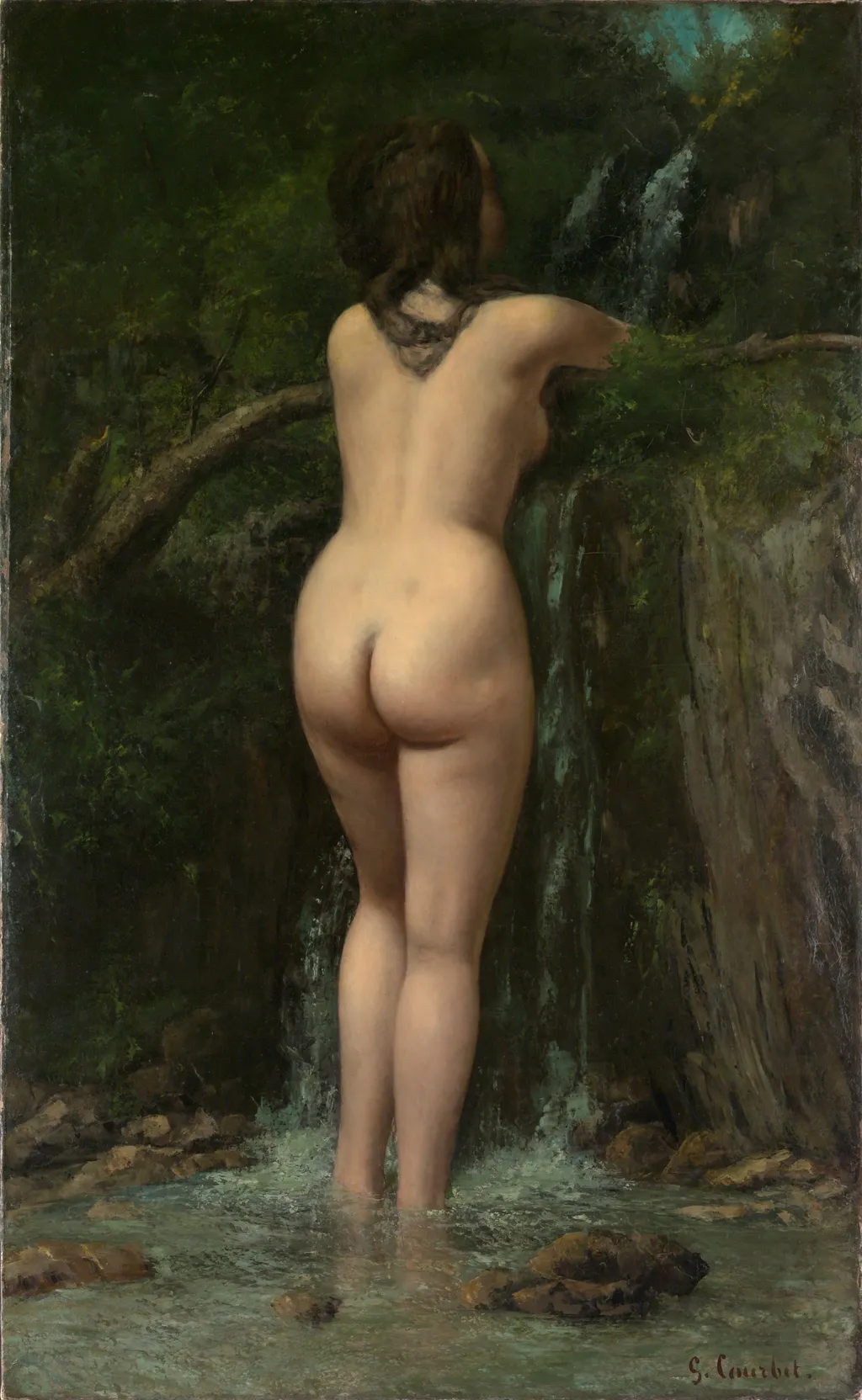
The Source is an oil painting by the Academic Art artist Gustave Courbet. It dates from 1862 and is held in the collection of the Metropolitan Museum of Art.
About this work
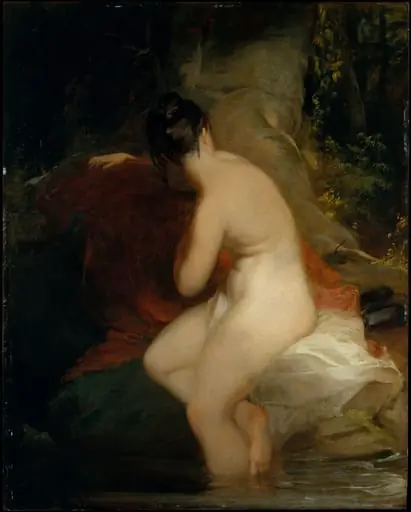
In Gallery 811 at the Metropolitan Museum of Art, a nude woman stands with her back to the viewer, arms thrust into a cascade of falling water.
In Gallery 811 at the Metropolitan Museum of Art, a nude woman stands with her back to the viewer, arms thrust into a cascade of falling water. Gustave Courbet painted this scene in 1862, stripping away the classical allegory that usually accompanied such titles. Where Jean-Auguste-Dominique Ingres had exhibited an idealized nude holding a water jar the year before, Courbet answered with unidealized flesh and a real mountain stream.
Subject & Meaning
The painting depicts a nude woman seen from behind, standing in a stream and reaching forward to caress the flowing water. Courbet rendered the figure with a deliberate realism, rejecting the idealized female form typical of academic art, most notably the 1856 painting The Source by Jean-Auguste-Dominique Ingres, to which Courbet's work is believed to respond directly. Where Ingres presented an idealized, frontal nude, Courbet shows a natural, unadorned back view, emphasizing the woman's physical connection to the rural landscape.
The stream acts as both the literal source of water and a symbolic wellspring of untamed nature. The identity of the model is unknown, and the work is often compared to Paul Gauguin's The Moon and the Earth (1893) for its fusion of the female figure with elemental forces.
Technique & Style
The Source is an oil painting on canvas, measuring 120 by 74.3 centimeters. Courbet employed a realist approach, depicting the nude woman from behind in a natural stream, deliberately distancing the figure from the idealized female forms of his academic contemporaries. The modeling is naturalistic, with soft contours and muted earth tones that merge the woman's back with the surrounding water and rock.
The brushwork is restrained, focusing on the play of light on skin and flowing water rather than sharp outlines. The composition emphasizes the figure's connection to the landscape, as she reaches into the stream, creating a seamless transition between body and nature.
History & Provenance
Painted in 1862 by Gustave Courbet, The Source may have been created as a direct response to Jean-Auguste-Dominique Ingres's 1856 painting of the same title. No commission is recorded for the work. In 1916 the American philanthropist Louisine Havemeyer acquired the painting.
Three years later, she anonymously lent it to the Metropolitan Museum of Art for a 1919 exhibition of Courbet's works. Havemeyer bequeathed The Source to the Metropolitan Museum of Art upon her death in 1929, and it has since remained part of the museum's permanent collection.
Context
Critical reception of The Source has centered on its realist departure from academic idealization, particularly in dialogue with Jean-Auguste-Dominique Ingres's 1856 The Source. Art historians note its relationship to later works such as Paul Gauguin's The Moon and the Earth (1893). The identity of Courbet's model remains unknown, with some scholars suggesting she may have posed for him on more than one occasion.
The painting was acquired by Louisine Havemeyer and lent to a 1919 Courbet exhibition at the Metropolitan Museum of Art, to which she later bequeathed it. Courbet revisited the theme in 1868 with another Source now at the Musée d'Orsay. These factors position the work as a key example of Courbet's reworking of classical nude imagery through a realist lens.
Legacy
The painting entered the collection of the Metropolitan Museum of Art through the bequest of philanthropist Louisine Havemeyer, who had acquired it in 1916 and anonymously lent it to a Courbet exhibition at the museum in 1919. Its legacy is shaped by art-historical comparisons: it is frequently discussed as a realist counterpoint to Jean-Auguste-Dominique Ingres's idealized 1856 painting of the same title, and has also been linked to Paul Gauguin's 1893 work The Moon and the Earth. Courbet himself revisited the composition in 1868, producing a second version now held at the Musée d'Orsay in Paris.
Overview
Gustave Courbet's 1862 oil painting, The Source, depicts a nude woman from behind, positioned against a natural waterfall in a forest. This work exemplifies Courbet's commitment to Realism, particularly his exploration of the female nude. It challenged the prevailing academic traditions of his era, which often presented idealized figures within allegorical or mythological narratives.
Own this work as a print
Artist & collection
Artist
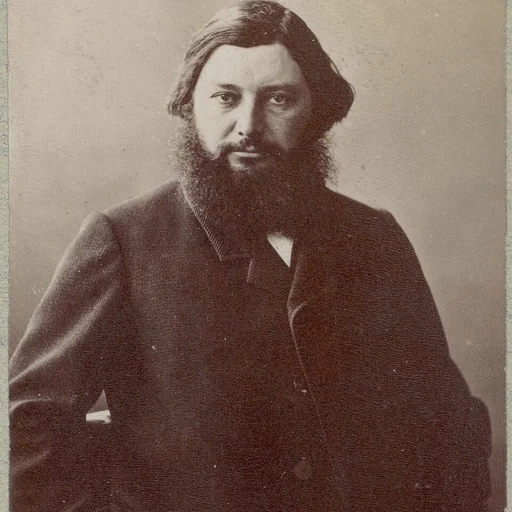
Jean Désiré Gustave Courbet (UK: KOOR-bay; US: koor-BAY; French:; 10 June 1819 – 31 December 1877) was a French painter who led the Realism movement in 19th-century French painting.

 Compared in the Impressionism course