Artwork
Yasoda and Krishna
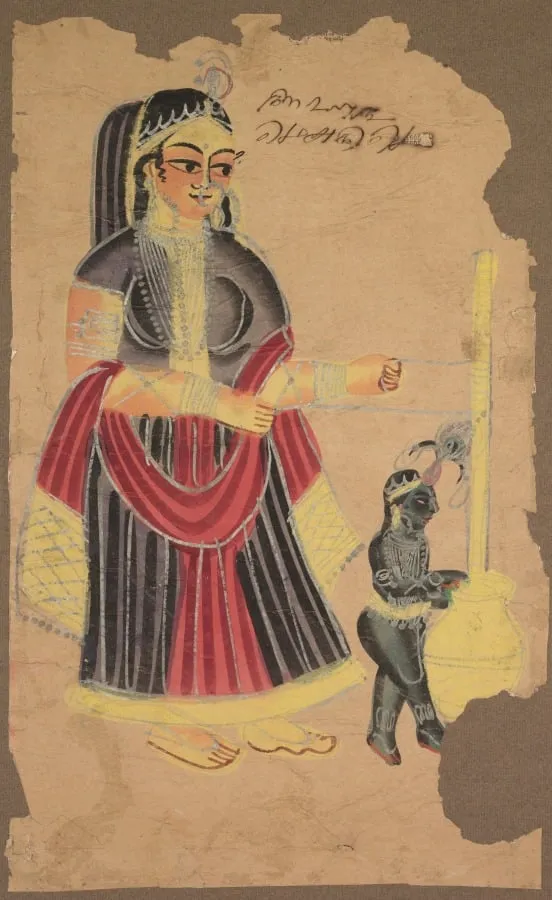
Yasoda and Krishna is an unspecified painting by the Bengal School artist Unknown. It dates from 1890 and is held in the collection of the Cleveland Museum of Art.
- Accession no.
- 2003.159
About this work
Overview
The work titled "Yasoda and Krishna" is a painted image on a sheet of aged paper. It depicts a woman dressed in dark blue and red garments edged with gold, holding a yellow fan, alongside a small child reaching toward her. The composition is set against a plain background, allowing the vivid hues to dominate the visual field.
Subject & Meaning
The figures represent Yasoda, a maternal figure in Hindu tradition, and the infant Krishna, a central deity in Indian mythology. The interaction, Yasoda’s protective stance and the child's eager gesture, conveys themes of devotion, nurturing, and divine playfulness that are common in devotional narratives.
Technique & Style
Executed in a folk painting tradition associated with the Kalighat region, the piece employs bold, flat colors and simplified forms. The brushwork appears loose and slightly uneven, suggesting frequent handling. Gold trim on the clothing and the stark contrast between pigments and the weathered paper surface are characteristic of the style's emphasis on decorative detail.
History & Provenance
The painting originates from the 19th‑century Kalighat school of Bengal, a period when itinerant artists produced devotional images for a growing market. The work’s worn condition indicates extensive display or collection, though specific ownership records are not documented.
Context
Kalighat paintings emerged near the famous Kali temple in Kolkata, reflecting both religious subjects and the tastes of urban patrons. This piece aligns with that tradition, illustrating how popular devotional iconography was rendered in an accessible, mass‑produced format for everyday viewers.
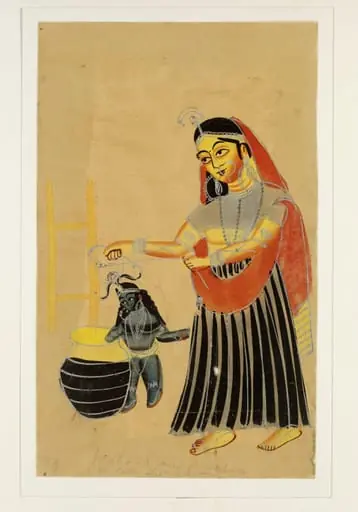
Artist & collection









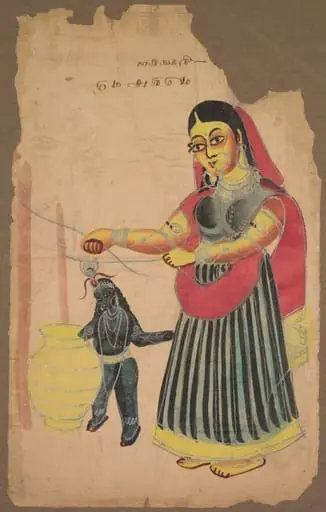 Yasoda with Krishna Churning Butter
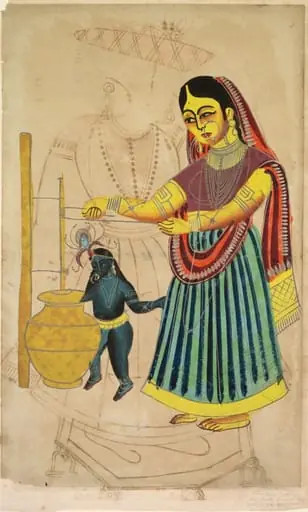 Yasoda Churning Butter (verso), from a Kalighat album
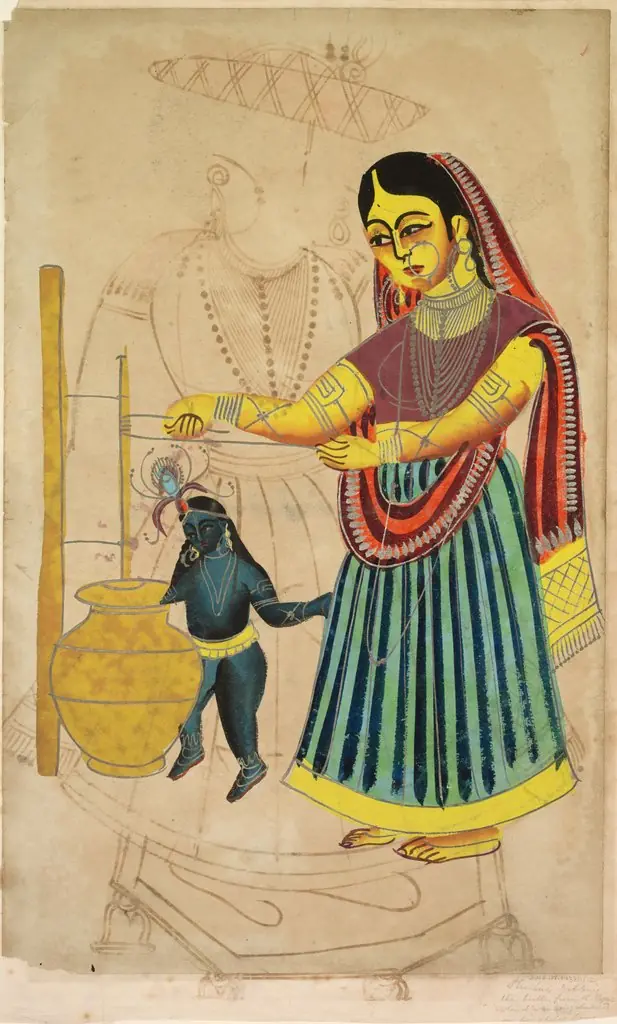 Yasoda Churning Butter (verso), from a Kalighat album
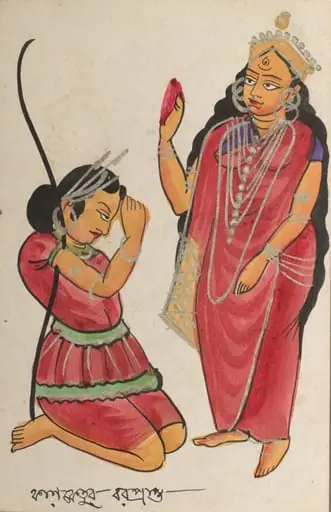 Kalaketu Receiving a Boon from the Goddess Chandi
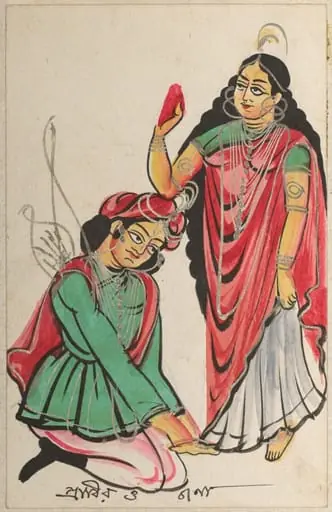 Pravira Kneeling at the Feet of Jana
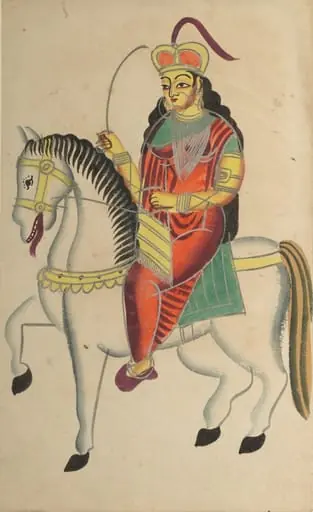 The Mutiny of the Heroine Rani Lakshmi Bai of Jhansi
 Sri Nathaji
 Head of a Beauty