Artwork
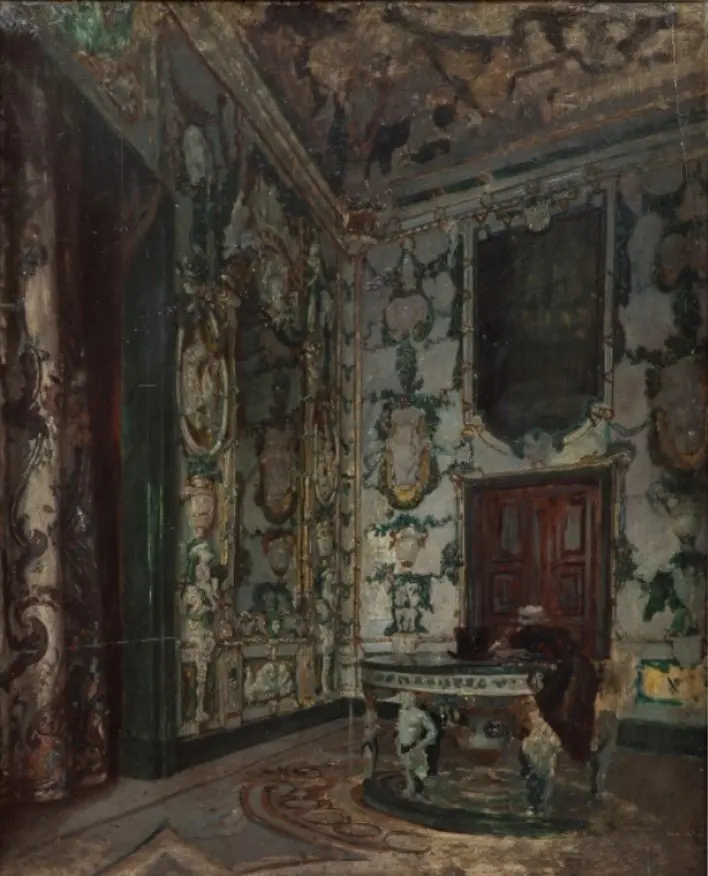
The chamber of Philip IV in the Buen Retiro Royal Palace
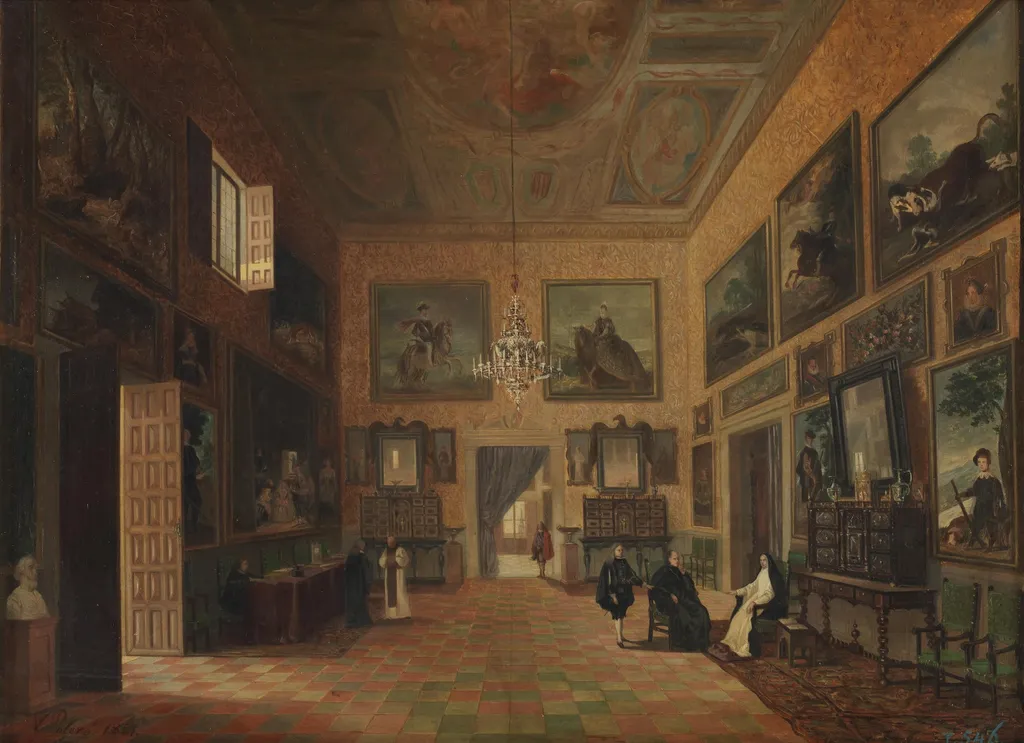
The chamber of Philip IV in the Buen Retiro Royal Palace is an oil painting by the Post-Impressionist artist Vicente Poleró y Toledo. It dates from 1891 and is held in the collection of the Museo del Prado.
About this work
History & Provenance
The painting The chamber of Philip IV in the Buen Retiro Royal Palace by Vicente Poleró y Toledo is held in the collection of the Museo del Prado in Madrid.
The painting depicting the chamber of Philip IV in the Buen Retiro Royal Palace was created by Vicente Poleró y Toledo in 1881. Executed in oil on panel, the work measures 53 cm in height and 66 cm in width. It currently resides in the collection of the Museo del Prado in Madrid.
The artwork portrays specific interior elements, including a Bargueño desk, a sculpture, and other paintings within the historic royal chamber.
The painting The chamber of Philip IV in the Buen Retiro Royal Palace by Vicente Poleró y Toledo is held in the collection of the Museo del Prado in Madrid. Created in 1881, the work is executed in oil on panel and measures 53 cm in height by 66 cm in width. The piece depicts interior elements including a Bargueño desk, a sculpture, and other paintings.
No specific accession number or exhibition history is provided in the available sources.
Context
The chamber of Philip IV in the Buen Retiro Royal Palace (1881) by Vicente Poleró y Toledo exemplifies academic historicism through its meticulous recreation of 17th-century Spanish royal interiors, blending archaeological precision with painterly homage to Diego Velázquez's court scenes. Art historians regard the work as a deliberate synthesis of 19th-century European fascination with Velázquez's compositions and Spain's Habsburg-era aesthetics, positioning it within Poleró y Toledo's broader exploration of historical genre painting that interrogated national identity through archival reconstruction. The painting's precise documentation of period furnishings and courtly objects reflects contemporary scholarly interest in material culture, while its residence at the Museo del Prado since acquisition underscores its canonical status in narratives of Spanish art historical consciousness.
Scholarly discourse has emphasized the work's role in advancing technical approaches to architectural interior rendering, with recent analyses linking its compositional strategies to broader European movements that sought historical authenticity in academic art. The painting's depiction of a Bargueño desk, sculptural elements, and layered pictorial space demonstrates Poleró y Toledo's engagement with 19th-century artistic debates about the interplay between historical accuracy and artistic interpretation, contributing to ongoing reevaluations of Spanish academic art's relationship with European artistic trends.
The work's significance is contextualized by its creation during a period of heightened Spanish cultural nationalism, where artistic representations of Habsburg-era spaces served as visual commentaries on imperial legacy. Its detailed rendering of courtly objects and spatial arrangements has informed studies on 19th-century museum practices and the construction of historical memory, establishing it as a key artifact for understanding how 19th-century artists mediated historical narratives through material culture.
Overview
Vicente Poleró y Toledo’s oil on canvas, completed in 1891, portrays the interior of the chamber of Philip IV within the Buen Retiro Royal Palace. The work is part of the collection of the Museo del Prado, where it is displayed as a representation of a historic royal setting rendered through late‑nineteenth‑century academic painting.
Subject & Meaning
The composition centers on a richly appointed room, its walls adorned with frescoed panels and a series of framed paintings depicting equestrian scenes, landscapes, and portraits. A chandelier hangs from the ceiling, casting light onto a marble floor of red‑and‑green checkerboard tiles, while a Bargueño desk and a sculptural figure occupy the foreground, suggesting the daily life and ceremonial duties of the monarch’s private space.
Technique & Style
Poleró employs a pronounced chiaroscuro, using deep shadows that stretch across the tiled floor to heighten the sense of depth and atmosphere. The contrast between the golden woodwork, the muted frescoes, and the illuminated figures creates a dramatic interplay of light and dark, characteristic of academic realism’s attention to detail and tonal modeling.
Own this work as a print
Artist & collection

- En sal i Palazzo Borghese
 En sal i Palazzo Borghese
 Spinet player in an interior with paintings
 Hall of Estates at the City Council in Antwerp
 The Art Gallery of Josephus Augustinus Brentano
 The Gallery at the Browsholme, near Clitheroe
 Louis-Philippe visiting the Luxembourg Museum
 Return of the Prodigal Son
 Gallery of Francis I at Fontainebleau
 Imaginary View of the Grande Galerie in the Louvre
 Salón de Porcelana del Palacio Real de Madrid
 Self-portrait in a room