Artwork
Cypresses
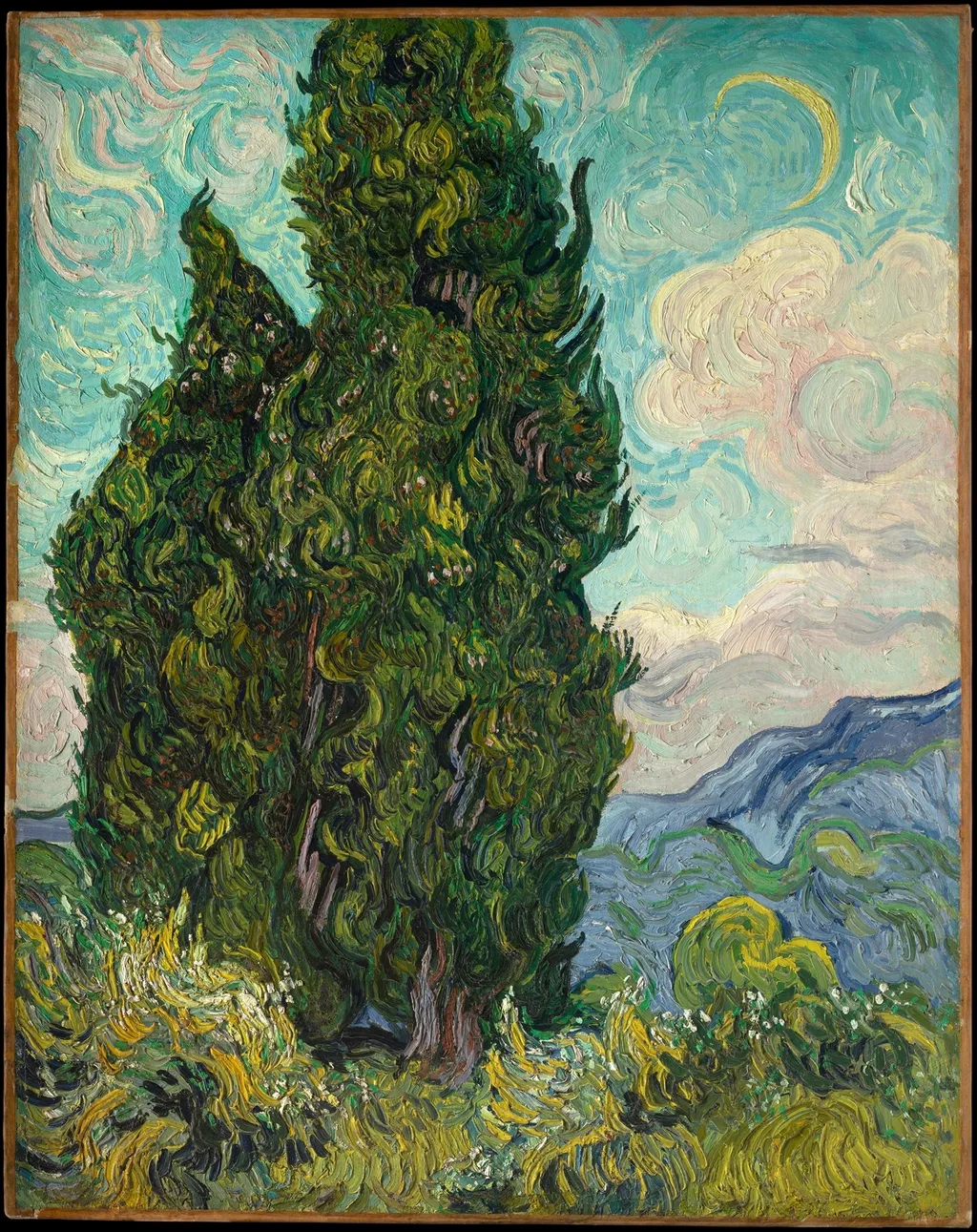
Cypresses is an oil painting by the Post-Impressionist artist Vincent van Gogh. It dates from 1889 and is held in the collection of the Metropolitan Museum of Art.
About this work
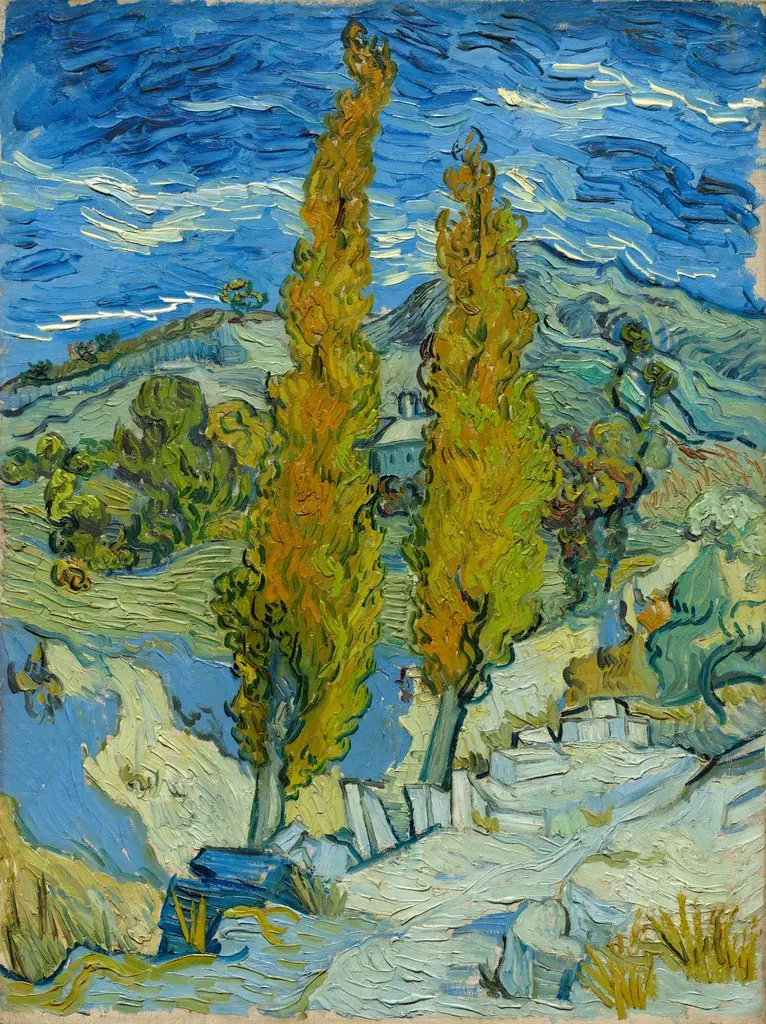
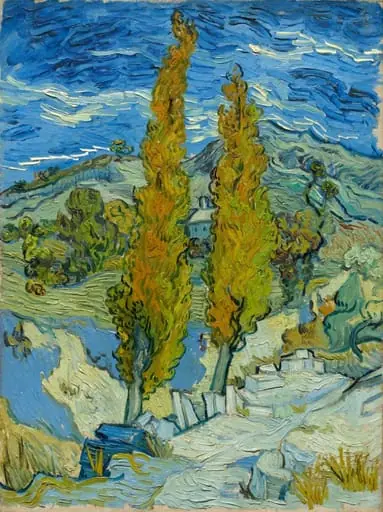
Van Gogh painted Cypresses in June 1889, just months after moving to a small town in southern France. Two tall cypress trees rise from the countryside, a common sight there that he saw his own way, dark and swirling and almost alive.
Subject & Meaning
He painted the work in June 1889 while a patient at the Saint‑Paul asylum in Saint‑Rémy, and later exhibited it at the 1890 Salon des Indépendants.
The painting shows two tall cypress trees rising against a bright, turbulent sky, a motif Van Gogh called "beautiful as regards lines and proportions, like an Egyptian obelisk". In Mediterranean tradition the cypress is linked to cemeteries and eternity, a symbolism Van Gogh emphasized by describing it as a "black note" in a sunlit landscape that hints at mortality. He painted the work in June 1889 while a patient at the Saint‑Paul asylum in Saint‑Rémy, and later exhibited it at the 1890 Salon des Indépendants. The cypresses thus embody both natural observation and a personal meditation on death and artistic harmony‑4).
Technique & Style
Cypresses is executed in oil on canvas, a medium and support consistent with Van Gogh's standard practice during his Saint-Rémy period. The painting measures 93.4 by 74 centimeters and is classified as a landscape. Van Gogh approached the cypresses with a distinctive formal sensibility, describing the trees as "beautiful as regards lines and proportions, like an Egyptian obelisk."
He treated the cypress as "the black note in a sunny landscape," one of the most interesting and difficult dark accents to render accurately, revealing his pursuit of musical correspondences between the arts. Stylistically, the work belongs to his late Post-Impressionist production and engages with motifs of turbulence, the moon, and garrigue vegetation within the Provençal countryside. The handling reflects his characteristic interest in dynamic, expressive brushwork suited to the twisting forms of the trees.
History & Provenance
Vincent van Gogh created Cypresses in June 1889 while a patient at the Saint-Paul asylum in Saint-Rémy-de-Provence, France. The oil-on-canvas work was sent to his brother, Theo van Gogh, in Paris on September 28, 1889. Following Theo's death, his widow, Johanna van Gogh, sold the painting in 1895 to art dealer Lucien Moline for 384 florins.
The ownership chain subsequently included Julien Leclercq, Maurice Fabre, and dealer E. Druet, who auctioned the piece at Hôtel Drouot in May 1908. It later passed to Fritz Meyer-Fierz in Zurich and then to the Thannhauser Gallery in Berlin by 1923 or 1924. In late 1932, Salman Schocken acquired the work, which eventually returned to Justin K. Thannhauser in New York by 1949 before being sold to the Metropolitan Museum of Art.
Legacy
Cypresses was first exhibited at the 1890 Salon des Indépendants in Paris, a showing that helped solidify van Gogh’s emerging reputation among avant‑garde circles; the work later entered a series of high‑profile transactions, passing from Fritz Meyer‑Fierz to Saloman Schocken and finally to Justin K. Thannhauser before being acquired by the Metropolitan Museum of Art, where it remains on public view; this trajectory placed the painting at the center of van Gogh’s posthumous legacy, influencing later movements that embraced his expressive treatment of nature.
Overview
Vincent van Gogh's Cypresses, an oil on canvas painting from June 1889, captures a pair of prominent cypress trees in the French countryside. This work exemplifies the artist's distinctive approach to landscape, transforming a common natural motif into a dynamic visual statement. It is currently housed in the collection of the Metropolitan Museum of Art.
Context
This work was created in June 1889, only a few months after Van Gogh relocated to a small town in southern France. During this period, he frequently explored the local landscape, finding inspiration in its distinctive flora. The cypress trees, a ubiquitous element of the region, became a recurring motif through which he explored his personal vision and emotional state.
Own this work as a print
Artist & collection
Artist
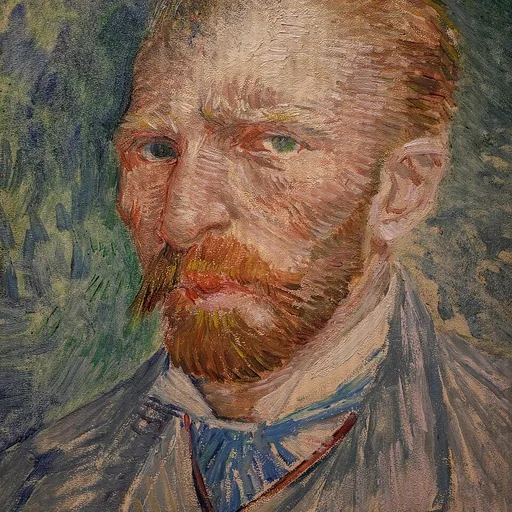
Vincent Willem van Gogh was a Dutch Post-Impressionist painter who is among the most famous and influential figures in the history of Western art.