Artwork
Self-Portrait
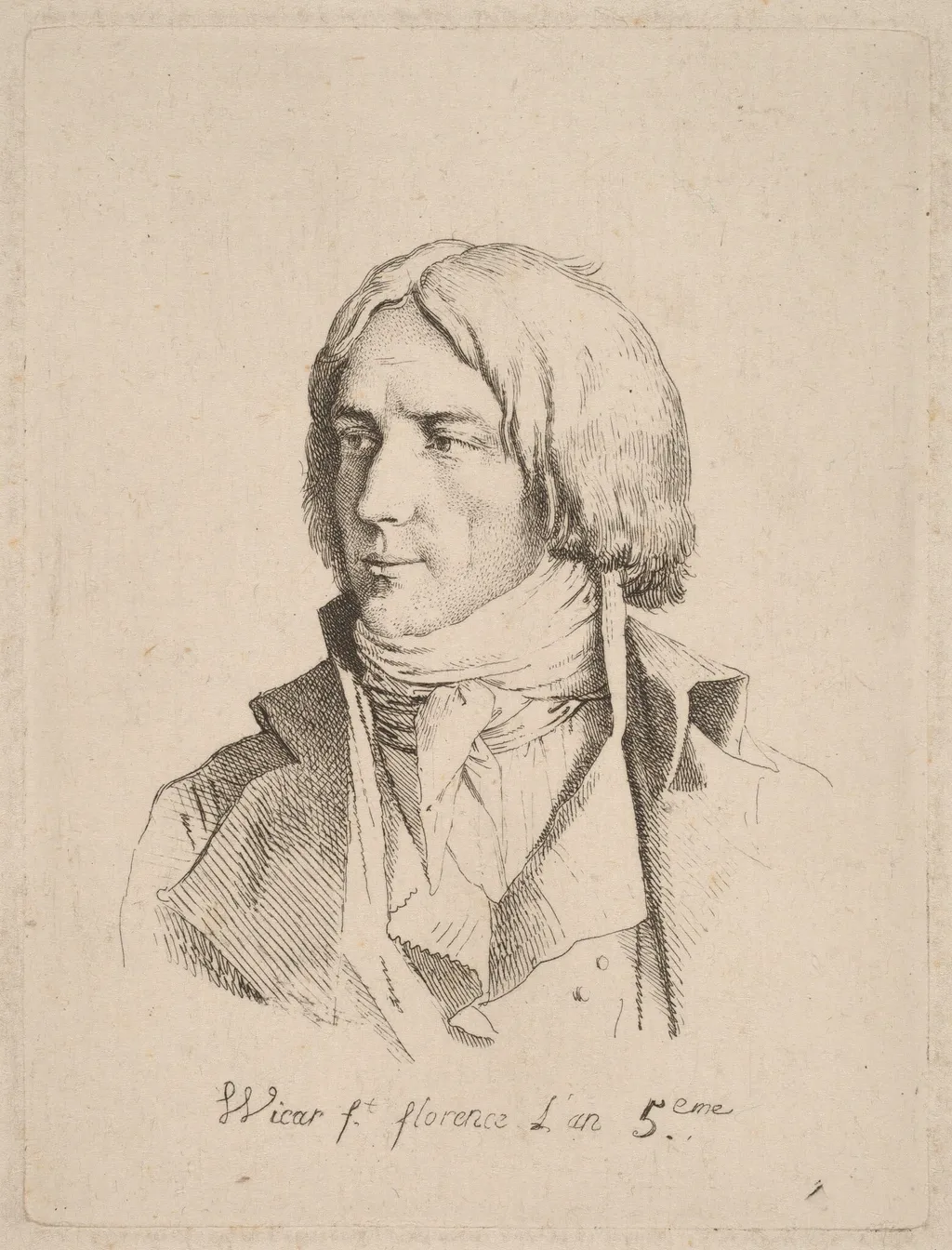
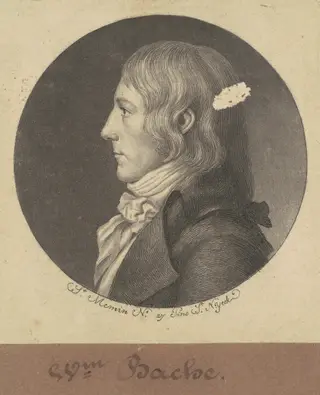
Self-Portrait is an ink print by the Romanticist artist Jean-Baptiste Joseph Wicar. It dates from 1797 and is held in the collection of the National Gallery of Art.
- Inscription
- Inscribed:lower center in plate: ft. florence l'an 5eme; by later hand, lower right in graphite: Salicetti
About this work
Overview
The piece bears the inscription "Wicar f't Florence L'an 5eme," confirming its creation in Florence during the fifth year of the French Republican calendar.
Jean-Baptiste Joseph Wicar's Self-Portrait is an etching on laid paper executed in 1797. The work depicts the artist in profile facing left, characterized by short, curled hair and attire consisting of a high-collared coat and a cravat. The composition focuses tightly on the head and shoulders, utilizing loose yet precise lines to define the facial features and drapery.
The piece bears the inscription "Wicar f't Florence L'an 5eme," confirming its creation in Florence during the fifth year of the French Republican calendar. This date places the work during Wicar's extended residence in Italy, where he served as a prominent collector and agent for French museums. As a self-representation from this period, the etching reflects the artist's professional identity and his deep engagement with Italian art history.
The medium of etching allowed for a direct, graphic interpretation of his likeness, distinct from his more famous oil paintings and drawings. The work stands as a significant document of Wicar's career, illustrating his presence in Florence at a pivotal moment in his development as a neoclassical artist and connoisseur.
Subject & Meaning
The work functions as a personal statement, capturing Wicar’s own likeness at a mature stage of his career. By choosing a profile view, he aligns himself with classical portrait conventions, while the restrained expression and modest dress suggest a focus on professional identity rather than overt self‑aggrandizement.
Technique & Style
Created through traditional etching, the artist incised lines into a copper plate, which were then bitten with acid to hold ink. The resulting prints on textured laid paper display a characteristic fine ribbing. Wicar’s hand is evident in the fluid yet controlled line work, especially in the rendering of facial features and the drapery of the coat.
History & Provenance
The plate bears the inscription “Wicar f’t Florence L’an 5eme,” indicating that Wicar signed the work in Florence during the fifth year of the French Republic (1797). This signature not only authenticates the piece but also situates its production within the artist’s Italian period, a time when he was engaged with the academic circles of Florence.
Context
The portrait emerges at the close of the 18th century, a period when French artists were increasingly traveling to Italy for study and patronage. Wicar’s choice of etching, a medium prized for its reproducibility, reflects the era’s growing interest in disseminating personal and artistic images beyond the confines of painted portraiture.
Own this work as a print
Artist & collection