Artwork
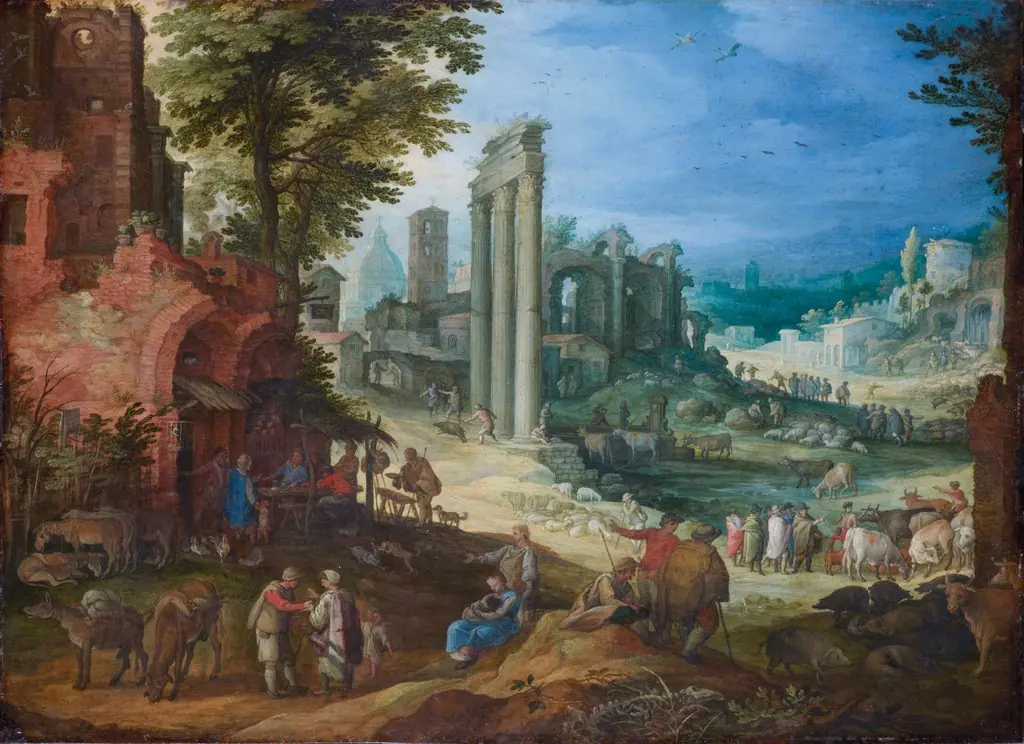
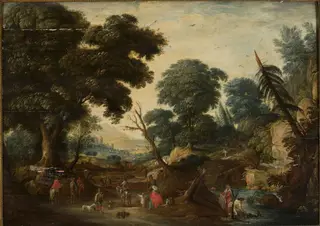
Landscape with Roman Ruins and the Meeting of Rebecca and Eliezer
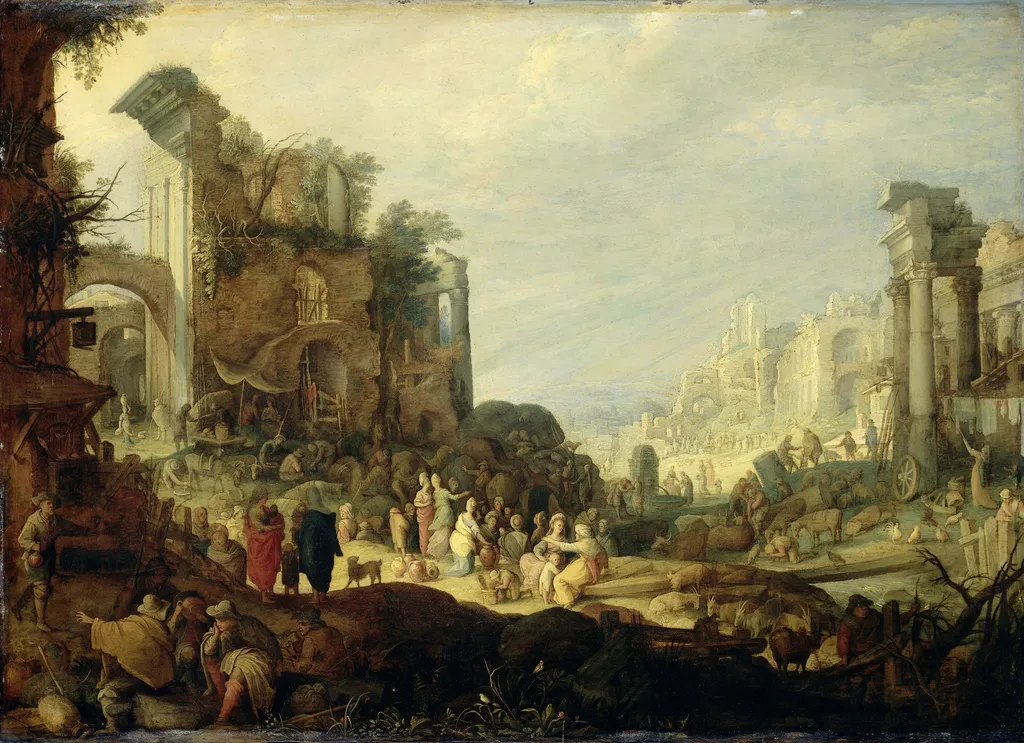
Landscape with Roman Ruins and the Meeting of Rebecca and Eliezer is an oil painting by the Flemish Baroque painting artist Willem van Nieulandt II. It dates from 1610 and is held in the collection of the Rijksmuseum.
About this work
Subject & Meaning
Despite using these sources, the composition transforms the ruins into an idealized setting rather than a topographically accurate one.
The painting depicts two scenes: a biblical meeting and a contemporary Roman landscape. In the foreground, Rebecca offers water to Eliezer at a fountain, illustrating the Old Testament episode where Abraham’s servant chooses a wife for Isaac (Genesis 24). This narrative episode is embedded within a crowded Roman scene of travelers, shepherds, and merchants, set among recognizable ruins.
The background features ancient Roman architecture rendered from sixteenth-century print sources rather than direct observation. The ruins include the Temple of Minerva on the Forum of Nerva, the temples of Vespasian and Saturn, and the Palatine hill, all combined in a fantastical arrangement. The fountain itself corresponds to a structure that stood on the Forum Romanum from 1593.
The artist drew on Hieronymus Cock’s 1551 print series of Roman ruins, adapting motifs such as the Forum Romanum view from the Capitol and the Palatine at sunrise. Despite using these sources, the composition transforms the ruins into an idealized setting rather than a topographically accurate one.
Technique & Style
Executed in oil on copper, the painting measures 41.5 by 57 cm and presents a densely populated Roman landscape in which antique ruins and biblical narrative are fused. Van Nieulandt drew on Hieronymus Cock’s 1551 Antwerp print series Praecipua aliquot Romanae Antiquitatis Ruinarum Monimenta to compose the architectural settings: the leftmost temple of Minerva is adapted from a Forum of Nerva view, while the temples of Vespasian and Saturn derive from a Capitool vantage of the Forum Romanum, altered so the former shows Ionic instead of Corinthian capitals. The background palatine motif comes from a dawn view of the Palatium, though the painting suppresses the Septizonium seen on the print.
Handling is smooth and precise, with fine brushwork animating the crowd of travelers, shepherds, laundresses, and merchants around a central fountain where Rebecca meets Eliezer. The copper support, reflective and durable, supports unusually crisp detail in the distant ruins and the closely observed human activity.
History & Provenance
Created in 1610, this copper painting is attributed to Willem van Nieulandt II, though it bears the signature 'P: Bril' and was historically linked to Paul Bril around 1600. Italian art historian Giorgio Faggin reattributed the work to Nieulandt in 1965, a view adopted by the Rijksmuseum, which dates the piece between 1600 and 1620. This dating suggests the work may have been executed in Amsterdam or Antwerp rather than Rome, despite its subject matter.
The painting's provenance begins in 1752 within the collection of Adriaan Leonard van Heteren in The Hague. Upon his death, the work passed to his son, Adriaan Leonard van Heteren Gevers. On June 8, 1809, the younger van Heteren sold the painting as part of the Kabinet Van Heteren Gevers, a sale comprising 136 artworks acquired by the Rijksmuseum.
Context
The painting was created in Rome between 1600 and 1620 by either Paul Bril or his pupil Willem van Nieulandt II, reflecting the Dutch artists' engagement with Roman antiquity during their formative years abroad. It draws on a series of prints by Hieronymus Cock depicting Roman ruins, particularly the Forum Romanum and Palatine Hill, which were widely circulated through publications such as Praecipua aliquot Romanae Antiquitatis Ruinarum Monimenta (1561). These visual sources informed the architectural details, including the Temple of Minerva, the temples of Vespasian and Saturn, and the Palatine ruins, though the compositions were adapted and not always architecturally precise.
The work synthesizes biblical narrative, specifically the meeting of Rebecca and Eliezer at a well, with a meticulously rendered antiquarian landscape, blending historical accuracy in certain elements with imaginative reconstruction. Its provenance traces back to the collection of Adriaan Leonard van Heteren Gevers, who sold it to the Rijksmuseum in 1809 after it remained in the family since 1752.
Overview
Willem van Nieulandt II, an Antwerp‑born painter active in the early seventeenth century, completed the copper painting Landscape with Roman Ruins and the Meeting of Rebecca and Eliezer in 1610. Executed in the Flemish Baroque idiom, the work combines a biblical narrative with a picturesque Italianate setting, and is now part of the Rijksmuseum’s collection.
Own this work as a print
Artist & collection
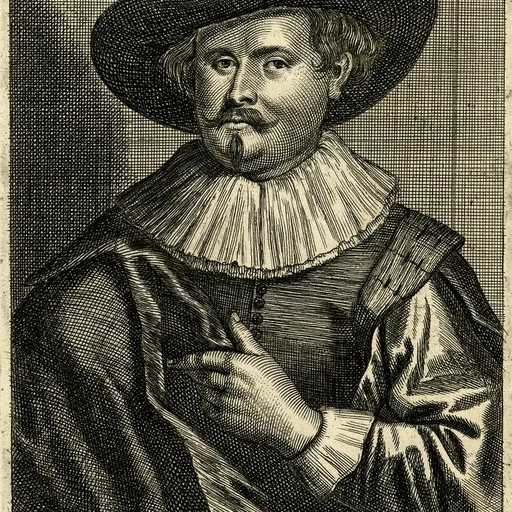
Artist
Guilliam or Willem van Nieulandt or van Nieuwelandt (1582/84–1635) was a Flemish painter, engraver, poet and playwright from Antwerp.

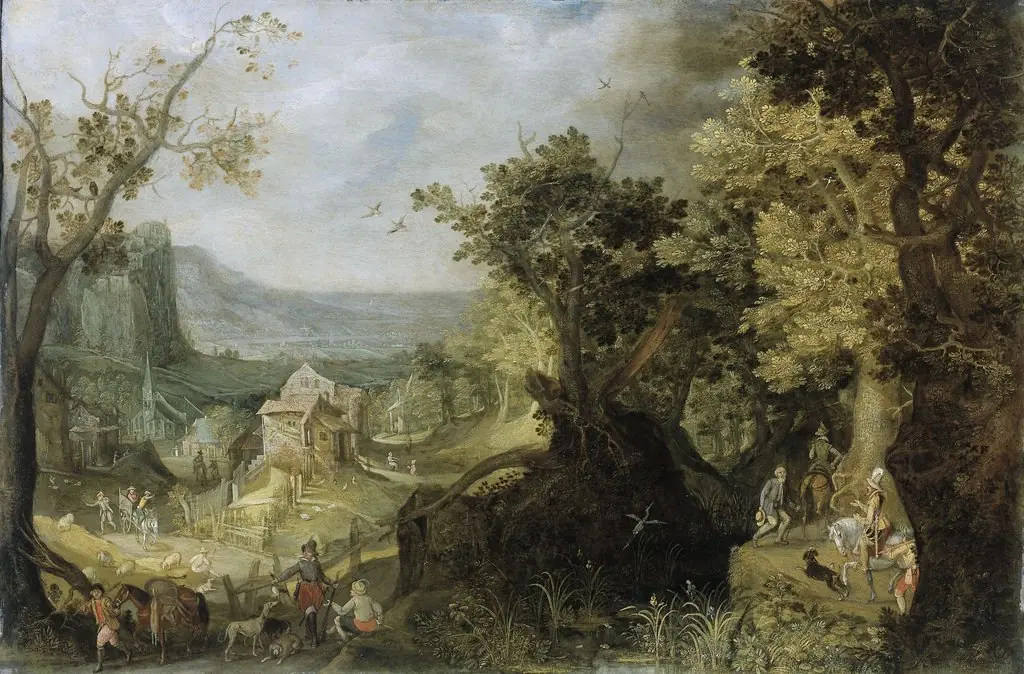 Wooded Landscape
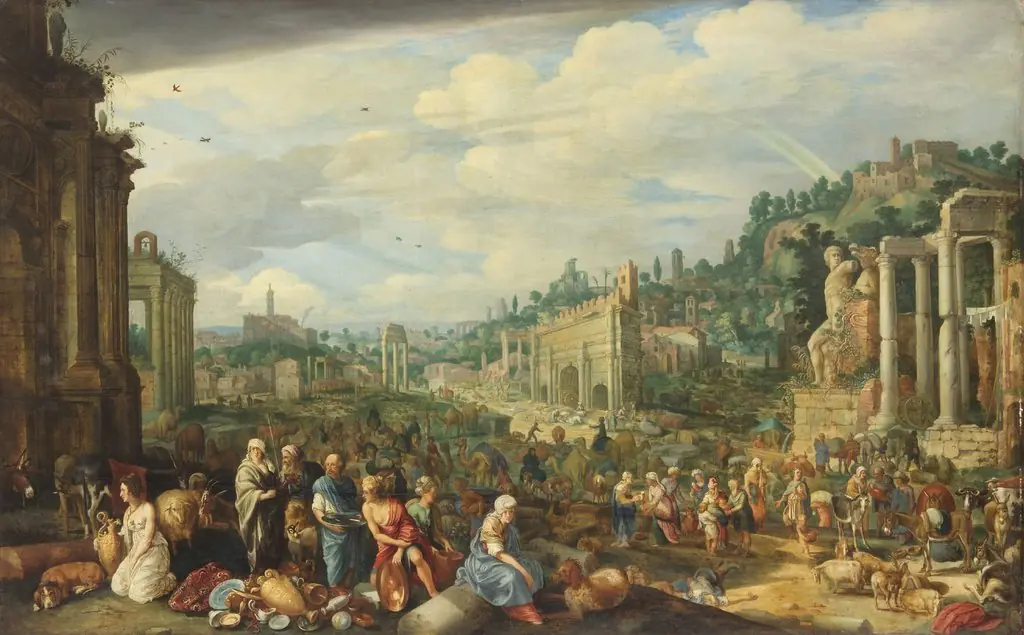 Ansicht des Campo Vaccino in Rom (Aufbruch der Israeliten aus Ägypten)
 Temptation of St Antony
 Moses and Aaron Changing the Rivers of Egypt to Blood
 Die Sintflut mit der Arche Noah
 Housing the poor
 Starting for the Chase
 Hunter and Horsemen on a Wooded Road, with a Village in a Valley beyond
 Landscape with ruins, cattle and deer
 Landscape with castle and tavern
 Mountain landscape with staffage
- Roman Ruins Landscape