Artwork
Eve Tempted by the Serpent
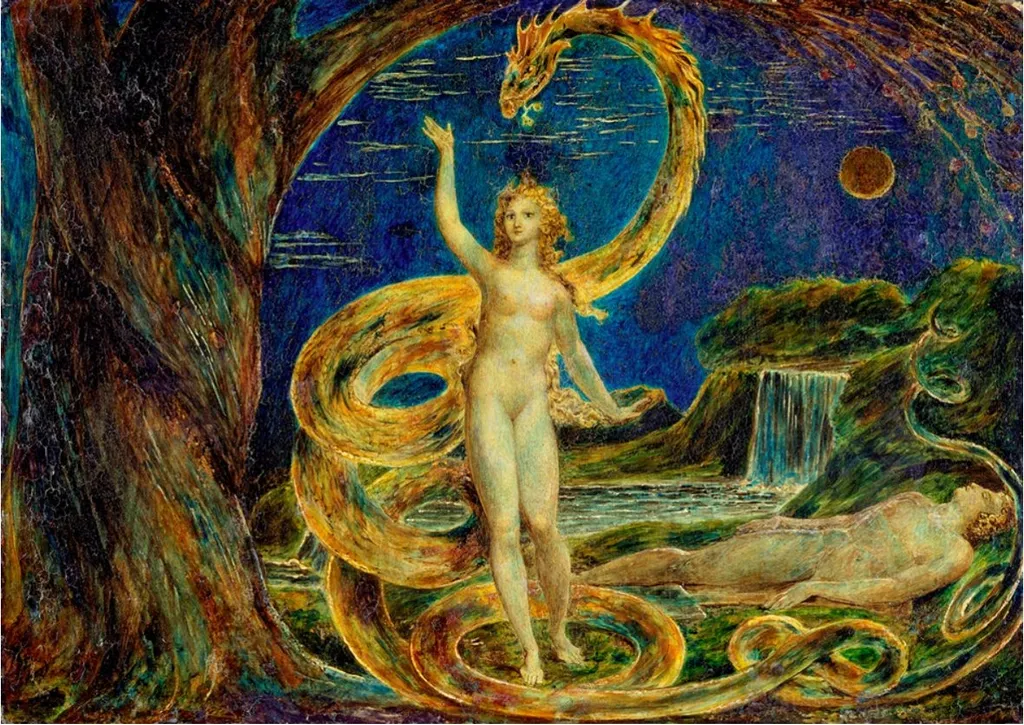
Eve Tempted by the Serpent is an unspecified painting by William Blake. It dates from 1796 and is held in the collection of the Victoria and Albert Museum.
About this work
Overview
It was commissioned by Thomas Butts and is currently held in the Victoria and Albert Museum in London, acquired by the museum in 1953 under accession number P.
Eve Tempted by the Serpent is a religious painting by the British artist William Blake, created circa 1799 to 1800. Executed in tempera and gold on a copper support, the work measures 27.3 by 38.5 centimeters. The painting draws its subject from the biblical book of Genesis and John Milton's epic poem Paradise Lost. It was commissioned by Thomas Butts and is currently held in the Victoria and Albert Museum in London, acquired by the museum in 1953 under accession number P.28-1953.
Subject & Meaning
The composition centers on a nude Eve, who stands as the vertical axis with her right arm raised toward a serpent coiled above her head and her left hand extended outward. The serpent forms a large golden loop against a deep blue sky, creating a curving frame around the woman. To the right, a nude male figure, Adam, reclines on the ground in sleep. A dark tree trunk, representing the tree of the knowledge of good and evil, occupies the left edge. Behind the figures, a waterfall cascades into a body of water surrounded by green foliage, while a dark circular form appears in the upper right sky. The scene captures the moment of temptation in the Garden of Eden, exploring themes of the fall, materiality, dominion by the feminine, and mystery.
Technique & Style
Blake executed the work using a glue-based tempera combined with gold on a copper panel. The palette is dominated by deep blues, golden yellows, browns, and greens. Blake's handling features visible brushwork with a somewhat rough, textured finish, and the serpent's body shows patterned color variation along its length. The artist deliberately chose tempera over oil paint to achieve clear, unmuddied colors and firm, determinate lineaments unbroken by shadows, rejecting the practices of later Italian and Flemish schools. This experimental technique, however, resulted in poor adhesion between the glue-based paint and the copper support, causing the surface to flake badly over time. The overall surface now exhibits a cracked, aged quality throughout.
History & Provenance
The painting was commissioned by Thomas Butts, a significant patron of Blake's work, and was likely painted in Great Britain between 1799 and 1800. The work is signed with Blake's monogram, WB inv, in the lower left corner. It eventually entered the art market and was purchased by the Victoria and Albert Museum in 1953, where it remains today under accession number P.28-1953. The painting is displayed in the Paintings gallery, room 82, on the south wall.
Context
The painting reflects William Blake's deep engagement with biblical scripture and John Milton's Paradise Lost, a literary source he continually reinterpreted throughout his career. The sleeping Adam in the composition has been compared to the sleeping Albion in Blake's later epic poem Jerusalem, situating this Edenic scene within the artist's broader personal mythology. Blake's choice of medium was tied to his theoretical stance on art, which he articulated in his 1809 Descriptive Catalogue. He advocated for clear colors and defined lineaments over the shadow-heavy techniques of the Renaissance and Baroque traditions, a principle he actively applied in this work despite the structural failures of his chosen materials.
Legacy
The work's legacy is largely defined by its material vulnerability, serving as a prominent example of the conservation challenges inherent in Blake's experimental painting methods. The severe flaking of the tempera from the copper support highlights the risks he took to achieve his desired aesthetic of clear, unblurred forms. As a visual interpretation of the Genesis narrative, the painting remains a notable example of Blake's unique synthesis of biblical and literary themes, filtered through his personal symbolic language regarding the fall and the emergence of materiality.
Artist & collection
Artist
William Blake (28 November 1757 – 12 August 1827) was an English poet, painter and printmaker.

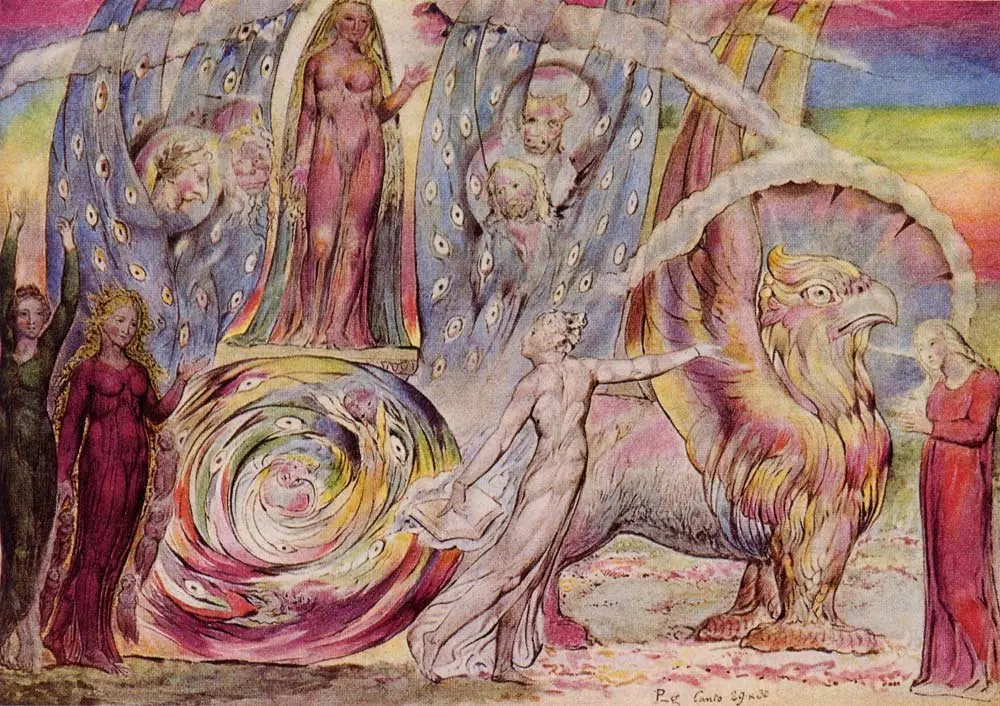 Beatrice Addressing Dante from the Car
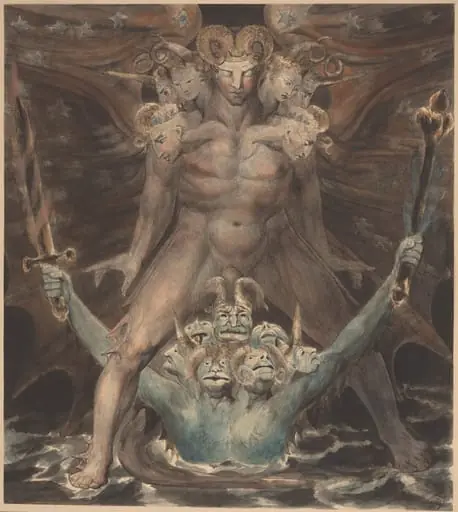
 The Great Red Dragon and the Woman Clothed with the Sun
 Satan Smiting Job with Sore Boils
 The Fall of Man (after Raphael)
 Eva cogiendo la manzana
 Saint Michael Archangel attacking the dragon
 Herakles erlegt den Adler des Prometheus
 Satan and Death with Sin Intervening
 The Freeing of Andromeda