Artwork
The Nativity
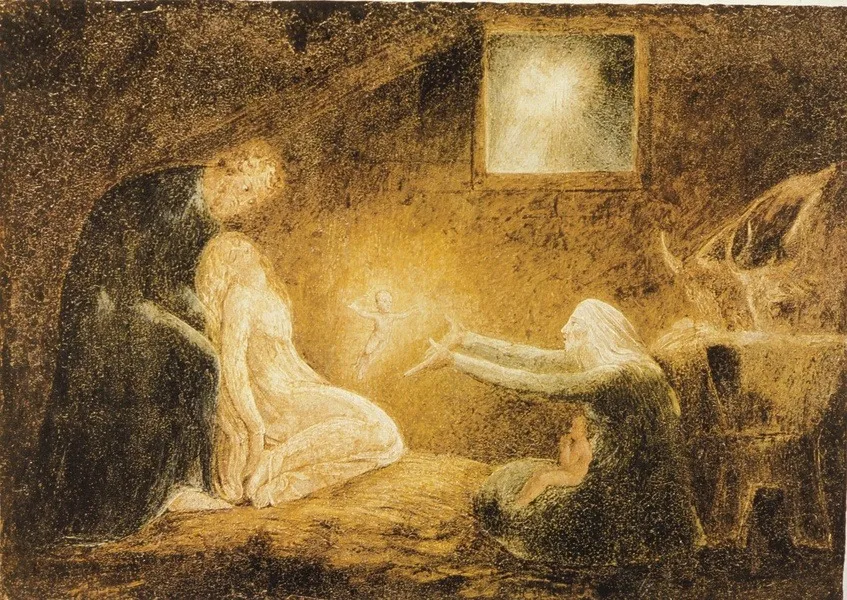
The Nativity is an unspecified painting by William Blake. It dates from 1796 and is held in the collection of the Philadelphia Museum of Art.
About this work
Overview
The painting is held in the collection of the Philadelphia Museum of Art in Philadelphia, Pennsylvania.
The Nativity is a religious painting by the English artist William Blake, created circa 1799 or 1800. Executed in tempera on a copper support, the work measures 27.3 by 38.2 centimeters. It forms part of a series of biblical illustrations that Blake produced for Thomas Butts, an important patron and a clerk in the War Office Department of Mustering. The painting is held in the collection of the Philadelphia Museum of Art in Philadelphia, Pennsylvania.
Subject & Meaning
The artwork depicts the nativity of Jesus, emphasizing the miraculous nature of the birth. Rather than a traditional stable scene, Blake presents a deeply intimate and mystical event. Joseph supports a swooning Mary, while the infant Jesus springs forth from her womb, hovering radiantly above the manger. He is received by Mary's cousin, Saint Elizabeth, who cradles her own child, John the Baptist, in her lap. The infant Jesus extends his arms outward, a gesture that prefigures his Crucifixion. A glowing cross appears in the window above, seemingly reflected by the light of the star of Bethlehem, further embedding themes of divine sacrifice and purity into the scene of birth.
Technique & Style
Blake applied tempera to a copper support, utilizing a limited palette dominated by warm browns, ochres, golden yellows, blues, and creams. The surface reveals a granular, textured brushwork that imparts a dreamlike, ethereal quality to the shallow, compressed space. Light emanates from both the hovering infant and the square window above, casting diffuse illumination rather than sharp shadows. This prioritization of inner radiance over realistic optics aligns the work with Symbolism and Romanticism, focusing on individualism and mysticism. The figures are pressed closely together, and the floating Christ child appears more like a small man than a newborn, subverting naturalism to emphasize spiritual revelation over physical reality.
History & Provenance
Commissioned by Thomas Butts around 1799 or 1800, the painting was part of a larger series of biblical illustrations that Blake executed for his primary patron. The work remained unmentioned in the immediate sources regarding its later ownership chain before entering the collection of the Philadelphia Museum of Art, where it is currently housed and accessible under object number 59857.
Context
Blake created this work during a period when he was deeply engaged with biblical imagery, despite his well-documented wariness of the established church. His artistic foundation relied heavily on copying drawings by Renaissance masters such as Raphael and Michelangelo, fusing classical technique with his own mystical theology. By the late eighteenth century, Blake's art had fully embraced the values of Romanticism, prioritizing imagination over the optical realism championed by earlier movements. His unique visionary perspective, informed by a lifelong claim to spiritual encounters, allowed him to approach traditional religious narratives with profound emotional intimacy and subjective symbolism.
Artist & collection
Artist
William Blake (28 November 1757 – 12 August 1827) was an English poet, painter and printmaker.

![Dream of Thiralatha [from "America," cancelled plate d], by William Blake](https://artifactworldgallery.com/img/william-blake--dream-of-thiralatha-from-america-cancelled-plate-d--5757b22438efa26a-w320.webp)