Artwork
Our Lady with the Infant Jesus riding on a Lamb
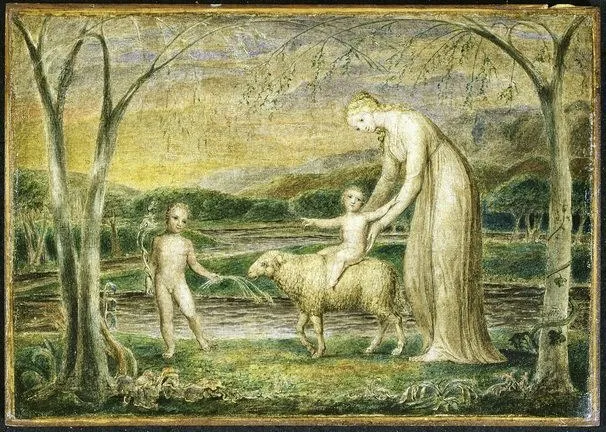
Our Lady with the Infant Jesus riding on a Lamb is an ink painting by the British Romanticist artist William Blake. It dates from 1800 and is held in the collection of the Victoria and Albert Museum.
About this work
Overview
Our Lady with the Infant Jesus Riding on a Lamb with St John is a tempera and pen painting on canvas by the English artist and poet William Blake, dated 1800.
Our Lady with the Infant Jesus Riding on a Lamb with St John is a tempera and pen painting on canvas by the English artist and poet William Blake, dated 1800. Measuring 27.3 by 38.7 cm, the work depicts the Virgin Mary steadying the Christ Child as he sits upon a lamb, while the youthful Saint John the Baptist stands nearby holding leafy branches. The painting is held in the Victoria and Albert Museum, London, under accession number P.26-1953, having been purchased by the museum in 1953. It is one of numerous works Blake produced for his principal patron, the clerk Thomas Butts, and exemplifies Blake's distinctive fusion of religious devotion with pastoral symbolism during a pivotal period of his career.
Subject & Meaning
The subject belongs to the tradition of the Virgin and Child with the youthful Saint John the Baptist, a theme that first emerged in the 1470s. Blake's composition presents a tall woman in a long pale gown standing beside a lamb, supporting a naked infant seated on the animal's back. To the left, a small naked child, identified as Saint John, holds leafy branches toward the lamb. The scene unfolds in a landscape framed by two slender trees with drooping branches, with a river curving through flat green land toward distant hills. The lamb carries layered significance: it evokes the paschal lamb of Israel sacrificed for Israel's deliverance, and more centrally, Christ as the Lamb of God who takes away the sins of the world. By placing the infant Christ upon the lamb, Blake invests the pastoral scene with prefigurative meaning, symbolizing Jesus's later sacrifice. The youthful Saint John's presence reinforces the theme of childhood innocence that Blake consistently associated with authentic spiritual states.
Technique & Style
The medium is tempera and pen on canvas, a combination that allows for both linear precision and matte, luminous color. The palette is muted, consisting of soft greens, yellows, and pale tones with darker tree trunks against a yellow-gray sky. The surface shows fine linear brushwork and a dry, delicate finish with visible texture throughout. Light appears diffused, with soft shadows beneath the figures. Small plants and grasses fill the foreground, contributing to the intimate scale and pastoral atmosphere. The handling demonstrates Blake's characteristic linear clarity and flattened composition, with bold outlines creating a visionary quality that transcends conventional religious illustration. The overall effect is one of quiet luminosity, the tempera medium permitting a matte, almost fresco-like surface that enhances the ethereal quality of the scene.
History & Provenance
The painting was created in 1800 as one of many works Blake produced for Thomas Butts, his principal patron. The provenance traces from Thomas Butts to his son Thomas Butts junior, then to Sir William Stirling Maxwell, followed by General Archibald Stirling. It was subsequently sold to the Victoria and Albert Museum by Lt.-Col. William Stirling of Kier. The museum acquired the painting by purchase in 1953, assigning it accession number P.26-1953. No exhibition history is recorded in the available sources.
Context
Blake's personal religious symbolism consistently found in childhood innocence and natural simplicity the authentic spiritual state from which adult experience of the world was a fall. This painting emerges from that philosophical framework, combining the holy family tradition with pastoral symbolism in a manner characteristic of Blake's visionary approach. The work belongs to a period when Blake was producing numerous paintings for Thomas Butts, creating a substantial body of religious imagery that sustained him financially while allowing him to explore his idiosyncratic theological ideas. The subject's roots in fifteenth-century Italian art demonstrate Blake's engagement with Renaissance traditions, even as his treatment transforms them through his distinctive aesthetic.
Legacy
The painting remains in the collection of the Victoria and Albert Museum, accessible to scholars and the public as a representative example of Blake's small-scale religious temperas. Its acquisition by a major national museum in 1953 secured its place within the institutional framework of British art history. The work continues to be reproduced and studied as part of Blake's broader exploration of Christian iconography through the lens of his personal mythology.
Artist & collection
Artist
William Blake (28 November 1757 – 12 August 1827) was an English poet, painter and printmaker.

 Allegory of Life
 Venus and Cupid in a Landscape
 Hagar and the Angel in the Desert
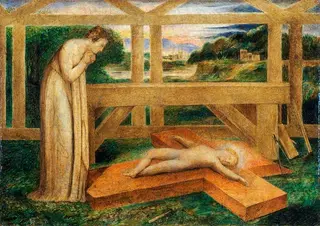
 The Christ Child asleep on a cross
 Actaeon Watching Diana and her Nymphs Bathing
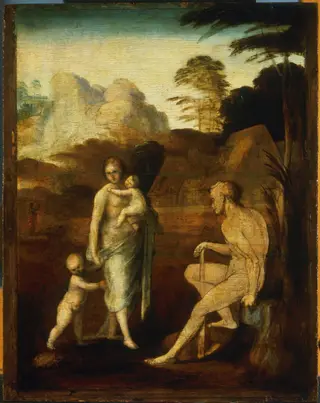 Adam and Eve with Cain and Abel
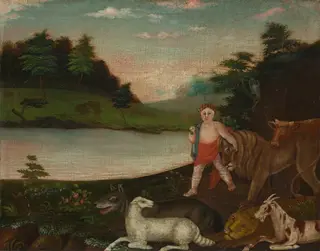 The Peaceable Kingdom
![Dream of Thiralatha [from "America," cancelled plate d], by William Blake](https://artifactworldgallery.com/img/william-blake--dream-of-thiralatha-from-america-cancelled-plate-d--5757b22438efa26a-w320.webp) Dream of Thiralatha [from "America," cancelled plate d]
Dream of Thiralatha [from "America," cancelled plate d]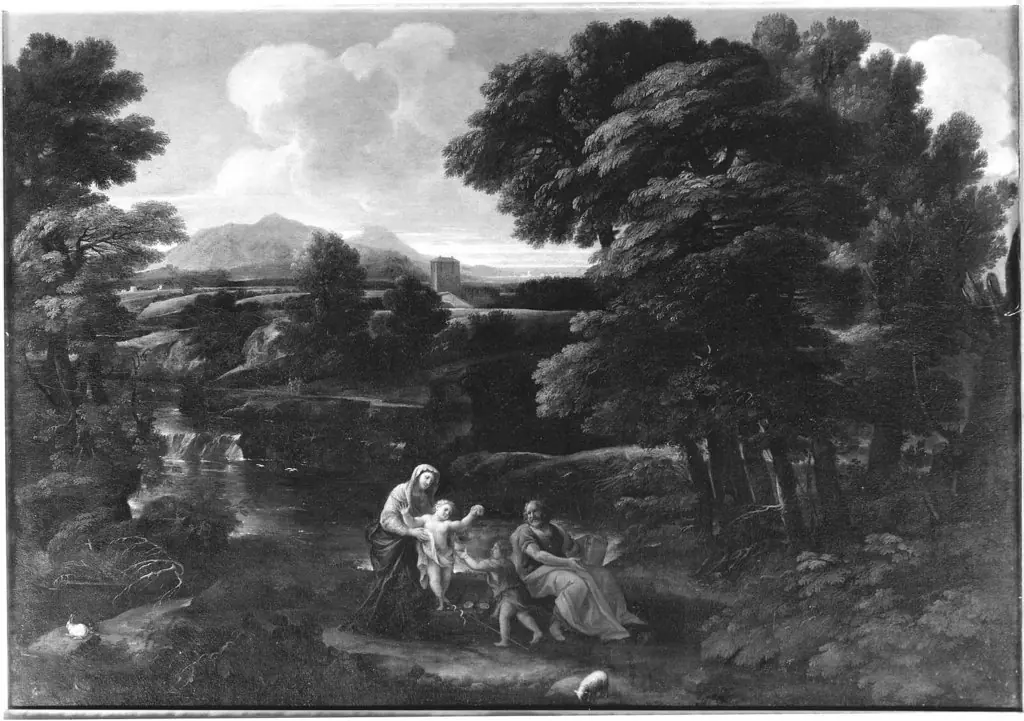 Landscape with the Holy Family and the Infant Saint John the Baptist
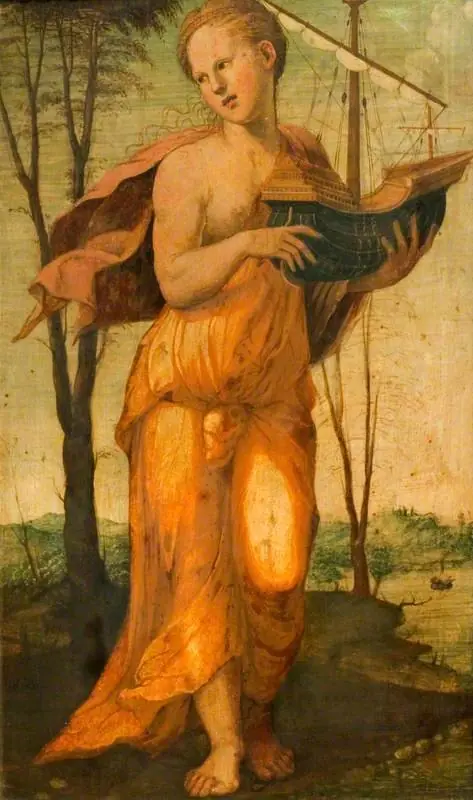 Confidence
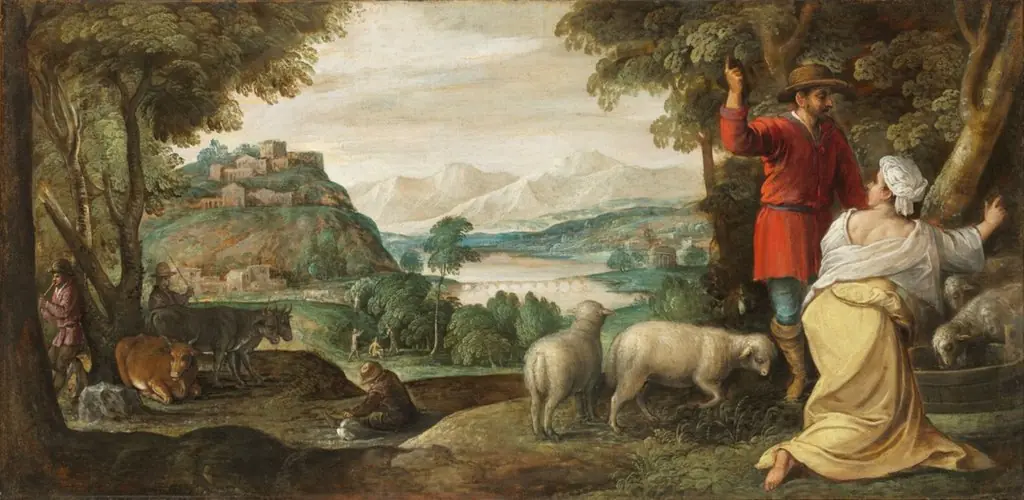 Jacob meeting Rachel at the Well
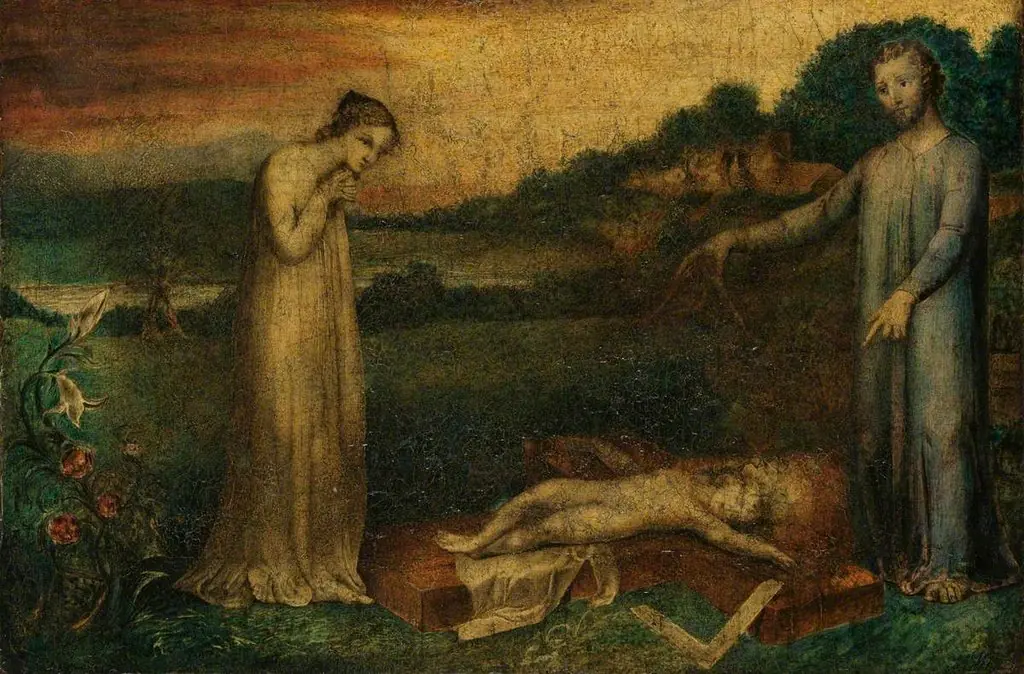
- The Christ Child Asleep on the Cross (Our Lady Adoring the Infant Jesus Asleep on the Cross)