Artwork
Girgenti (The Temple of Juno Lacinia at Agrigentum)
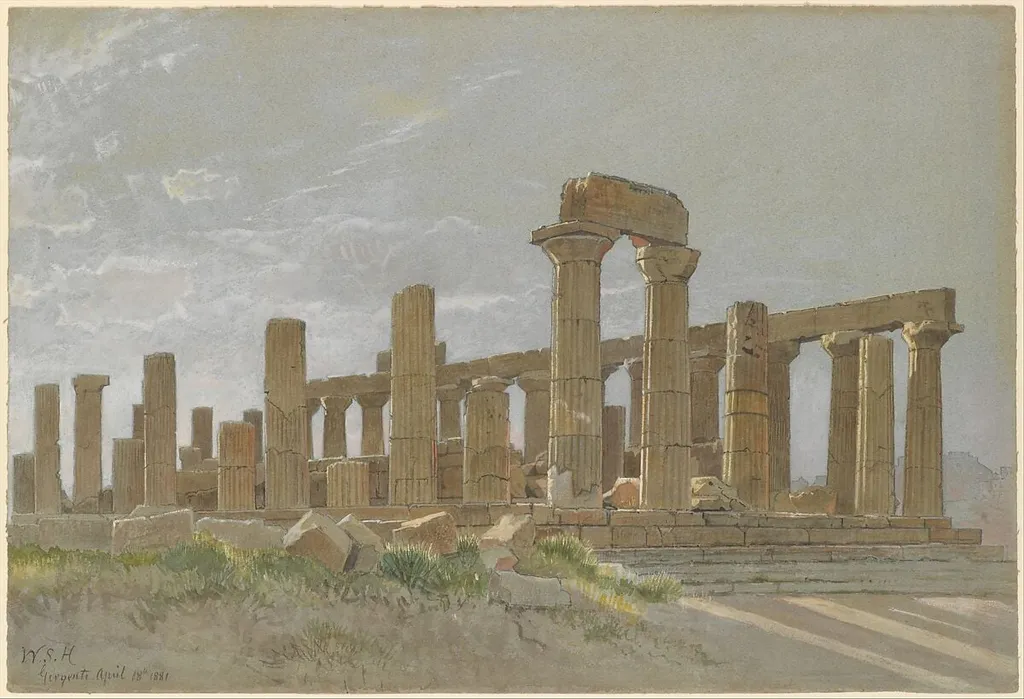
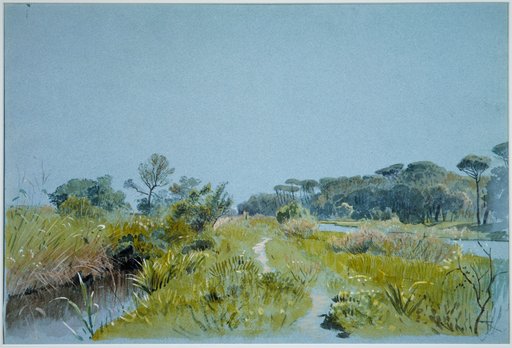
Girgenti (The Temple of Juno Lacinia at Agrigentum) is a watercolor work on paper by the American Impressionist artist William Stanley Haseltine. It dates from 1881 and is held in the collection of the Metropolitan Museum of Art.
- Accession no.
- 1994.502
- Credit line
- John Osgood and Elizabeth Amis Cameron Blanchard Memorial Fund, 1994
About this work
Subject & Meaning
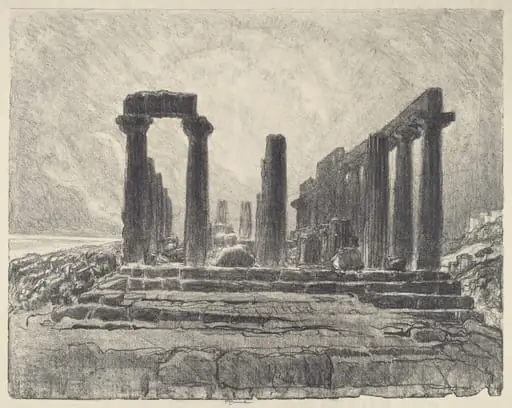
William Stanley Haseltine's 1881 work depicts the ruins of the Temple of Juno Lacinia located at Agrigentum, historically known as Girgenti.
William Stanley Haseltine's 1881 work depicts the ruins of the Temple of Juno Lacinia located at Agrigentum, historically known as Girgenti. The composition focuses on the architectural remnants of this ancient site, presenting them within a landscape setting. By rendering the dilapidated structure on blue paper using watercolor, gouache, and graphite, the artist captures the enduring presence of classical antiquity amidst its natural surroundings.
The subject matter serves as a direct representation of historical decay and the passage of time, characteristic of landscape studies from this period that prioritized the documentation of significant archaeological sites.
Technique & Style
Executed in 1881, this landscape depicts ancient ruins using a mixed-media approach on blue paper. Haseltine combined watercolor and gouache with graphite to construct the image, leveraging the toned support to unify the composition. The application of opaque gouache alongside transparent washes allows for varied handling of light and texture across the architectural forms.
The work measures 38.1 cm in height and 55.6 cm in width. The selection of blue paper as the ground suggests an intentional strategy to modulate the atmospheric quality of the scene, while the graphite underdrawing provides structural definition for the depicted temple remains.
History & Provenance
William Stanley Haseltine created this watercolor, gouache, and graphite work in 1881. It was produced as a landscape depiction of the Temple of Juno Lacinia at Agrigentum in Sicily and is classified within The American Wing at the Metropolitan Museum of Art. The piece entered the museum's collection through a documented acquisition and has remained part of its permanent holdings since inception.
The artwork measures 38.1 cm in height by 55.6 cm in width and portrays classical ruins characteristic of 19th-century American landscape painting. Its creation reflects Haseltine's detailed approach to architectural and natural scenery, aligning with the stylistic trends of the American Hudson River School. The work has been exhibited as part of The American Wing's collection presentation, underscoring its significance in the narrative of American art history.
The watercolor painting Girgenti (The Temple of Juno Lacinia at Agrigentum) is held by The Metropolitan Museum of Art, New York, where it is catalogued as part of the institution’s holdings.
It has no recorded exhibition history in the provided sources.
Overview
William Stanley Haseltine’s 1881 watercolor, titled Girgenti (The Temple of Juno Lacinia at Agrigentum), presents a tranquil view of an ancient stone temple set upon a Sicilian hill. Rendered on blue paper with watercolor, gouache, and graphite, the composition balances muted blues, grays, and subtle greens, emphasizing the quiet atmosphere of the ruin under a pale sky.
Artist & collection
Artist
William Stanley Haseltine was born on June 11, 1835, in Philadelphia to John Haseltine, a successful businessman, and Elizabeth Shinn Haseltine, an amateur landscape painter.