Artwork
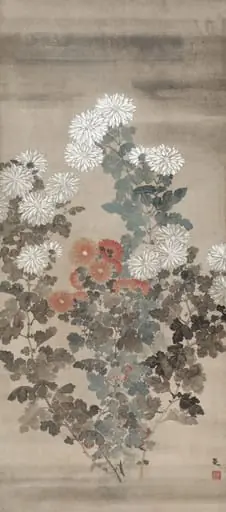
明/清 項聖謨 白菊圖 軸|White Chrysanthemums
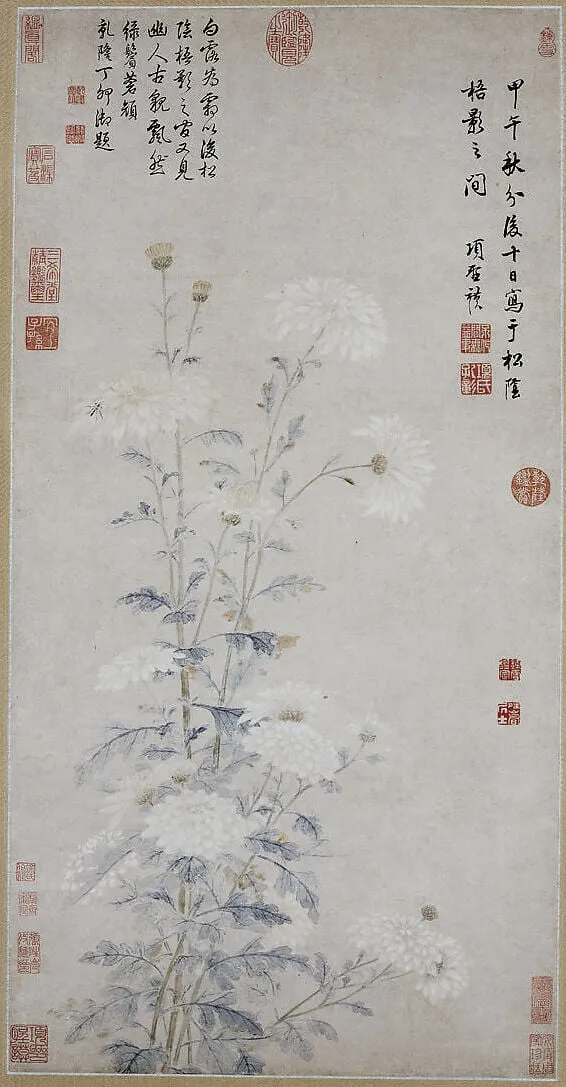
明/清 項聖謨 白菊圖 軸|White Chrysanthemums is a paint painting by the Baroque artist Xiang Shengmo. It dates from 1654 and is held in the collection of the Metropolitan Museum of Art.
About this work
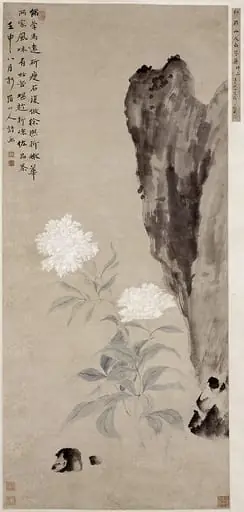
A tall scroll shows white chrysanthemums bending in a breeze. Dark stems and leaves fill the bottom; pale blooms float above like clouds.
Xiang Shengmo painted this in 1654, right after the Ming dynasty fell. The flowers look calm, but the empty space around them feels heavy, maybe a quiet protest.
To see how other Chinese artists painted flowers, look up flowers, china, flower.
Subject & Meaning
Chrysanthemums held symbolic importance in Chinese culture, often representing autumn, longevity, and resilience.
The painting depicts white chrysanthemums, rendered in delicate ink and color on a hanging scroll. Chrysanthemums held symbolic importance in Chinese culture, often representing autumn, longevity, and resilience.
In the context of seventeenth-century Chinese painting, the choice of white blossoms further emphasized purity and steadfastness, qualities aligned with literati ideals. The work’s title, White Chrysanthemums, directly identifies the subject, underscoring the artist’s focus on a single floral motif rather than a broader seasonal composition.
Technique & Style
Created in 1654, White Chrysanthemums is executed as a hanging scroll using color on paper. The work is classified within the still-life genre and focuses on the depiction of flowers. As a product of 17th-century China, the piece demonstrates the artist's handling of pigment on a paper support, presented in a vertical scroll format typical of the period. The formal presentation emphasizes the botanical subject through the application of color on the paper medium.
History & Provenance
The work titled White Chrysanthemums is a hanging scroll painted in color on paper by the Chinese artist Xiang Shengmo in 1654. It belongs to the still‑life genre and represents a flower. The painting was created in China and subsequently entered the collection of the Metropolitan Museum of Art, where it is catalogued as part of the museum's holdings. No further details about its commission or earlier owners are recorded in the available documentation.
The work titled White Chrysanthemums, also known as 明/清 項聖謨 白菊圖 軸, is a hanging scroll painted in 1654 by Xiang Shengmo. It is classified as a still‑life painting and is part of the Metropolitan Museum of Art’s collection in New York.
The catalog entries do not provide an explicit inventory or accession number, nor do they list any exhibition history for the piece. Consequently, its provenance beyond the museum’s ownership remains unspecified in the available sources.
Context
Xiang Shengmo created the hanging scroll White Chrysanthemums in 1654, employing color on paper to depict a cluster of white chrysanthemums; the work is classified as a still‑life painting and features a flower motif. The scroll entered the Metropolitan Museum of Art collection, recorded as originating in China, and is dated to 1654. As part of Qing‑era Chinese flower painting, it exemplifies the refined treatment of botanical subjects within the still‑life genre, reflecting broader artistic trends of the period. Its presence in a major museum highlights its significance within the historical trajectory of Chinese art.
Overview
Painted in 1654 by Xiang Shengmo (1597–1658), White Chrysanthemums is a hanging scroll executed in color on paper. The composition features a cluster of white chrysanthemums rising from dark, sturdy stems and leaves at the bottom, with the pale blooms extending upward into a vast expanse of empty space. Xiang, a member of the prominent Xiang family of Huzhou and a direct descendant of the Ming imperial lineage, created this work shortly after the fall of the Ming dynasty and the establishment of the Qing regime.
In the context of his career, the painting reflects his adherence to literati traditions while expressing the political and emotional turmoil of the dynastic transition. The white chrysanthemum, a symbol of purity and reclusion, is rendered with precise brushwork that balances realistic observation with expressive restraint. The heavy use of negative space surrounding the flowers is often interpreted by art historians as a visual metaphor for the artist's loyalty to the fallen Ming court and his refusal to serve the new Qing rulers.
This work stands as a significant example of late Ming-early Qing painting, where botanical subjects frequently carried coded political meanings regarding integrity and resistance.
Artist & collection