
Movement
Hard Edge
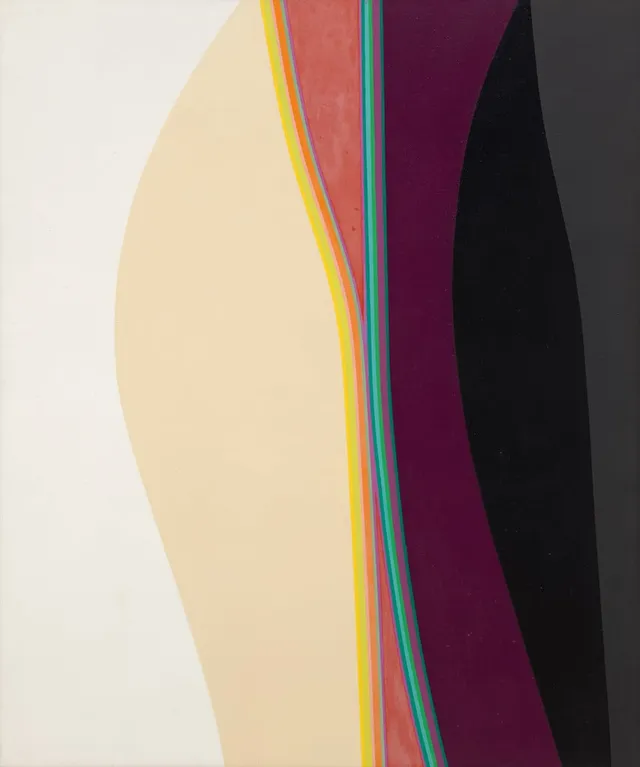
Hard Edge is an art movement of the 1950–1970 period. The gallery holds 1 work in this movement, including works by Lorser Feitelson. Browse Hard Edge paintings, portraits, pictures and artworks from the world's public-domain museum collections.
Hard-edge painting is the term for a strain of geometric abstraction that crystallized in the United States around 1959, most decisively in Southern California. The phrase was coined by the Los Angeles critic Jules Langsner to describe a new, deliberately cool form of abstract art that turned away from the gestural heat of Abstract Expressionism, then dominant in New York. Where the Abstract Expressionists prized energetic brushwork, subjectivity, and raw emotion, Langsner saw a younger tendency that was clean, precise, and impersonal—a "classical" rather than "romantic" temperament. He gave it form in the landmark 1959 exhibition Four Abstract Classicists at the Los Angeles County Museum, which paired Lorser Feitelson (1898–1978) with John McLaughlin (1898–1976), Frederick Hammersley (1919–2009), and Karl Benjamin (1925–2012). When the show traveled to the Institute of Contemporary Arts in London, the British critic Lawrence Alloway renamed it "West Coast Hard-Edge," and the label "hard-edge" stuck.
Visually, the style is defined by abrupt, knife-clean transitions between flat areas of unmodulated color, often achieved with masking tape to produce edges with no painterly feathering. Alloway summarized its values as "economy of form," "fullness of color," "neatness of surface," and a non-relational, allover arrangement of shapes across the canvas. The picture plane is emphatically flat; brushstrokes, texture, and any trace of the artist's hand are suppressed in favor of an anonymous, almost industrial finish. Form and hue are reduced to their essentials, so that a few crisp shapes and saturated colors carry the entire pictorial argument.
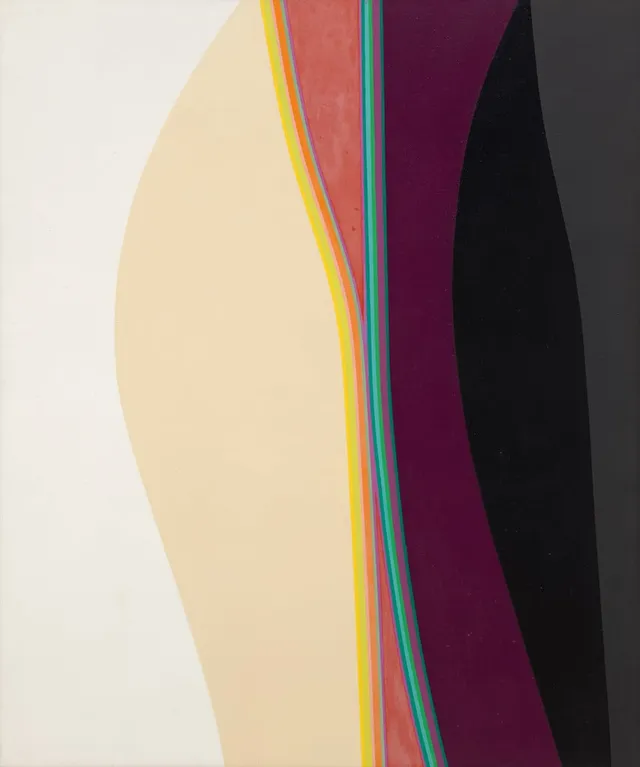
Though born on the West Coast, hard-edge quickly became a national vocabulary. East Coast painters such as Ellsworth Kelly, Kenneth Noland, Frank Stella, Ad Reinhardt, Al Held, and Jack Youngerman pursued parallel ambitions—flat expanses of color, clean boundaries, and rejection of gestural mark-making. Feitelson, represented in our collection by his Untitled, exemplifies the movement's economy: a few taut shapes set against open ground.
Hard-edge painting belongs to a broader 1960s reordering of abstraction and is closely bound to its neighbors. Tate describes it as a subdivision of post-painterly abstraction that evolved out of [Color Field](color_field) painting, while drawing on the earlier geometric rigor of Mondrian and Josef Albers. Its disciplined clarity also fed Op art and Minimalism, leaving a lasting imprint on later abstraction.
Key artists
Works
Frequently asked questions
What is Hard Edge?
Hard Edge is an art movement. A 1960s strand of abstraction defined by crisp boundaries between flat areas of color.
Who are the key Hard Edge artists?
Key Hard Edge artists in the collection include Lorser Feitelson.
When did Hard Edge take place?
Hard Edge dates from 1950–1970.
Where can I see Hard Edge works?
Hard Edge works in the collection are held by Museum of Modern Art.