Eighteenth-century painting was an export business before it was anything else. The styles we now file under the century were worked out in a few square miles of Paris and a handful of Italian workshops, then carried outward by dealers, traveling specialists, princesses married across borders, and cheap reproductive engravings. Not one of them arrived anywhere unchanged. A French manner built for the panelled salon of a Paris townhouse meant something different by the time it reached a Venetian quayside, a Dutch parlour, a London drawing room, or a clapboard parlor in Vermont. The interesting question about the 1700s is not what the new style looked like at its source. It is what happened to it in transit.
So here is the argument this essay will carry work by work: the most revealing pictures of the century are the ones caught mid-translation, where an imported manner collides with a local purpose and bends. The Rococo curve that signals erotic leisure in François Boucher becomes, a thousand miles away, a tool for recording who owns the farm. Artifact World Gallery holds 21,644 works dated to this century, spread across 156 venues and made by some 3,603 named hands, clustered between 1700 and 1799. That is a sample wide enough to watch one style change its accent every time it crosses a frontier, and that drift, not the Paris original, is the real subject of 18th-century art.
A style that began as an insult
The Rococo did not announce itself. It crept in after 1715, in the slack years following the death of Louis XIV, when the court loosened its grip and aristocratic life moved out of the vast state rooms of Versailles into smaller, warmer, more private Paris interiors. The style took its cues from those rooms: light, sensuous, packed with ornament, built around asymmetrical shell and rock forms. The word comes from rocaille, the French term for the rock-and-shell encrustation of garden grottoes, and the manner grew up in conscious retreat from the heavy ceremonial grandeur of the old reign, according to the Tate's account of the term. The shell gave the style its line. Everything curves, nothing sits square, and the eye is kept moving.
The name was a slur before it was a category. It was reportedly coined in the 1790s by a student in Jacques-Louis David's studio, the term aimed backward at the frivolous art made under Louis XV, as Smarthistory notes in its primer on the style. That hostility matters to the travel story. By the time the word existed, the thing it described had already spread across the Continent and started to mutate. The insult was coined by people who wanted it dead. It survived because it had escaped Paris long before, riding a distribution system the previous century never had.
That system had a public face. The first formal Salon opened at the Louvre on 18 August 1737, in rooms that had hosted exhibitions on and off since 1667, and from then the Academy showed to a paying crowd on a regular cadence. The Salon turned painting into something reviewed, argued over, and reported. It set the standard that provincial and foreign painters then measured themselves against from a distance, often through prints, rarely in front of the canvases themselves. Reputation could now travel faster than any single picture.
Boucher, and the engraving that did the traveling
If one hand fixed the mature Rococo and shipped it outward, it was Boucher's. The Metropolitan Museum names him as the painter most responsible for the formulation of the developed style and its spread throughout Europe, in its Heilbrunn essay on the artist. Boucher gave the manner its repertory: rosy nudes, plump cupids, pastoral shepherds who never sweat, a palette of cream, sky-blue, and shell-pink. With 144 works under his name in this collection, he is one of the densest single presences in the century's holdings, and that density is the point. Boucher was an industry. Cartoons for the looms, stage designs, porcelain models, and above all engravings carried his inventions far past the people who could afford an original.
This is the mechanism of transit worth pausing on. A provincial painter in Naples or Philadelphia rarely saw a Boucher canvas. He saw a black-and-white print after one, and from that print he reconstructed a style with the color guessed, the scale guessed, the touch invented from scratch. The Rococo that reached the edges of Europe and the colonies was a copy of a copy, translated through the burin of an engraver and the imagination of a local hand. Drift was built into the supply chain. A style defined by its color and its feathery brushwork was distributed mainly in a medium that had neither.
The page held a hair too forward
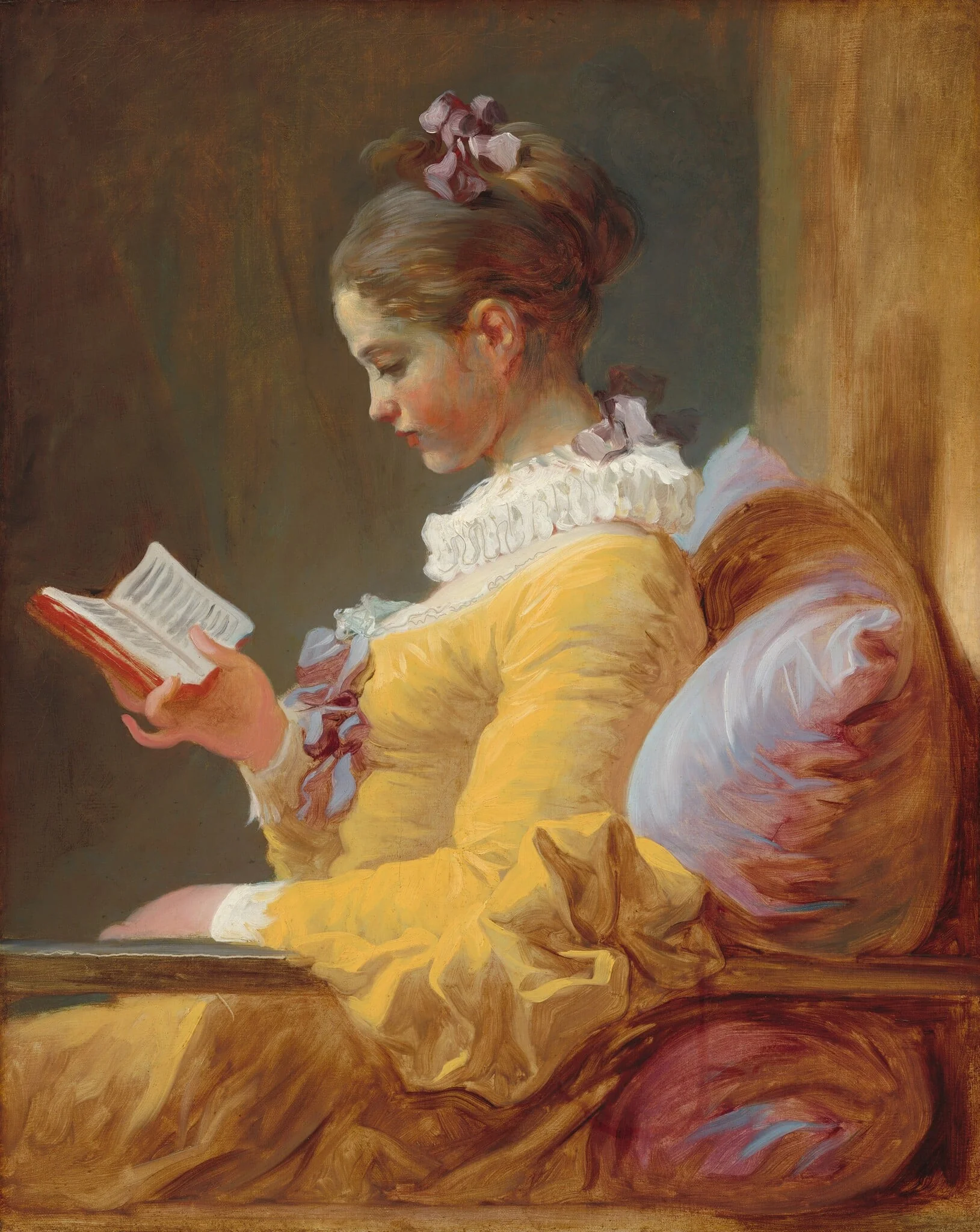
Look hard at Young Girl Reading by Jean Honoré Fragonard, because it shows what the engraving could never carry. The girl sits in strict profile, turned to our right, propped against a great soft cushion the color of dust. Her dress is a single lemon-yellow flare, and Fragonard has built it not from drawing but from paint laid on wet and fast: the white ruff at her cuff is three or four loaded strokes, the collar a flick, the ribbon at her throat a tiny violet knot dropped in last. She holds a small book delicately, between fingertips, lifted just clear of her lap. The book is tipped up toward us a fraction more than a real reader would tip it, so that the page catches the light and the gesture stays legible. That small lie is the whole picture. He is not recording a girl reading. He is composing the idea of unbothered leisure into a shape the eye can take in at one glance.
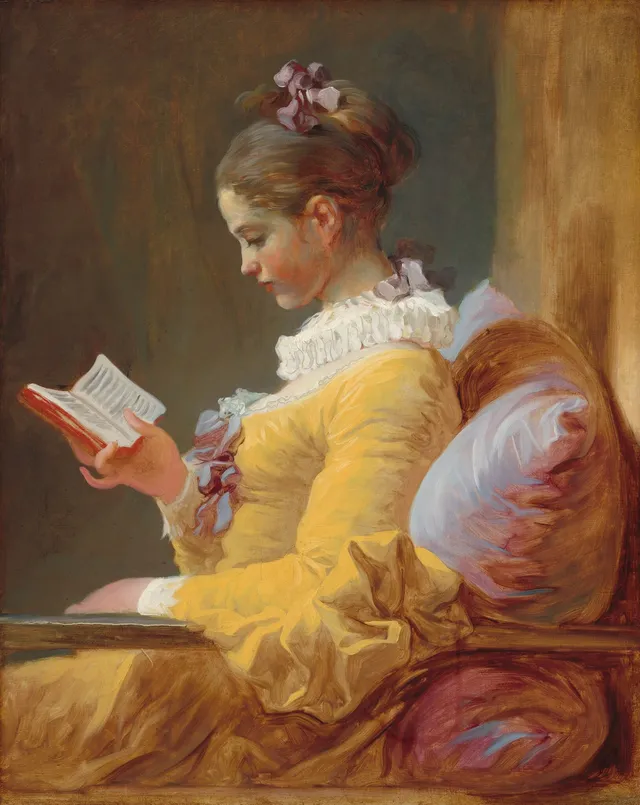
Now imagine that picture reduced to an engraved line. The yellow goes grey, the speed of the brush flattens into careful cross-hatching, and what survives is only the pose: a young woman reading, decorous, contained. That surviving residue, the pose stripped of its color and its bravura, is exactly what reached painters abroad. They received the grammar of the Rococo without its native music, and so they filled the silence with their own. Fragonard's 127 works in this collection let you see how loose and how confident the French original could be. The foreign variants almost always tighten.
Venice sells the view back to the visitor
Italy did not import the Rococo so much as run a parallel export of its own. The Grand Tour had made Venice a destination, and the city learned to manufacture its own image for departing Englishmen to carry home. The view painting, the veduta, was a souvenir before it was a genre. Procession of Gondolas in the Bacino di San Marco by Antonio Joli is one of these machines for memory. The water fills the lower third in long horizontal bands, the gondolas strung across it in a dark dotted line; behind them the Doge's Palace and the Salute hold the horizon in even, sunlit order. Joli was a stage-set painter by training, and it shows in the way the architecture is racked back like flats, each plane parallel to the picture surface, the perspective clean to the point of being a diagram.
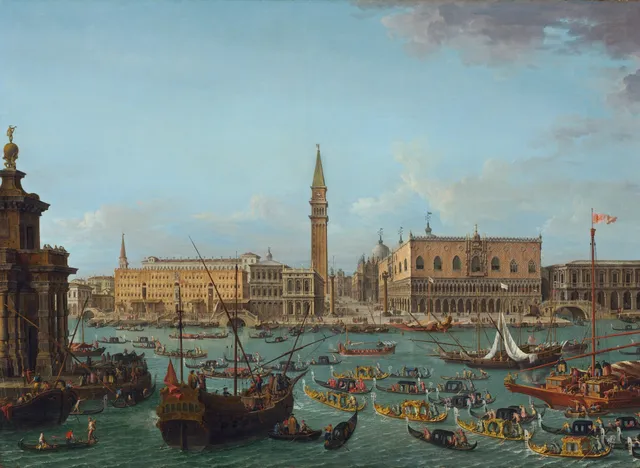
Here transit runs the other way. The picture was made in Venice to be shipped to England, designed from the start to read on a London wall as proof of a journey taken. The Venetian veduta is a Rococo cousin in its lightness and its love of sparkle, but its purpose is documentary, even commercial. Joli, who worked in Madrid, Naples, and London as well as Venice, is himself a small map of the century's mobility, with eight works here tracing a career that never stayed in one capital. The lesson holds: a style on the move acquires a job. In Paris the manner served pleasure. On the lagoon it served the tourist trade.
The Dutch keep it indoors
The Dutch Republic had no court to set fashion and no Versailles to react against, so the French style landed there with its social engine removed. What the Netherlands took instead was the intimacy and the small scale, and it bent them toward the conversation piece, the modest group portrait of a family at ease in its own rooms. Cornelis Troost built his reputation on exactly this: intimate family portraits and comic scenes drawn from the stage, work that made him one of the most important Dutch painters of the century, as the Rijksmuseum tells his story. The French curve is there, but it has been put to work describing real people in real parlours rather than shepherds in an imaginary Arcadia.
Older Dutch habits persisted underneath, and you can feel them in a stranger holdover like The Ark by Lodewijk Tieling, a painter so obscure that only this single work survives in the collection, his activity placed around the turn of the century. A biblical animal scene of this kind belongs to a seventeenth-century lineage, not a Parisian one. It is a useful reminder that the century was never a clean sweep. In the provinces, the imported Rococo did not replace local traditions. It layered over them, and often the older grain showed straight through the new finish.
London turns the family into a stage
Cross the Channel and the conversation piece changes character again. The English took the same small group portrait the Dutch favored and gave it a theatrical openness, setting the family outdoors in a managed landscape that doubled as a statement of property. The Saithwaite Family by Francis Wheatley is the type at its most genial. The figures are arranged across a parkland setting with the easy spacing of actors who know where the audience sits, the costume rendered crisply, the whole scene lit with the even daylight the English preferred to French candle-glow. Wheatley, with fifteen works here, worked this seam of polite outdoor portraiture for a clientele that wanted to be shown both affectionate and landed.
The contrast with Fragonard is the argument in miniature. Fragonard dissolves a single figure into atmosphere and paint for the pleasure of the dissolution. Wheatley assembles a whole family into a clear, countable, sober group, because the picture has a civic job to do. It must testify to the standing of the people in it. The same century, the same broad lineage of style, two opposite ideas of what a painting is for. One performs leisure. The other notarizes status.
The colonial ledger
At the far end of the supply line stood the American colonies, where the style arrived last, thinnest, and most transformed. Mrs. Noah Smith and Her Children by Ralph Earl shows the European group portrait rebuilt by a painter working for Connecticut and Vermont families who had never seen a Salon. Earl gives Mrs. Smith and her children a frank, planar clarity. The faces are firmly drawn, the fabrics described thread by thread, the room laid out with a flat-footed honesty that owes nothing to French softness. There is no atmosphere to speak of, and that absence is not failure. It is a different aesthetic, plainer, harder, more interested in the fact of the sitter than in the flattery of the light.
Earl, with fifteen works in the collection, had in fact trained partly in London, which makes the plainness a choice as much as a limitation. He fitted the imported manner to a Yankee sense of what a portrait owed its subject: an accurate, durable record. The anonymous Domestic Scene in the holdings, an unattributed everyday interior of the period, makes the same point from below the level of the named masters. The century's appetite for ordinary domestic life had filtered down to hands history did not bother to record, and it kept its shape there even when the signature was lost. By the time the style reached the edges of its reach, it had shed nearly everything Parisian except the basic premise: that ordinary people, at home, were worth painting.
Works discussed in this article
The turn against the curve
The Rococo's own children killed it, and they did so with an argument as much as a brush. By mid-century a counter-style was forming around the recovery of antiquity and the cool, straight-edged authority of Greece and Rome. The Neoclassical reaction was not only a matter of taste. It ran alongside the Enlightenment, a separate movement that kept crossing paths with it, the painting serving as a visible form of the philosophy being written down in the same decades. That entanglement is set out in the J. Paul Getty Museum's teaching material on the subject. Where the Rococo curved, the new manner straightened. Where it flirted, the new manner moralized.
Theory hardened too. In London, Sir Joshua Reynolds, founding president of the Royal Academy, delivered his Discourses on Art as annual lectures to its students, laying down a standard for the grand manner that treated painting as an intellectual discipline answerable to the antique. Reynolds preached idealization and the study of the old masters, and his lectures became one of the century's foundational statements of academic doctrine. The argument over what painting should be had become as transportable as the pictures, carried in printed lectures and pattern books to anyone, anywhere, who could read.
Set the works side by side and the century stops looking like a single style and starts looking like a relay. Fragonard's loaded yellow, Joli's racked palaces, Troost's parlours, Wheatley's parkland, Earl's plain Connecticut faces: each is the same broad current bent by the place it ran through. The thing that traveled was never the look. It was a set of premises about intimacy, about leisure, about whose private life deserved a frame, and those premises survived translation even when the brushwork did not. That is why a painting made in Vermont and a painting made on the Seine can both belong to the 1700s without resembling each other at all.
If you want to test the claim yourself, the holdings make it easy. The collection's coverage of the eighteenth century is dense enough at its 21,644 works to line up a Boucher pastoral, a Venetian view, a Dutch family group, and a colonial portrait on one screen and read the drift between them directly. Start with Fragonard's yellow dress, then walk it outward across the borders. The century is most itself in the gap between the source and the copy that did not quite obey.
Sources & further reading
- Rococo, Art Term — Tate
- A beginner's guide to Rococo art — Smarthistory
- François Boucher (1703-1770) — The Metropolitan Museum of Art, Heilbrunn Timeline of Art History
- Cornelis Troost — Rijksmuseum
- Salon of 1737 — Wikipedia
- Neoclassicism and the Enlightenment — The J. Paul Getty Museum
- Sir Joshua Reynolds: Discourses on Art (1891 ed.) — Internet Archive
- The Age of Watteau, Chardin, and Fragonard — National Gallery of Art