The figure a movement uses to pick a fight
Look at enough angels across the long arc of Western painting and a pattern surfaces that has little to do with devotion. The angel as a subject in art is the place a movement goes to argue with the movement it is trying to replace. No painter has ever worked from a live angel, so the figure carries no obligation to a body in the room. It is built entirely out of convention, which means it can be rebuilt entirely out of convention, and nobody can stand in front of the new version and say it looks wrong. That freedom made the angel the safest place in the picture to stage a revolt. When a generation wanted to overturn what it had inherited, it tested the overturning here first.
My claim is narrow, and I will hold to it work by work: each major shift in European art settled its dispute with its predecessor on the body of the angel before it settled that dispute anywhere else. The early Christians stripped the messenger of his wings to keep him clear of a pagan victory-goddess. The Florentine fifteenth century handed the wings back and added a naked, kicking infant, announcing that antiquity was now an ally instead of a contamination. The Netherlandish masters buried the angel in brocade and gave it real weight, insisting the divine could be measured and counted. Then Édouard Manet painted an angel so plainly mortal that the Salon took it as a provocation. Lined up in order, these are not four styles. They are four rebuttals, and the angel is where each one is filed.
The first quarrel: wings or no wings
The argument begins before painting in the modern sense. The earliest known Christian image of an angel, in the Cubicolo dell'Annunziazione of Rome's Catacomb of Priscilla, around the middle of the third century, shows the messenger to Mary as an ordinary young man with no wings at all, according to the survey of angels in art. The wings arrive later, and they arrive borrowed. The first known winged angel sits carved on the so-called Prince's Sarcophagus, dated to the reign of the emperor Theodosius I near the end of the fourth century. The hesitation was deliberate. Wings belonged to Victory, the pagan Nike whose feathered figure crowded Roman triumphal sculpture, and to wing the angel was to risk confusing a servant of God with a goddess of conquest. When the church finally accepted the feathers, it was deciding how much of the classical past Christian art could take and still mean what it meant to mean.
That first negotiation, pagan form pressed into Christian content, is the template for everything that follows. The angel is never just drawn. It is always argued, and the terms of the argument are always the terms of whatever the previous generation took for granted.
The Quattrocento gives the wings back, and adds a child
Skip forward a thousand years to Florence in the 1420s. The classical winged infant, the putto, had effectively vanished from art across the Middle Ages, and its revival in the early Renaissance is generally credited to Donatello working in that decade, as the history of the putto records. This matters more than it sounds. The Gothic angel had been a tall, vertical, weightless herald, a sign pointed upward. To reintroduce a fat pagan baby into sacred imagery was to declare that the body, antiquity, and the world of flesh were no longer the enemies of faith but its raw material.
Donatello pressed the same point in his stone Cavalcanti Annunciation in Santa Croce, where Gabriel and the Virgin meet in high relief at the instant of the announcement, a relief Smarthistory reads as a turn toward classical poise and human gesture. The archangel kneels with the courtesy of a Roman orator. He has weight, contrapposto, a real spine. The Gothic herald had floated; Donatello's angel stands on the same ground the viewer does. The quarrel with the medieval past is fought, and won, in the carriage of a single figure.
The North weighs the angel down
The Netherlandish painters took the Florentine argument and answered it with a counter-argument of their own. Where Italy reached for classical lightness, the North reached for substance. An angel, to a Bruges master, had to be as densely real as a velvet cope or a brass candlestick, because the whole northern method was to make the sacred convincing by making it physical.
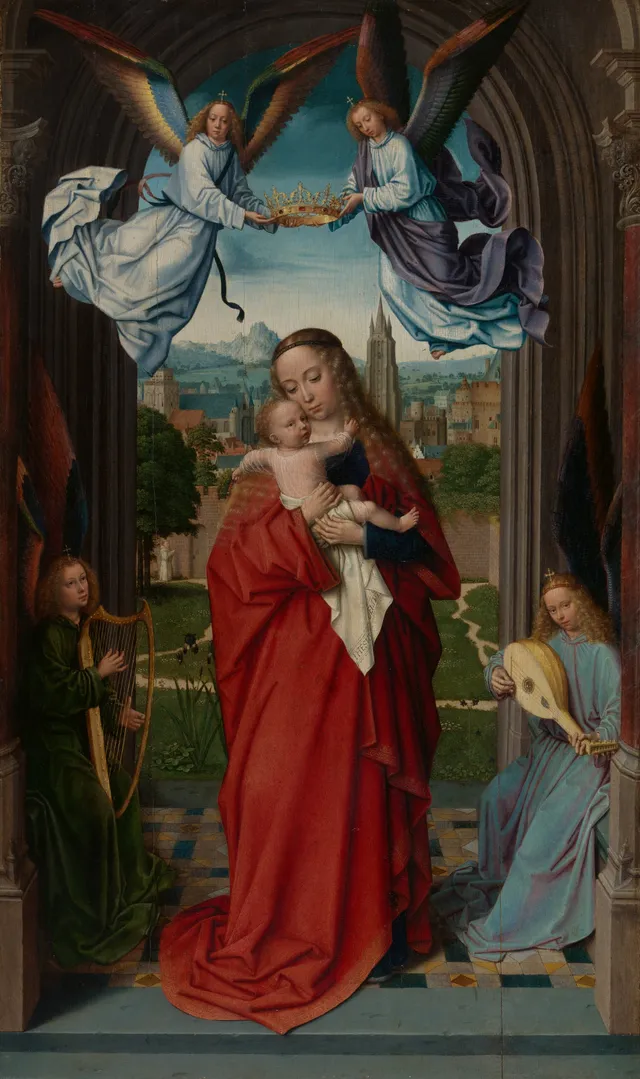
Gerard David gives the clearest case. Stand in front of his Virgin and Child with Four Angels and look at how the four are deployed. Two hover at the top of a stone arch, holding a jeweled crown over the Virgin's head, their wings spread but their hands doing the careful, two-fingered work of someone afraid to drop something heavy. The other two stand below at ground level, and they are not floating: one plays a lute, the other a small harp, and David has bothered to render the tension of the strings and the angle of the picking hand. Through the arch behind them, a Flemish town recedes in real perspective, a church tower, tiled roofs, a clear sky bleached at the horizon. The angels share that town's light and that town's gravity. David's claim against the Italians is exactly here: the divine is not weightless. It can hold a crown, finger a string, and cast the same shadow as the city outside the window.
The same instinct runs through Hans Memling. In his Annunciation, Gabriel arrives not as a streak of light but as a figure dressed in a heavy liturgical cope, the kind a real priest would wear, fastened with a real morse. Memling stages the encounter inside a furnished domestic room, and he lets attendant angels physically support the Virgin, hands under her arms, as though she might actually fall. The supernatural is admitted only on the condition that it behave like matter. That is the northern rebuttal to Florence in one gesture: keep the wings, but make them carry weight.
Mourning made physical
Filippino Lippi shows what happens when the Italian and the human pressures meet inside one Florentine painter a generation after Donatello. His Pietà, with the dead Christ mourned by Nicodemus and two angels, hands the angels a job that earlier centuries would have reserved for human mourners. They do not announce or adore. They grieve, and they hold a body. Filippino was the son of a friar-painter and the heir to Botticelli's nervous line, and you can see the inheritance in the way the angels' drapery breaks into anxious, restless folds around a corpse that has gone slack and gray. The classical revival had argued that the angel could be as real as a Roman youth. Filippino extends the claim into feeling: if the body is real, the sorrow over it must be real too, and an angel can weep with the full weight of a person.
What the archive shows
Set against the histories, our own holdings make the spread of the subject legible. Artifact World Gallery catalogs 443 angel works, drawn from 66 separate venues and the hands of 239 distinct artists, with the earliest near 1100 and the latest in 1931. Two facts jump out of those numbers. The span is more than eight centuries, far longer than any single style, which is why the angel is such a good instrument for hearing movements argue across time. And the figure is spread thin across 239 hands, so no single master ever owned it. Each painter inherited the angel from someone, disagreed, and passed on a corrected version. The corpus is, in effect, a long relay of revisions.
Not every painter fought the fight head-on. Hieronymus Bosch offers the instructive exception. In his Adoration of the Magi, the angelic presence is pushed to the margins while Bosch crowds the foreground with kings, ruined sheds, and the half-seen menace of his odd background figures. He keeps the orthodox angel small and quiet precisely so the strangeness elsewhere reads as strangeness. The conventional figure becomes his baseline, the thing the viewer trusts, against which everything deviant is measured. Even refusing the argument is a position in it.
Manet breaks the contract
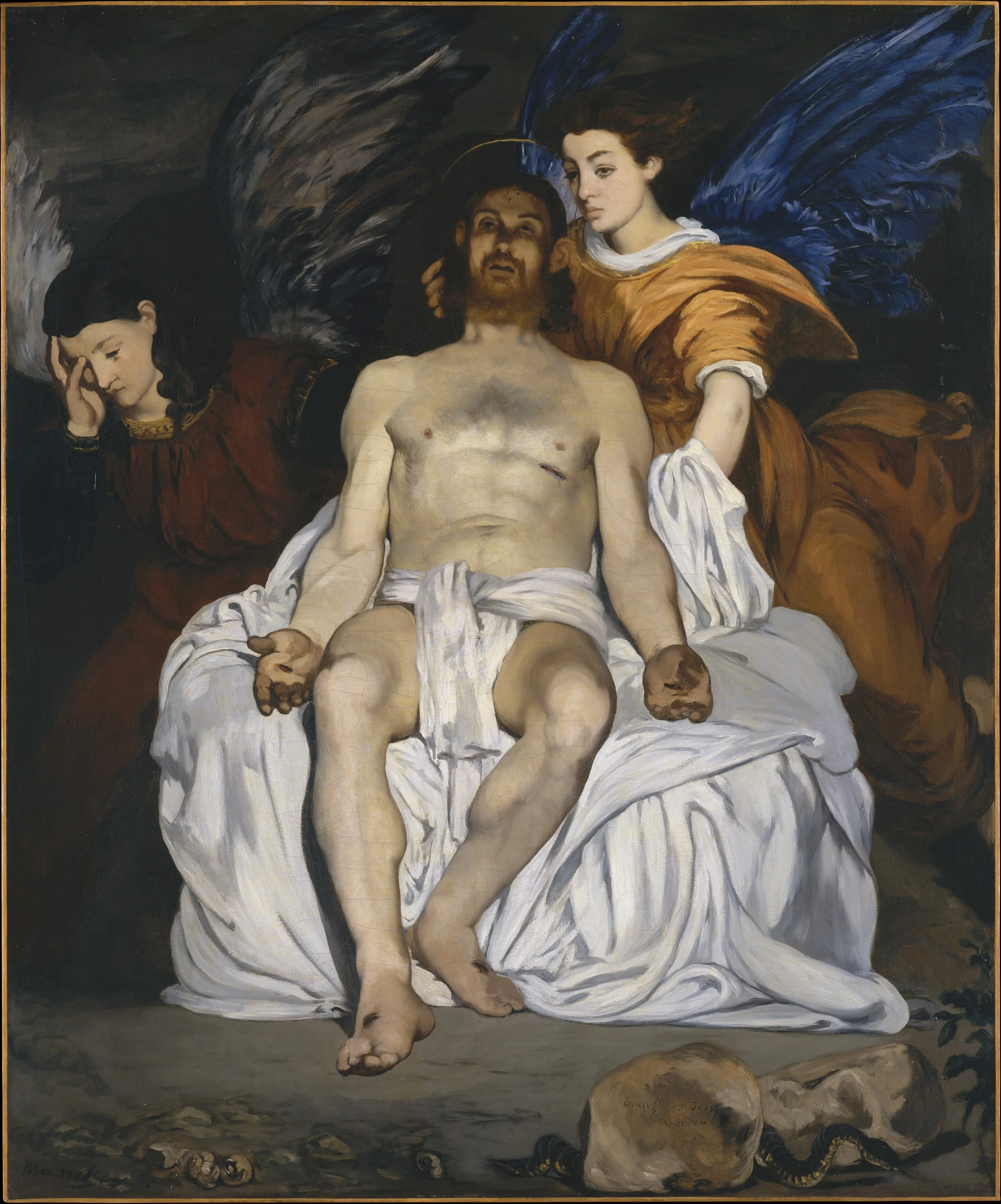
For four centuries the unspoken contract held: the angel might be argued over, restyled, weighed down or lightened, but it remained legible as a sacred being. Manet broke the contract. The hero of this essay, his The Dead Christ with Angels of 1864, is the moment the modern movement turns on its entire predecessor tradition and stages the rupture, as always, on the angels.
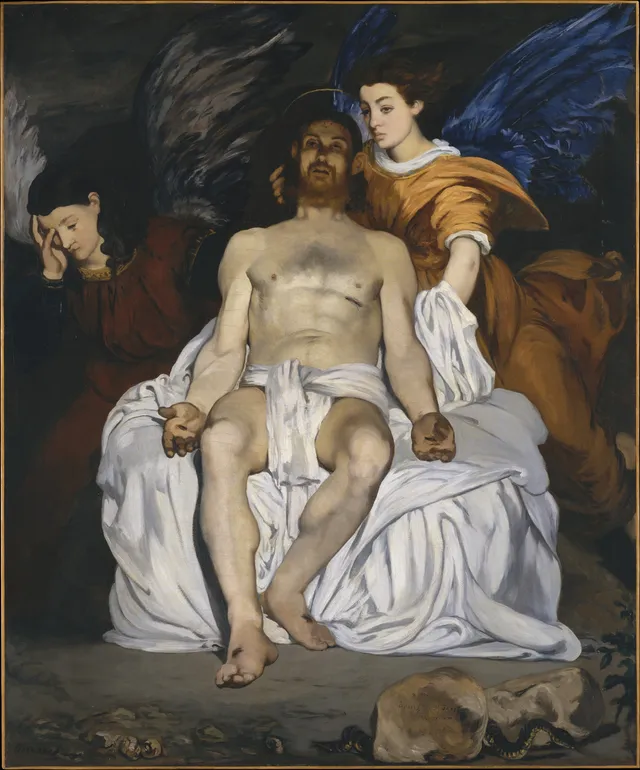
Look at what is actually on the canvas. Christ sits propped upright against a stone, knees up, the body a cold gray-green that Manet refuses to flatter. Two angels flank him, one in deep blue leaning in at the left, and they hold the dead man the way studio assistants hold a heavy prop, with strain in the arms and no transfiguring glow anywhere. The wings are dark, almost dirty, and they read as attached to the women rather than grown from them. Manet leaves the brushwork bare, so the flesh looks built from loaded strokes instead of smoothed into illusion. He even put the spear wound on the wrong side of the body, and contemporaries noticed and complained. The whole picture argues against the accumulated craft of the David-to-Lippi tradition that had spent four centuries making the divine look inevitable. Manet's angels do not descend. They pose. The light is the flat, frontal studio light of 1860s Paris, not the radiance of Bruges or Florence. This is the founding gesture of modern painting carried out on exactly the figure where the previous quarrels had been settled: he keeps the iconography and strips out the belief, leaving the viewer holding paint that admits it is paint.
That is why the Salon read it as an affront rather than a devotion. The offense was not theological. It was art-historical. Manet had taken the most argued-over figure in the tradition and used it to announce that the tradition's whole machinery of persuasion was now optional.
Gauguin moves the argument out of Europe
The generation after Manet pushed the quarrel one step further by changing where it took place. Paul Gauguin painted Ia Orana Maria in Tahiti, and it is an Annunciation relocated wholesale. A Tahitian Mary carries a Tahitian child, a winged angel half-hidden among the foliage gestures the announcement, and two women stand in attitudes lifted, by Gauguin's own account, from a Javanese temple frieze rather than from any European altarpiece. The flat zones of saturated color and the dark contour lines reject Renaissance modeling outright. Where Manet emptied the angel of belief, Gauguin pulls it out of its civilization entirely and asks whether the sacred figure means anything once you remove the European frame that always supplied its meaning. The post-Impressionist answer is that the angel survives the move, but only as a borrowed sign, a piece of imported iconography pinned to a world that never asked for it.
Works discussed in this article
The angel after belief
By the time Manet and Gauguin were done, the angel had become available for purposes its medieval inventors would not recognize. The Romantics had already begun the loosening. J. M. W. Turner's late, apocalyptic The Angel Standing in the Sun, exhibited in 1846 and now at Tate, dissolves the figure almost entirely into a furnace of light, so that the messenger and the medium it travels through become hard to separate. The angel stops being a body with wings and starts being a condition of the painting itself, a charge in the air. That dissolution is the far end of the same road Donatello started down when he first gave the figure weight: once you grant the angel real presence in the world, you can keep increasing the realism until the figure burns off into pure paint.
Set the sequence end to end and the lesson holds. The wingless youth of the catacombs, Donatello's standing herald, David's lute-playing pair, Lippi's grieving attendants, Manet's strained studio models, Gauguin's transplanted messenger in the leaves: each one is a correction of the version just before it. The reason the corrections land on this figure rather than on a Virgin or a saint is simple. The Virgin had a face the church wanted kept stable. The saint had relics and a record. The angel had nothing but precedent, and precedent is the one thing a movement is built to overturn.
So the next time an angel turns up in a gallery, do not ask what it believes. Ask what it is correcting. Trace the wing back one generation and you will find the style it was built to refute still hanging on the opposite wall, and the two of them, centuries apart, still mid-argument.
Sources & further reading
- Angels in art — Wikipedia
- Putto — Wikipedia
- Donatello, Annunciation (Cavalcanti Annunciation) — Smarthistory
- J. M. W. Turner, The Angel Standing in the Sun — Tate
- Simone Martini, The Angel of the Annunciation — National Gallery of Art
- The Birth and Infancy of Christ in Italian Painting — The Metropolitan Museum of Art
- Angel (English alabaster relief, about 1420-1430) — The J. Paul Getty Museum
- Clara Erskine Clement Waters, Angels in Art (1898) — Internet Archive