Artwork
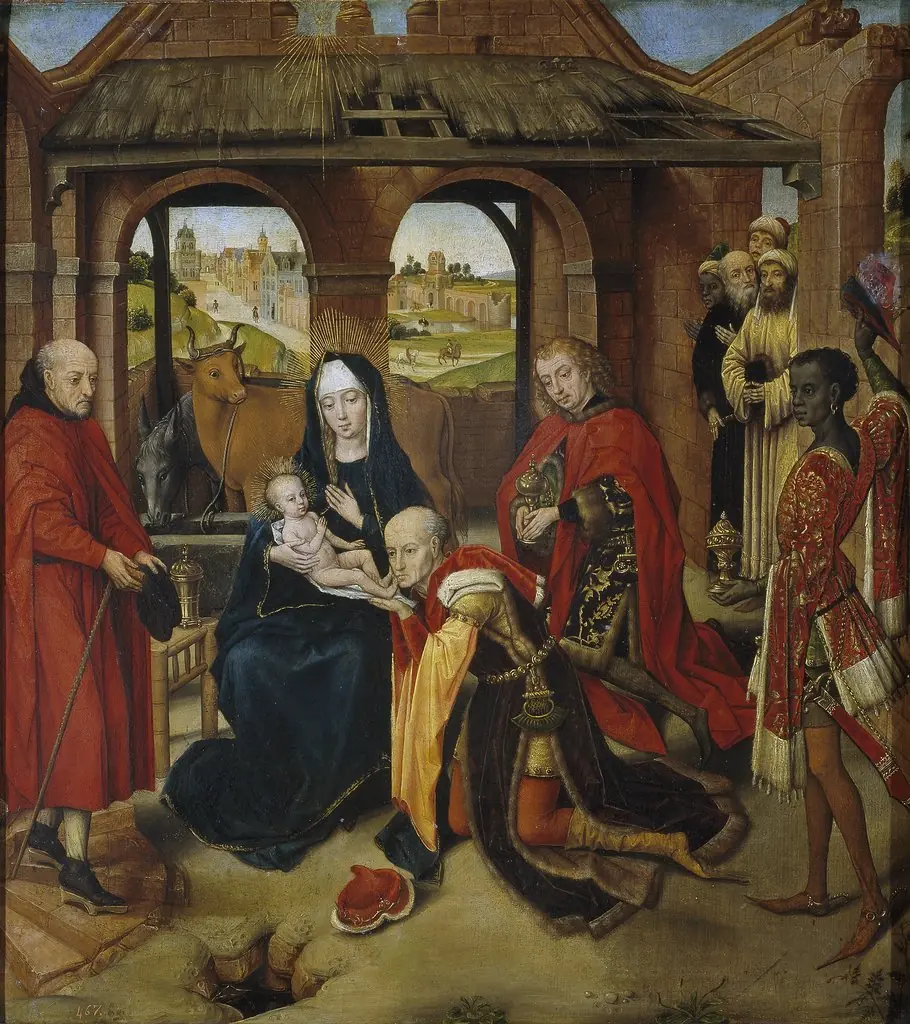
The Adoration of the Magi
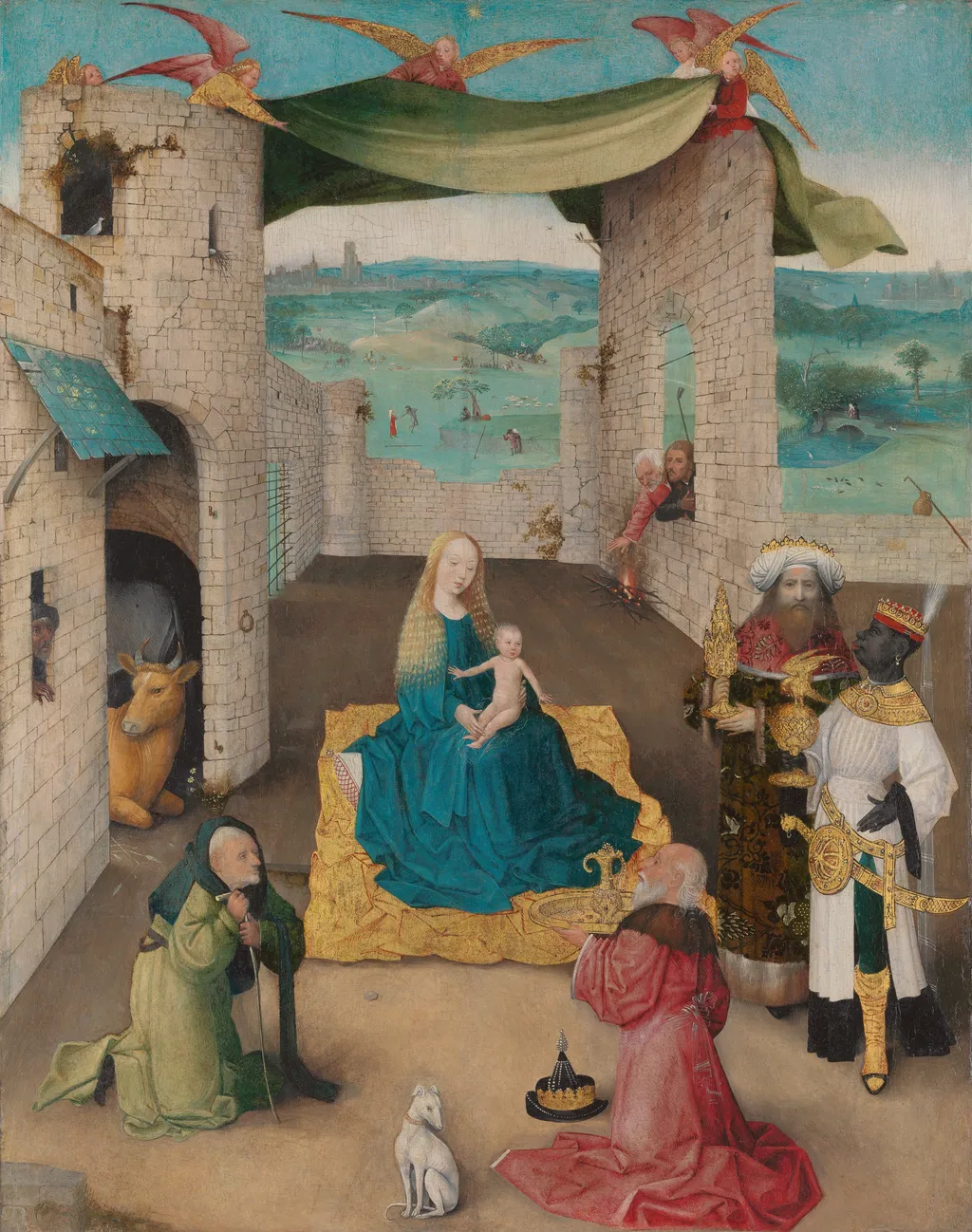
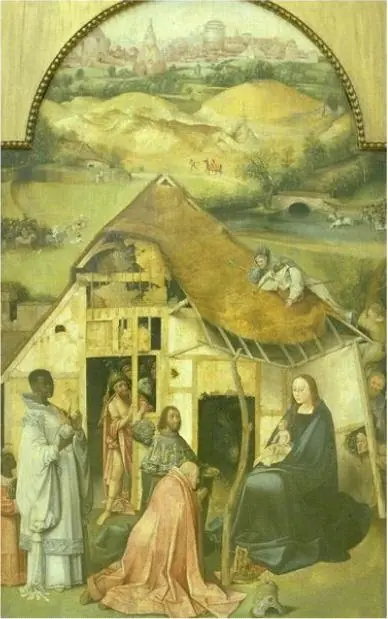
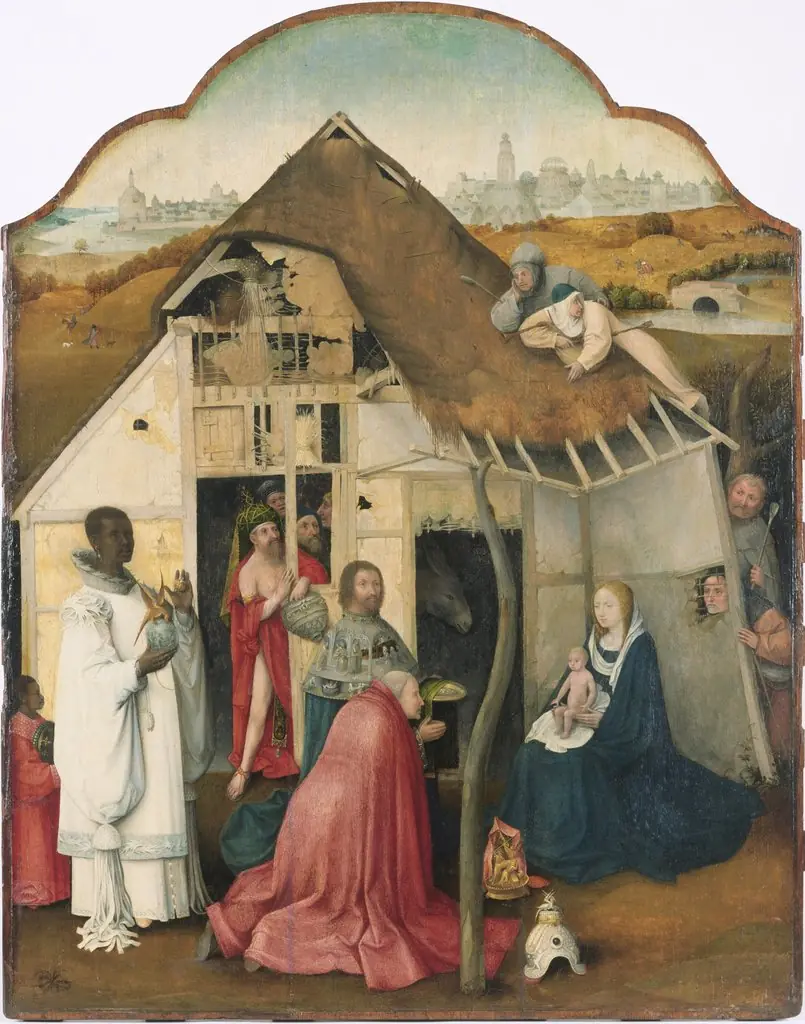
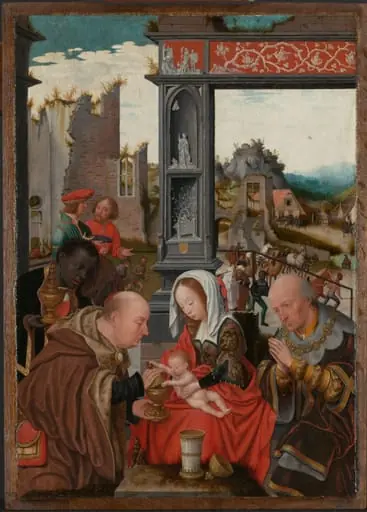
The Adoration of the Magi is an oil painting by the Northern Renaissance artist Hieronymus Bosch. It dates from 1475 and is held in the collection of the Metropolitan Museum of Art.
About this work
Subject & Meaning
Iconographically, the three kings represent the known continents: Europe (kneeling aged king), Africa (Balthasar), and Asia (king in turban).
The painting depicts the Adoration of the Magi, structured in a stage-like composition possibly influenced by contemporary religious plays. Iconographically, the three kings represent the known continents: Europe (kneeling aged king), Africa (Balthasar), and Asia (king in turban). Their gifts carry symbolic weight: Melchior offers a flagon and basin, Caspar a ciborium with myrrh, and Balthasar a golden cup topped with a pelican pecking its breast, a traditional symbol of Christ's sacrifice.
The ruined castle and an owl hidden in a shadow have been interpreted as symbols of the Old Testament and ignorance, respectively. Other details such as the greyhound (possibly indicating the kings' retinue) and shepherds warming themselves add naturalistic touches while enriching the narrative. Overall, the work weaves established Christian iconography with Bosch's characteristic moral and symbolic layers.
Technique & Style
The Adoration of the Magi is executed in tempera and oil on an oak panel assembled from two planks. The support is prepared with a ground, and the painting incorporates extensive gold leaf, notably on the Magi's gifts, the Virgin's cover, and angel wings. Pigments include red lake, azurite, lead-tin-yellow, and ochres.
Underdrawing, executed in brush, reveals multiple revisions indicative of an original creative process rather than a copy. The handling is characterized by a somewhat rigid drawing style with black-outlined contours, atypical of Bosch's mature work. Formally, the composition employs a strong "tunnel" perspective with a high horizon, a stage-like arrangement, and a profusion of gold that recalls International Gothic conventions. Deterioration and later repainting complicate stylistic analysis, but the figures have been noted as wooden in pose.
History & Provenance
The dating of The Adoration of the Magi is established through dendrochronological analysis, which indicates that the oak panel could have been painted no earlier than about 1468, with a likely execution around 1474–1475. The painting was originally owned by German art historian Friedrich Lippmann (died 1903). It was sold at auction by the Rudolph Lepke house in Berlin in late November 1912.
Acquired using the bequest of John Stewart Kennedy, the work entered the collection of the Metropolitan Museum of Art in New York in 1913, where it has remained. No specific commission details are recorded; the work is generally accepted as an early autograph piece by Hieronymus Bosch, though its precise creation history within the Bosch family workshop remains a subject of scholarly discussion.
Context
The attribution of this panel has been a central point of scholarship. Early 20th-century authorities like Max Friedländer considered it an early work, but from the 1930s Charles de Tolnay argued it was a later pastiche, a view that long influenced the museum's own cataloging. Renewed scientific analysis, including dendrochronology dating the panel to around 1474 and infrared reflectography revealing authoritative underdrawing, led the Bosch Research and Conservation Project in 2016 to confirm it as autograph.
This reversal situates the painting as one of Bosch's few securely dated early works, showing him still employing International Gothic gold leaf alongside the innovative perspectival stage-like compositions inspired by religious tableaux. Its contested reception reflects broader debates in Bosch studies, and its execution suggesting a family workshop practice, with possible involvement of his father Anthonius van Aken.
Legacy
The work's legacy is marked by its contested attribution and eventual confirmation as an autograph Bosch. Initially doubted as a later copy or pastiche, dendrochronological and underdrawing studies from the Bosch Research and Conservation Project (2016) affirmed its authenticity. Its influence extends beyond painting: in 1951, Gian Carlo Menotti was inspired by the panel to create the opera 'Amahl and the Night Visitors.'
Early copies, such as a mid-16th-century version in Rotterdam and a later replica in 's-Hertogenbosch, attest to its enduring appeal and the dissemination of Bosch's imagery.
Overview
Hieronymus Bosch's The Adoration of the Magi, painted around 1475, is an early work by the Netherlandish artist. This oil painting on wood panel is housed at the Metropolitan Museum in New York. It depicts the biblical scene of the Magi's homage to the infant Christ, notable for its detailed composition and specific material choices.
Own this work as a print
Artist & collection
Artist
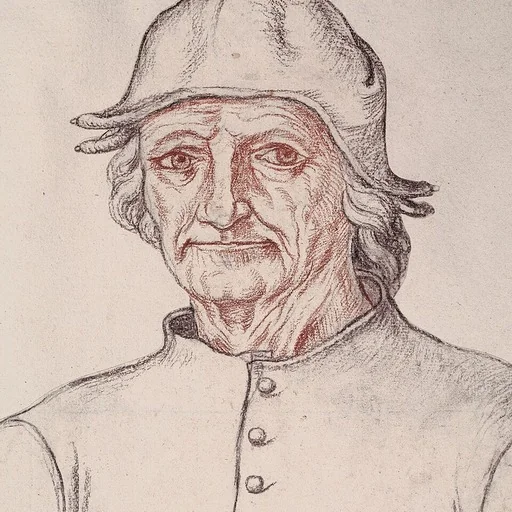
Hieronymus Bosch (; Dutch:; born Jheronimus van Aken; c. 1450 – 9 August 1516) was a Dutch painter from Brabant. He is one of the most notable representatives of the Early Netherlandish painting school. His work,…