Artwork
Pietà (The Dead Christ Mourned by Nicodemus and Two Angels)
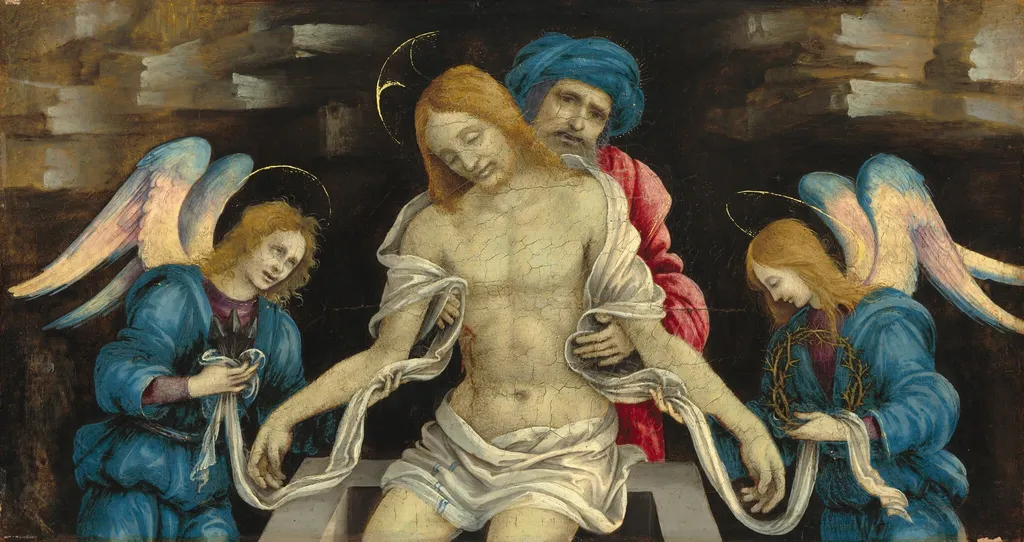
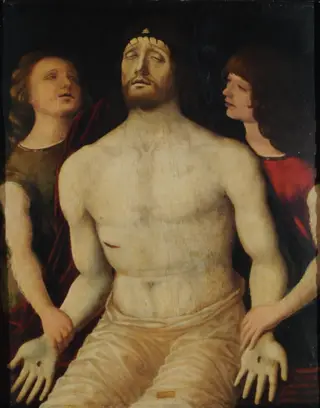
Pietà (The Dead Christ Mourned by Nicodemus and Two Angels) is an oil painting by the Early Renaissance artist Filippino Lippi. It dates from 1500 and is held in the collection of the National Gallery of Art.
About this work
Filippino Lippi painted this Pietà around 1500, probably as part of the predella for the Casali chapel altarpiece in Bologna's San Domenico.
Nicodemus supports the dead Christ's torso while two angels cradle his arms in a panel barely seventeen centimetres high. Filippino Lippi painted this Pietà around 1500, probably as part of the predella for the Casali chapel altarpiece in Bologna's San Domenico. The work spent two centuries in private hands before British collector Robert Henry Benson acquired it in 1902; it entered the National Gallery of Art in 1952 through the Samuel H. Kress Collection.
Subject & Meaning
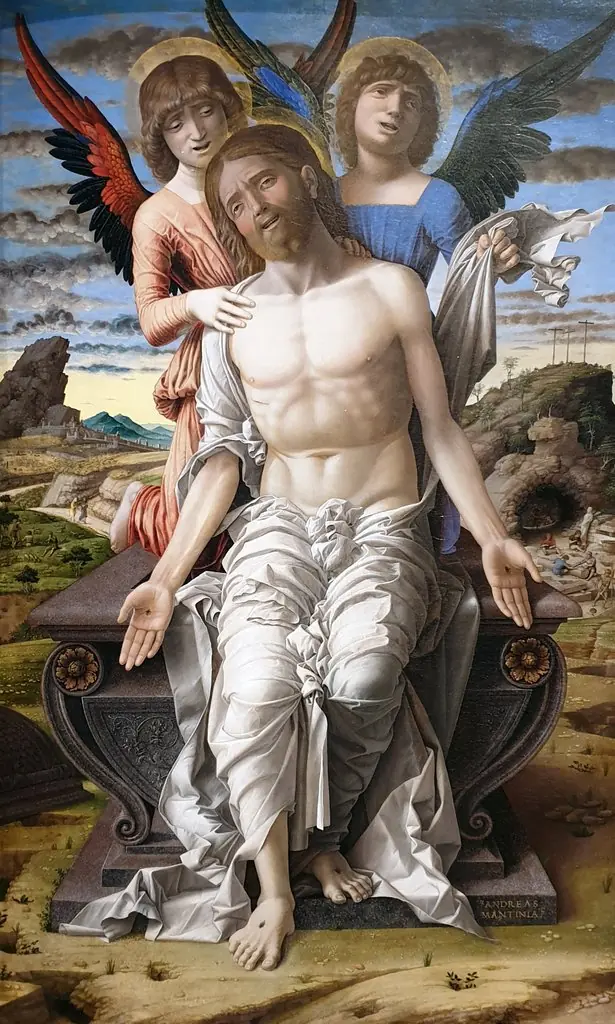
The painting depicts a Pietà scene, showing the dead Christ supported by Nicodemus and flanked by two mourning angels. As a religious work, it centers on the suffering and death of Jesus, with Nicodemus, a Pharisee who helped prepare Christ's body for burial, serving as a figure of faithful service and witness. The angels' grief amplifies the emotional resonance of the moment, emphasizing the human sorrow of the Passion.
The iconography follows a variant of the Pietà theme common in Renaissance devotional art, where the deceased Christ is presented for meditation on his sacrifice. The inclusion of Nicodemus rather than the Virgin Mary shifts the focus to Christ's reception after the crucifixion, underscoring themes of burial and redemption.
Technique & Style
Executed in oil (and possibly tempera) on panel, this work exemplifies Filippino Lippi's late technique. The painting displays a close stylistic relationship to the artist's altarpiece in the Casali chapel at San Domenico in Bologna, dating to 1500. The handling of the figures and the somber mood characteristic of a Pietà align with Lippi's religious works of this period.
The support is a wooden panel, typical of Italian Renaissance devotional paintings. The available sources do not provide further details on condition or handling.
History & Provenance
The painting, likely dating to 1500–1501, was probably executed for the Casali chapel in the church of San Domenico, Bologna, where it originally formed part of the predella of the altarpiece. It remained in the chapel until the late 1720s, after which it passed into private hands, presumably the Isolani family of Bologna. Around 1900 it was sold to Charles Fairfax Murray and Haskard & Co., London; then to Thomas Agnew & Sons in December 1901; and to Robert and Evelyn Benson in February 1902.
The Bensons' collection was sold to Duveen Brothers in 1927. By 1931 the panel belonged to Frederick Housman, New York, and later to Frederick Mont, who sold it to the Samuel H. Kress Foundation on 30 January 1952. The Kress Foundation gifted the work to the National Gallery of Art, Washington, later that year.
Overview
Filippino Lippi's Pietà, painted around 1500, depicts the deceased Christ supported by Nicodemus and two angels. This small panel, executed in oil and possibly tempera, showcases the artist's mature style through its vibrant color and dynamic composition. Measuring only 17.5 by 33.3 centimeters, it was likely part of a larger altarpiece predella, offering a poignant devotional image.
Context
Filippino Lippi, born an illegitimate son to Fra Filippo Lippi and Lucrezia Buti around 1457, received his initial artistic training from his father. He later honed his skills in Sandro Botticelli's workshop in 1472 and famously completed Masaccio's fresco cycle in the Brancacci Chapel. This foundational experience shaped his development into an independent master, whose late works, like this Pietà, reflect a distinct personal style.
Artist & collection

Artist
Filippino Lippi (probably 1457 – 18 April 1504) was an Italian Renaissance painter mostly working in Florence, Italy during the later years of the Early Renaissance and first few years of the High Renaissance.