Look across five centuries of European and American painting and you find the child as a recurring subject who is almost never simply a child. A painter setting a small figure on canvas was answering a question the culture kept asking and kept failing to settle: what is a child for? Is it an heir, a soul to be saved, a worker, a sentimental ornament, a creature with an inner life of its own? The argument of this essay is narrow and I will hold to it work by work. There is no single child in the history of art. The child is the most contested small body a painter could be handed, and each era painted not the thing in front of it but the answer it needed that thing to give.
That is the lens here: one question, several answers, and the answers contradict each other so flatly that you cannot reconcile them into a tidy line of progress. A dynastic portrait and a beggar study can be made in the same decade, in the same city, by neighbours. What changes is not skill but the assignment. Sometimes the child carries a family's future. Sometimes it carries a moral. Sometimes, late and rarely, it is allowed to carry nothing but itself. Watch how the same subject keeps switching jobs and you watch a society arguing with itself about what childhood is, in paint, where the argument is hardest to take back.
The question stated
Begin with the hard case. Diego Velázquez built one of the most analysed pictures in the canon around a five-year-old. The Infanta Margarita stands at the centre of Las Meninas (1656), then the only surviving child of Philip IV and Queen Mariana, ringed by her ladies-in-waiting in the painter's own workroom inside the Madrid palace.Smarthistory's reading of the picture stresses how much political weight rides on that small figure. She is not a girl who happens to be painted. She is a dynasty's whole hope, lit and centred so the eye cannot escape her. Here the answer to the question is blunt: a child is continuity, the thread by which a crown stays on a head. The toddler is a constitutional document with hair ribbons.
That answer ruled portraiture for a long time, and it produced a whole genre to house it. In eighteenth-century Britain the family group went informal and domestic in the conversation piece, a small-scale picture of relatives and friends arranged in a parlour or a garden. The form was, by Tate's account, brought into Britain by Philip Mercier around 1725 and made fashionable by William Hogarth and his successors.
You can read the whole logic off Francis Wheatley's The Saithwaite Family. The parents anchor the composition, the children cluster between them, and the grouping itself is the message: a line, intact, presentable, continuing. Wheatley was working squarely inside the convention Tate describes, where the conversation piece turned the family into a stable, sellable image of itself. The child's individuality is beside the point. What matters is that there is a child at all, and that it stands where an heir should stand.
The American version of the same instinct arrives a century on and louder. Seymour Joseph Guy painted The Contest for the Bouquet: The Family of Robert Gordon in Their New York Dining-Room for a wealthy New York merchant, and it is worth standing in front of it for a moment.
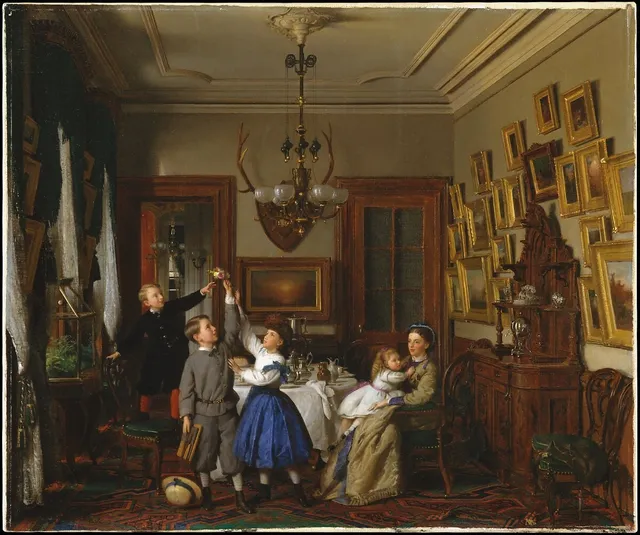
The room is the real subject of the picture, and the children are how Guy makes you read it. A bouquet has become the pretext for a tussle, and the small figures lean and reach across a polished interior thick with the props of arrival: the heavy table, the gilt, the disciplined light of a household that has money and wants the fact recorded gently. Guy keeps the faces sweet and the gestures playful, but the composition is doing dynastic work. The contest for the flowers is a rehearsal of inheritance, staged so it looks like nothing more than a charming afternoon. The children are the proof that the Gordons have a future, painted with enough tenderness that you almost miss the accounting underneath. This is the dynastic answer in its Gilded Age dress, and the sweetness is exactly the point of disguise.
Answer two: the child who works
Now change the assignment. For most of history most children were not heirs to anything; they were hands. The painters who looked at that fact gave a second, contradicting answer, and the two answers hung in the same galleries without resolving.
Bartolomé Esteban Murillo is the hinge figure. Alongside the religious commissions that filled Seville's churches, he made genre studies of the city's flower girls, urchins, and beggars, the children of the street as they actually lived. The Young Beggar, painted around 1645 to 1650 and now in the Louvre, is, by the standard account, the first known street-urchin Murillo ever painted, the opening of a long series. A boy sits alone in a shaft of light, picking at his rags, and Murillo refuses to prettify the poverty even as he composes it like a saint. The child here answers a different question entirely. Not who will inherit, but who survives, and at what cost.
Across the Pyrenees, François Boucher took the working child in the opposite direction, and the difference is instructive. In Washerwomen, labour becomes a pastoral. Women scrub at the water's edge while children play nearby, and Boucher dresses the whole scene in a rococo prettiness that softens the work into a decorative idyll. The child is present, but it has been recruited to make hard labour look like leisure. Set Boucher beside Murillo and you see two French and Spanish answers to the same subject pulling in flat opposition: one insists on the dirt, the other paints it out. Both are choices about what a poor child is allowed to mean.
The American genre tradition split the difference and gave the working child a civic job. William Sidney Mount built Cider Making around the rhythms of a Long Island autumn, and children move through the scene as part of the season's economy: fetching, watching, carrying, learning the work by doing it. Mount was painting a young republic that wanted to see itself as wholesome and productive, and the child folded into the cider press is a small emblem of that self-image. Labour here is neither Murillo's hardship nor Boucher's perfume. It is citizenship in training, the child as apprentice to a way of life. Three painters, three verdicts, and not one of them is about the child as such. Each is about what the adult world needed the child to demonstrate.
Answer three: the child who is only a child
Something shifts around 1800, and it is the most genuinely new answer in the whole sequence. Painters begin, hesitantly, to grant the child an interior life: a self, a mood, an experience of the world that is not a rehearsal for adulthood and not a moral lesson for the viewer. Philipp Otto Runge's The Hülsenbeck Children of 1805 to 1806 is usually held up as the threshold work. Smarthistory frames it as marking a new era in the representation of children, one organised around individual selfhood, interiority, and a specific idea of youthful innocence, rather than the older habit of painting children as miniature adults in shrunken finery. The change is philosophical before it is visual. Once a society decides childhood is a distinct state worth protecting, its painters have to find a way to show a person who is not yet finished and is complete anyway.
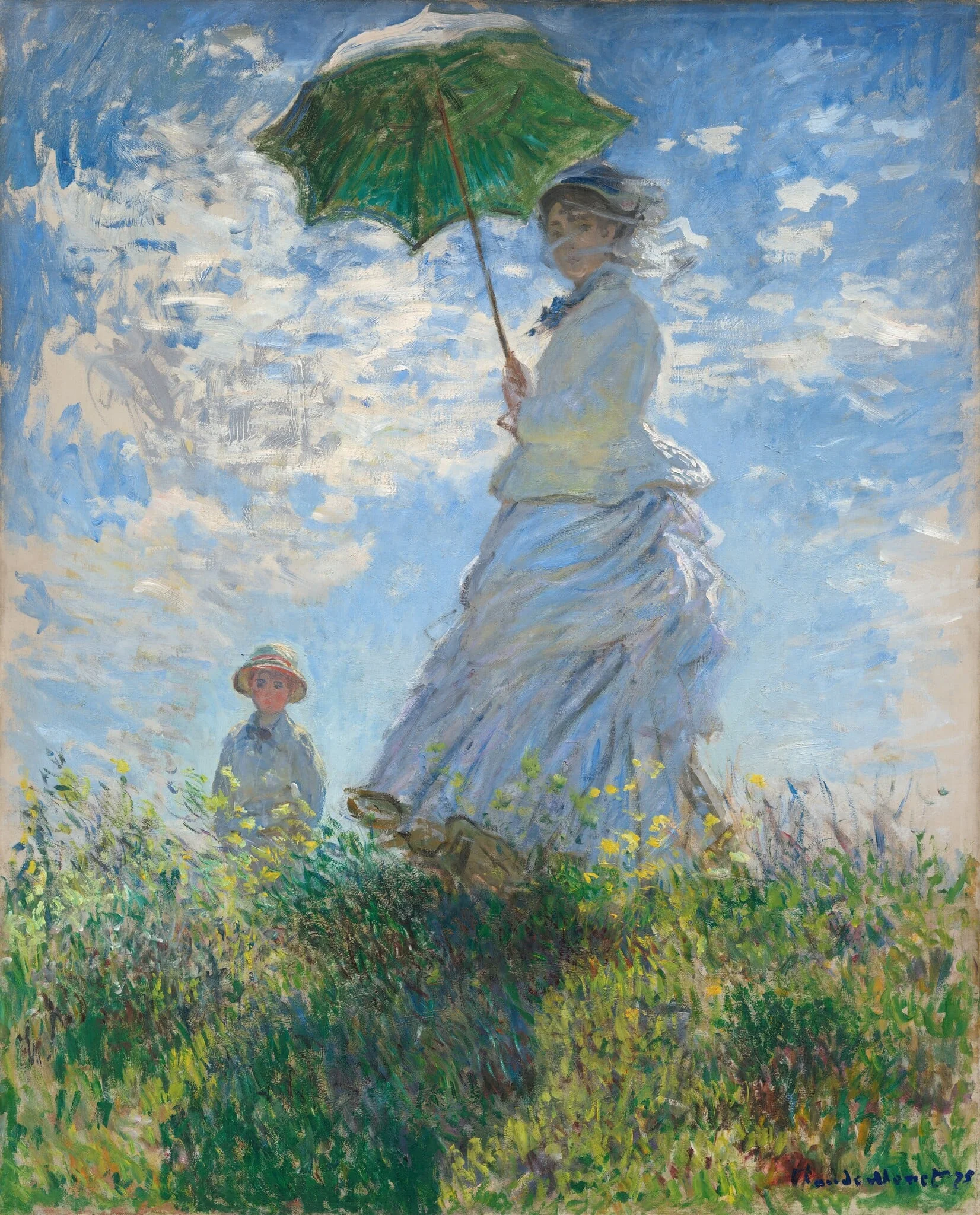
Claude Monet, two generations later, shows how thoroughly that idea had soaked into the way an artist composed. His Woman with a Parasol - Madame Monet and Her Son is worth slowing down on, because the child is doing something quietly radical by doing almost nothing at all.
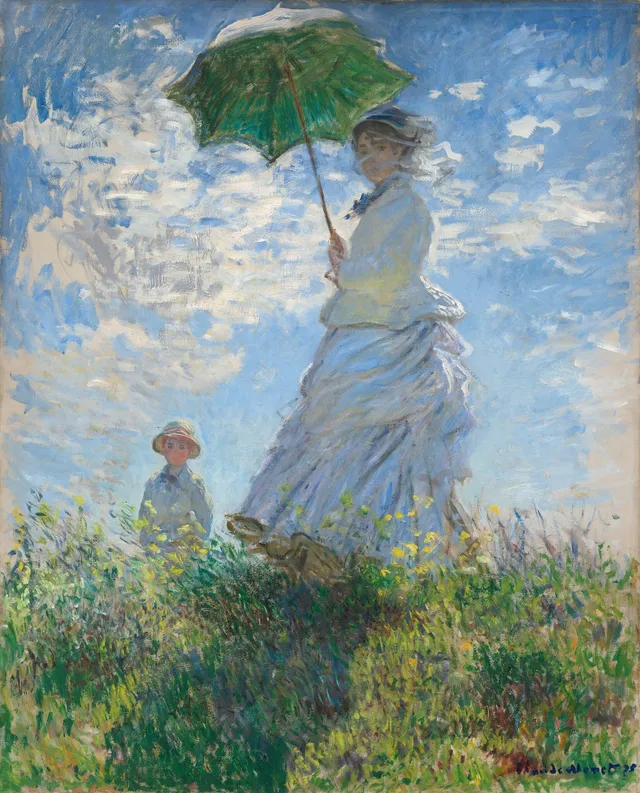
Stand close. Camille fills the canvas from below, seen against a high bright sky, her veil and skirt streaming sideways in a wind you can practically hear. The boy, Jean, stands behind and below the crest of the grassy rise, so that only his upper body clears the horizon line of the slope. Monet paints him smaller, dimmer, and looser than his mother, half-dissolved into the same green and the same moving light. He is not posed and not presented. He waits, a little apart, while the breeze does to him what it does to the field. The whole picture is built on rapid, broken touches that refuse to fix anything in place, and the child is the figure that submits to that dissolution most completely. He is not an heir on display and not a worker and not a lesson. He is a small presence inside a passing moment of weather, which is to say he is finally allowed to be nothing but a child, caught and let go. Monet hands the subject the one thing the dynastic and the moralising traditions never could: ordinariness.
The same period that learned to see the child also learned to sell it, and the two are not separable. John Everett Millais painted his five-year-old grandson, William Milbourne James, blowing soap bubbles in a picture he called A Child's World (1886). It survives under a cruder name. After a bar of soap was painted into the image, Bubbles became a Pears advertisement, and the tender new vision of innocent childhood went straight to market. The lesson is not that the Victorians were hypocrites. It is that the moment the culture decided childhood meant purity, purity became the most valuable thing a brand could borrow. The interior life Runge had fought to depict was, within a lifetime, a logo.
Answer four: the child as sign
Underneath all of these runs an older stratum, where the child is not a person at all but a symbol with a fixed grammar. Renaissance and Baroque painters inherited a whole vocabulary of small bodies that mean things. The Getty sorts the terms cleanly: a putto is a chubby, often winged child figure; give him religious weight and he is a cherub; arm him with arrows and he is a Cupid. These are not portraits of children. They are children used as punctuation, scattered through ceilings and altarpieces to signal love, divinity, or the soul. The child-as-sign asks no question about real childhood, because it was never looking at a real child.
What makes the late nineteenth century fascinating is how the sacred sign and the modern self collide. Mary Cassatt, an American among the French Impressionists, painted secular mothers and children for years, and in Mother and Child, sometimes called The Oval Mirror, of around 1899, she let the old religious image surface through the new domestic one. An oval mirror behind the boy's head frames it like a halo, summoning the centuries of Virgin-and-Child painting that stand behind every modern picture of a woman holding an infant. Cassatt's child is a real, specific, ordinary child, and at the same time it is the Christ-echo it cannot escape. The two readings sit on the same canvas at once, and she means them to. The child is both the person Monet discovered and the symbol Murillo's churches required, and the friction between those is the picture's whole charge.
What the archive shows
The contradiction is visible in our own holdings as a shape, not just a theory. Across Artifact World Gallery, the child surfaces 483 times, under 301 different hands, hung across 66 venues, with the earliest works reaching back to the 1360s and the latest pressing up to the eve of the Second World War, around 1939. That spread is the evidence. Nearly six centuries, three hundred artists, and no convergence on a single way to paint the subject. A spread like that is not what a settled idea looks like. It is what an open argument looks like, recorded one canvas at a time, with the dynastic heir and the street urchin and the bubble-blowing grandson all kept on the same shelves.
Set that figure against the external authorities and it sharpens. Each of the works the scholars single out as a turning point, Velázquez's Infanta, Murillo's first urchin, Runge's threshold portrait, occupies a different point on our own timeline, and the corpus simply will not let you draw a clean arrow from one to the next. The heir does not give way to the worker, and the worker does not give way to the free child. They overlap, they recur, they argue. The archive's three hundred artists are three hundred people answering the same question and refusing, across six hundred years, to agree.
Reading the answers together
It would be easy to tell this as a tale of liberation: the child starts as property, becomes a worker, ends as a free self, and we all grow kinder. The pictures will not support the story. Cassatt's halo-mirror is later than Mount's cider press, and it is more bound to old symbolism, not less. Millais arrives at the free, interior child and immediately rents it to a soap company. Boucher prettifies child labour in the same century that Murillo refused to. The answers do not climb. They circulate, and a society reaches for whichever one it needs at a given moment, then files it next to its opposite.
Which is why the subject repays close looking better than almost any other. A landscape mostly wants to be beautiful and a still life mostly wants to be true, but a painted child always wants something more from you, because the painter wanted something from it. Find what the child is doing in the composition, where it stands, how much light it gets, whether it is presented or simply present, and you have found the era's real answer to a question it could never close. The genre this work lives nearest is portraiture, and the movement that finally loosened the child from its assignments was Impressionism, though even that loosening, as Cassatt shows, never fully cut the old cord.
Works discussed in this article
One more thread worth pulling. The republican optimism in Thomas Pritchard Rossiter's Washington and Lafayette at Mount Vernon, 1784 places children at the feet of the founders as living proof of the nation's continuity, the dynastic answer transposed from a single family to a whole country. The heir is no longer a prince. It is the republic itself, and the small figures are how the picture promises it will last. Six centuries on from the Madrid alcázar, the question has not changed. Only the size of the inheritance has.
Sources & further reading
- Conversation piece, Art Term — Tate
- Diego Velázquez, Las Meninas — Smarthistory
- Philipp Otto Runge, The Hülsenbeck Children — Smarthistory
- The Young Beggar — Wikipedia
- Bubbles (painting) — Wikipedia
- Putto, Cherub, Cupid: What's the Difference? — The J. Paul Getty Museum
- Bartolomé Esteban Murillo, Artist Info — National Gallery of Art
- Mary Cassatt, Mother and Child (The Oval Mirror) — The Metropolitan Museum of Art