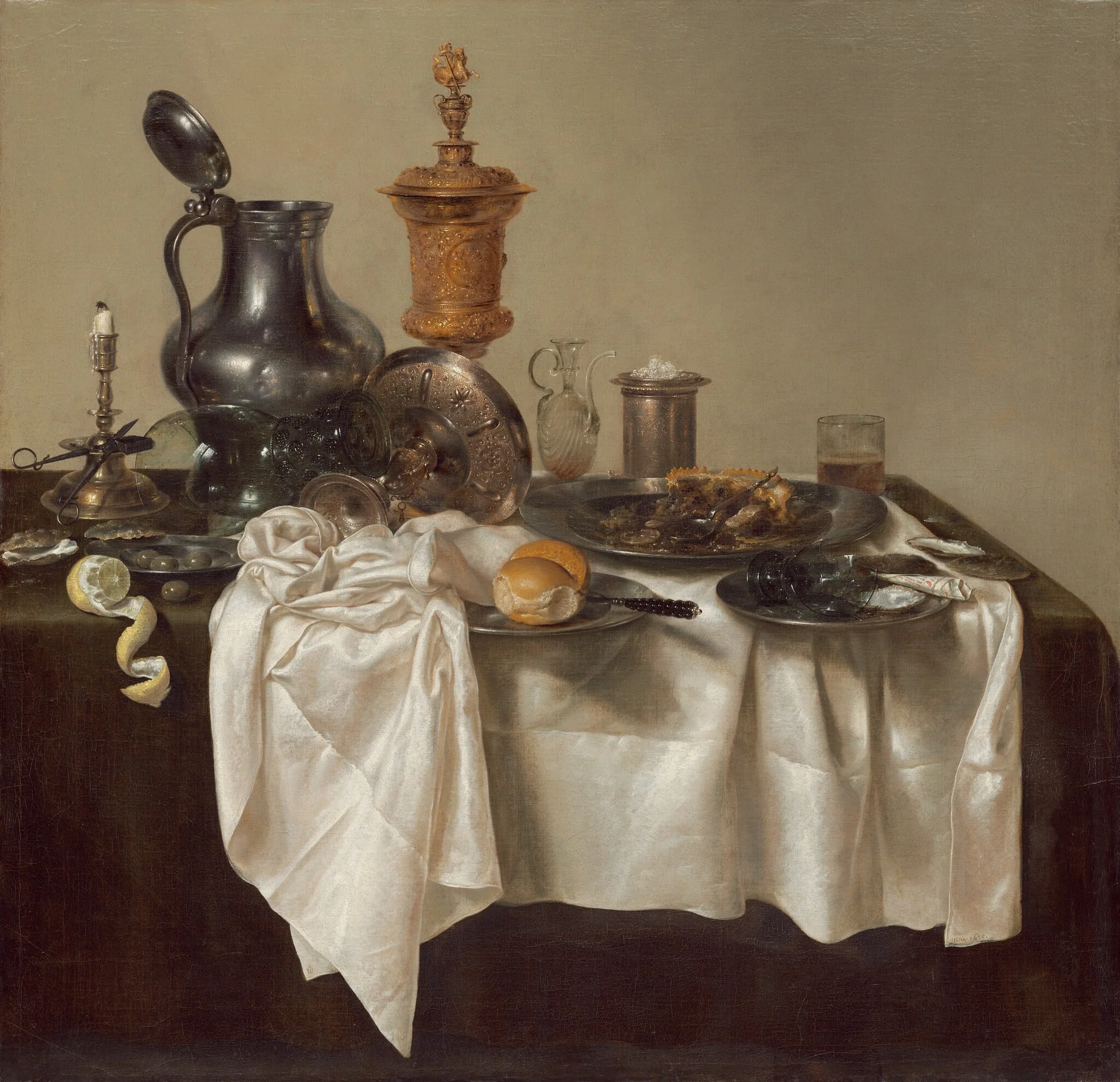
The Dutch Golden Age is usually taught as a catalogue of specialisms: the seascape painter, the church-interior painter, the man who did nothing but tabletops. That inventory is accurate and it misses the point. The deep subject of the period is attention itself. A Dutch picture of the 1630s asks you to look harder at a lemon than the lemon seems to deserve, and in the asking it trains a habit of seeing that earlier European art had mostly reserved for saints, sovereigns and battles. I want to defend that claim through one work, Willem Claesz Heda's Banquet Piece with Mince Pie, because almost everything the movement learned to do is already finished inside its frame. Spend an hour with that one table and you will not need a wall of labels to understand the rest of the room.
My argument is narrow and I will hold to it. The achievement of seventeenth-century Holland was a transfer, not an invention. Painters took the sustained, reverent looking that European tradition had spent on sacred and heroic subjects and turned it onto ordinary matter, and that transfer is clearest where the stakes look lowest, in still life. Read one Heda table closely and the rest of the field reorganizes itself. The church interiors, the kitchen scenes, the flower pieces, even the costumed portraits stop looking like separate departments and start looking like a single discipline pointed at different objects. The pages that follow test that idea against five other works in our collection and against what the period actually believed about the worth of its own pictures.
A table seen at eye level
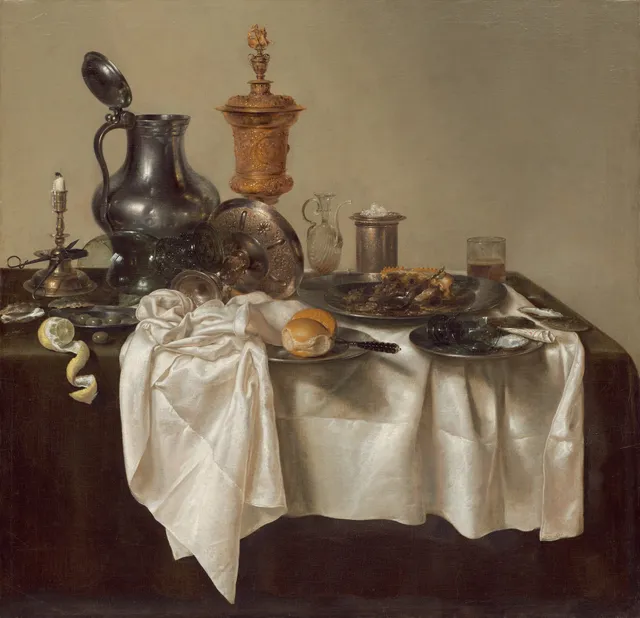
Stand in front of the Banquet Piece with Mince Pie and the first surprise is how little colour Heda allows himself. He builds the whole picture from a narrow band of silver, pewter grey, ochre and the tired green of a half-empty roemer. Critics later named this restrained manner the monochrome banketje, the tonal breakfast piece, and Heda is its quietest master. The cloth is bunched and creased, not smoothed for display. A pewter plate juts out past the table edge toward you, and the broken mince pie of the title sits with its pastry lid lifted, the dark filling exposed, a few crumbs scattered onto the linen. Nothing here has been arranged to flatter. It has been arranged to be true.
Then the lemon. Heda gives it the most labour of anything on the table, peeling it half-away so the bright rind spirals down over the plate's lip in one unbroken ribbon, its pith catching the light, its cut flesh glistening. Nearby a tall glass holds the day's last inch of wine, the leaded window behind the painter reduced to a few cold reflections in the curve of the bowl. A vessel lies overturned. A knife is angled outward, its handle hanging into our space, an old trick for puncturing the picture plane. Light arrives from the left and dies softly across the cloth. Look long enough and you notice that Heda has painted three or four different ways for a surface to hold light: the dull absorbent linen, the matte body of the pewter, the hard glitter of glass, the wet shine of fruit. Each material is given its own law.
None of this is incidental, and here the looking turns into reading. The meal is over, the diners have gone, the order of the table has collapsed into the casual ruin of a thing recently used. Heda is painting time. The peeled lemon will brown, the wine will sour, the pewter will dull, and he wants you to feel that knowledge sitting under the silver. There is a vanitas current running through the picture, but it never lectures. The moral lives in the handling of paint, in the patience that records a reflection on a knife blade so faithfully that the reflection becomes the argument. A history painter could move you with a martyrdom. Heda moves you with the aftermath of breakfast, and that is the larger claim the whole movement is quietly making.
One discipline, many objects
The Dutch did something the rest of Europe found faintly improper. They inherited a strict hierarchy of subjects and then let the lowest-ranked subjects flourish anyway. In the academic scheme, later hardened by the French academies, history painting sat at the summit and still life at the floor, with portraiture and landscape ranked in the middle, as the Tate's glossary of genre painting still records. Holland kept the theory and inverted the market. Burghers with cash and wall space wanted not altarpieces but the visible world, and a free trade in pictures grew up to supply them. A baker or a brewer could own a dozen paintings, and many did.
Specialization is the engine. The division of labour into distinct genres sharpened from the late 1620s, and the stretch from then to the French invasion of 1672 is what most historians treat as the core of Golden Age painting, according to the survey of Dutch Golden Age painting at Wikipedia. A painter became the herring man, or the winter-landscape man, and built a whole career on the narrowing. That same source notes a richer offshoot, the pronkstilleven or ostentatious still life, worked up in 1640s Antwerp by Flemish artists such as Frans Snyders before a generation of Dutch painters took it over. Heda stands at the austere end of that tradition, Snyders' heirs at the lavish end, and the distance between them is a distance of temperament, not of skill.
Specialization is what makes the transfer of attention possible. You cannot render the entire visible world with equal devotion. You can, if you spend twenty years on tabletops, learn to make a half-peeled lemon carry the weight a lesser painter would need a crucifixion to bear. The narrowness is the point. It concentrates looking until ordinary matter starts to behave like subject matter that matters. A market that rewarded the herring man for painting herrings better than anyone alive was, without quite meaning to, building a school of pure observation.
The eye redirected
Once you accept that the Heda table is a school of seeing, the other genres read as the same lesson aimed elsewhere. Take Emanuel de Witte. His Interior of the Oude Kerk, Amsterdam applies still-life patience to architecture and to air. The whitewashed columns of the stripped Protestant church recede in measured perspective, daylight pools on the worn stone floor, small figures and a stray dog scatter through a space built for God and now occupied by townspeople. De Witte records the fall of light on plaster with exactly the devotion Heda gives to pewter. The subject changed. The discipline did not. You can browse more of Emanuel de Witte's work and watch the same cool attention move from nave to nave.
Domestic genre painting pulls the eye indoors. Nicolaes Maes's The Lacemaker sets a woman over her bobbins, head bent, the whole picture organized around the downward tilt of her attention. Maes carries the tonal warmth of Rembrandt's circle into the hush of a single room, and the lace, the cloth, the modest furniture get the same close handling a still-life painter would give a glass. The moral here is labour and quiet, not abundance. Maes is well represented in our holdings, and across his interiors he keeps returning to the same human note, the woman so absorbed in her task that she has stopped noticing she is watched.
Now the harder case, the one that seems to break my thesis. Johannes Vermeer's Allegory of the Catholic Faith is a late, strange picture in which the painter of quiet rooms tries his hand at high allegory. A woman personifies Faith, hand on heart, foot on a globe, a glass sphere hanging above her, a chalice and a crushed serpent doing iconographic duty around her. The composition strains where Vermeer's domestic scenes glide. And yet the thing that holds the painting together is the still-life eye. The drawn-back curtain, the glint on the glass orb, the cold gleam of the marble floor: these are observed with the patience Vermeer learned on humbler subjects, pressed reluctantly into the service of doctrine. The allegory is borrowed. The looking is his own. More of Vermeer's surviving output makes the contrast plain, and it is worth noticing how much better he is when no idea is asked of him.
Rembrandt sits at the centre of the period's reputation, and the contrast with Heda is instructive. His vast civic group portrait of a militia company, the picture most surveys lead with, marks the grand, public, history-inflected pole of the movement, crowded with figures and lit like a stage. But look at Rembrandt's Flora, a single figure costumed as the goddess of spring, and the same intelligence is at work on a smaller stage. The light gathers in the heavy fabric and the flowers at her brow, the face emerging from shadow with a softness no contemporary could match. Whether he paints a militia or a model in a borrowed role, Rembrandt is doing what Heda does to a lemon, only with a human presence as the object of attention. The devotion is identical. The object is warmer.
And then the flowers themselves. Margaretha Haverman's A Vase of Flowers belongs to the most demanding branch of still life, the bouquet that no eye ever saw whole because its blooms flower in different months and had to be assembled from study sheets. The discipline of looking becomes, here, a discipline of memory and assembly. Each petal is observed from life at a different time of year, then composed into a season that never existed. Haverman is the rarest figure in this essay, a woman who broke into a guarded trade and whose surviving work is sparse. Our archive carries a single picture under her name, which tells its own story about who got to keep painting and whose canvases were kept.
Works discussed in this article
What survives, and where
Numbers can sharpen a thesis that close-looking alone cannot prove. Our own archive holds 8,667 works tied to the Dutch Golden Age, made by 1,175 named artists and scattered across 131 venues, with attributions ranging across roughly 1500 to 1967. That last figure looks wrong until you remember that a movement does not stop at its own death. The late dates are copies, revivals and homages, the long afterlife of a way of seeing that kept being relearned. The spread across 131 institutions tells the other half of the story. This was art made to be sold, dispersed and hung in ordinary rooms, not locked into a handful of princely collections. A style built for the open market scattered the way a market scatters things, into hundreds of hands and, eventually, hundreds of museums.
The category that dominates that count is the one the academies ranked last. Still life emerged as an independent genre in Northern Europe and flourished across roughly 1600 to 1800, the long arc treated by The Met's Heilbrunn essay on still-life painting in Northern Europe. The market kept rewarding it, collectors kept chasing it, and the genre that the theory called lowest turned out to be the one that taught the rest of European painting how to see a surface. The proportions in our holdings are not an accident of acquisition. They follow what the seventeenth-century public actually bought, and what later buyers, copying that taste, went on chasing for three more centuries.
The argument the eye won
There is a long habit of treating Dutch painting as charming minor art, the world rendered without ideas. The nineteenth century half-believed it, even as it fell in love with the pictures. Eugène Fromentin's old study of the Flemish and Dutch masters, The Masters of Past Time, still freely readable today, wrestles openly with the question of how work this modest in subject can feel this serious in execution. The answer he circles, and the answer the paintings give, is that subject and seriousness had quietly come apart. A nation of merchants decided that the visible world, looked at hard enough, was worth a master's whole life.
That is why a single table can carry the whole period. Heda's lemon contains the program: secular matter, specialized skill, the rendering of light and time as if they were the real protagonists, the moral folded into the paint rather than printed on a banner. The church interiors of De Witte and the domestic quiet of Maes are the same discipline finding new objects. The eye that the Dutch trained on a tabletop is the eye that Chardin inherited a century later, and that the Impressionists borrowed when they decided a glance at a café table was a fit subject for a painting. The lineage runs straight from a peeled lemon in Haarlem to a glass of absinthe in Paris.
So here is the test. The next time a gallery hangs a Heda beside a history canvas three times its size, watch which one the visitors stand in front of longest. They will lean toward the smaller picture, toward the half-peeled lemon and the broken pie, and they will not entirely know why. The reason is that Heda is not asking them to admire a story. He is asking them to look, and the asking outlasts every grander claim in the room. Three hundred years on, the lemon is still mid-fall, the wine still unfinished, and we are still leaning in.
Sources & further reading
- Dutch Golden Age painting — Wikipedia
- Genre painting — Tate
- Still-Life Painting in Northern Europe, 1600-1800 — The Met
- Getty Acquires Two 17th-Century Dutch Still-Life Paintings — The Getty
- The Masters of Past Time, or Criticism on the Old Flemish & Dutch Painters — Internet Archive