Girl: Iconography and what the pictures meant to their first viewers
A painted girl as a subject in Western art almost never meant only a girl. To the people who first stood in front of these pictures, the young female figure was a sign to be read, and they read her fluently, the way we now read a traffic light. She could stand for a family's future, for a household's moral temperature, for the danger or the promise of education, for the marriage market that organized so many lives. Her youth made her seem innocent of meaning, and that is exactly what made her useful: a figure who looks like nothing in particular can be loaded with almost anything. The thesis of this essay is blunt. The girl is the most ideologically freighted of all the subjects that pass for innocent, and the history of the subject is the slow story of how she was emptied of legible meaning until, by the late nineteenth century, charm was allowed to be enough.
That arc is worth defending work by work, because it cuts against the way the subject is usually shrugged off. Survey writing tends to treat the girl as decorative filler, a soft motif between the battles and the altarpieces. The pictures themselves refuse that. A daughter in a colonial portrait is doing dynastic labor. A maid asleep in a Delft interior is a moral cartoon about idleness and appetite. A girl trying on a new bonnet is a small essay about vanity and money. Only later, with Renoir, does the girl finally get to be valued for the light on her cheek and very little else. Across our own holdings the figure recurs with real density. Artifact World Gallery catalogues 441 works on the girl subject, drawn from 67 venues and the hands of 290 different artists, the earliest dated near 1142 and the latest to 1941, which spans almost the whole interval during which the sign was loaded and then, gradually, unloaded.
A face that is not a portrait
Start with the hardest case for my argument, the picture that seems to be about a specific girl and nothing else. The single most famous girl in painting is the one in Vermeer's so-called Girl with a Pearl Earring, and the standard art-historical reading is that she is not a portrait at all. As Smarthistory sets it out, the picture belongs to the Dutch category of the tronie, a study of a head in costume rather than a likeness of a known sitter.
That distinction mattered to a seventeenth-century buyer in ways it no longer does to us. A tronie was bought as a demonstration piece, a flourish of skin, fabric, and unlikely light, and the exotic turban and outsized pearl told the first owner that this was an exercise in the imaginary, not a record of the girl next door. The face is generic on purpose. Strip away the modern habit of seeing her as a real person with a secret, and you are left with what the picture's first audience saw: a brilliantly handled type. The girl here is a surface for the painter's skill, and the anonymity is the point, not a loss. Hold that idea, because it returns transformed two centuries later in Paris.
The girl who reads
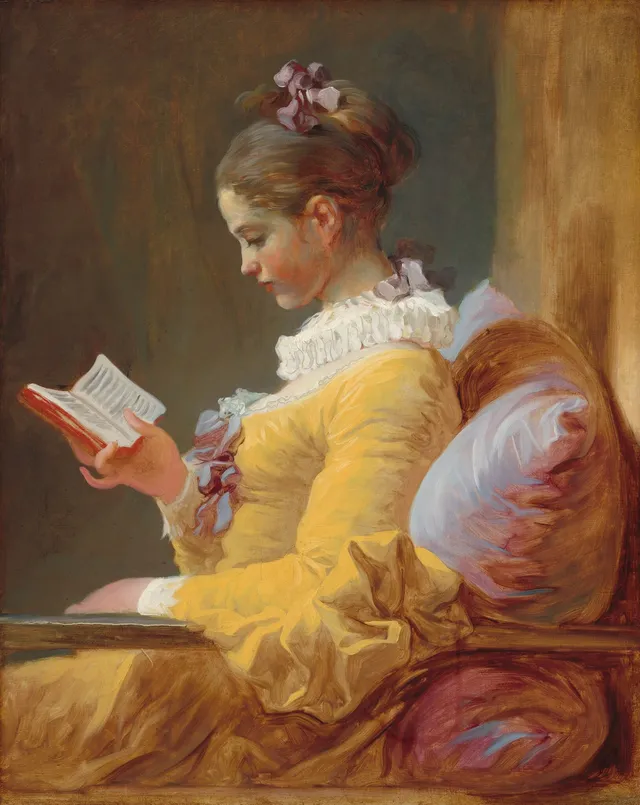
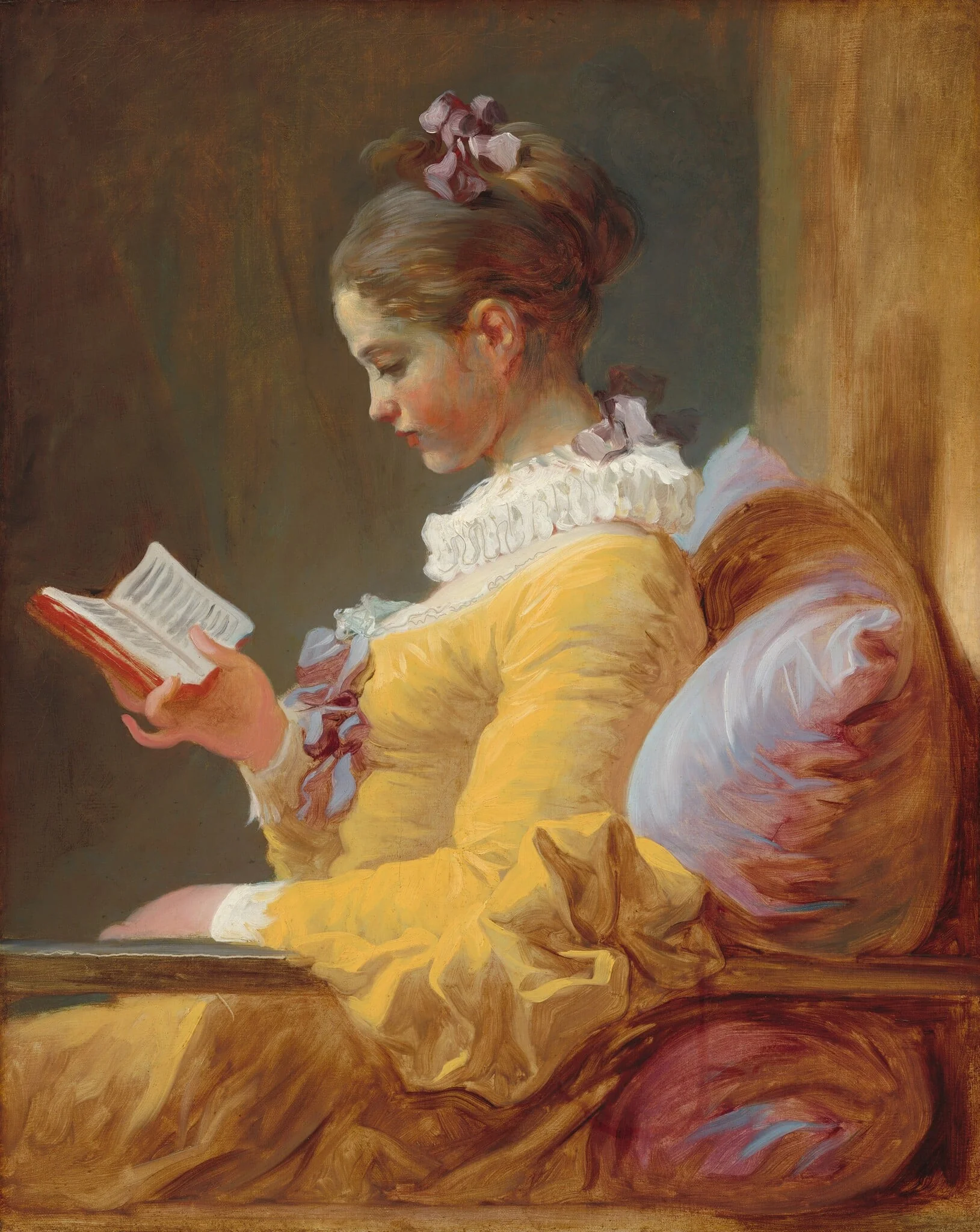
Now look hard at one painting. Fragonard's Young Girl Reading sets a young woman in strict profile against a warm, almost weatherless wall. She wears a saffron-yellow gown that catches the most light in the picture, with a soft white ruff bunched at the throat and a second frill at the wrist. A lilac cushion props her at the small of the back, and her right hand holds a little bound volume up and out, pinched at the corner between thumb and fingers, the way you hold something you do not want to crease. The brush moves fast. The ruff is laid in with a few loaded strokes that do not pretend to describe every fold, and the yellow of the dress is dragged so that the weave of the cloth and the weave of the canvas almost rhyme. Her eyes are down on the page. Nothing happens. That stillness is the whole event.
To a French viewer around 1769 this was not a neutral image of leisure. The reading girl was a live cultural argument. The book is small and bound for the pocket, the format of a novel, and the novel was precisely the form moralists worried would inflame a young woman's imagination and unfit her for duty. Set against that anxiety, Fragonard's choices read as a gentle verdict. He gives her composure, not flush. She sits upright, decorous, absorbed without being unstrung, a picture of interior life kept under control. The profile pose denies us her gaze and so denies us any flirtation. He paints reading as a self-possession rather than a temptation, and a buyer fluent in the debate would have caught the position the picture takes. The looseness of handling, the speed of it, belongs to the Rococo at full confidence, and Fragonard uses that fluency to make virtue look effortless rather than preached.
Daughters as evidence
Move across the Atlantic and the girl stops being a type and becomes a witness for the family. In Mrs. Noah Smith and Her Children the New England painter Ralph Earl arranges a Vermont matron with her children around her, and the daughter in the group is doing specific work. She is evidence. A provincial portrait like this was commissioned to assert standing in a community that had no aristocracy and few other ways to record itself. The clothes are painted with a hard, inventory-keeping clarity because the clothes are part of the claim. The daughter, dressed as a smaller echo of her mother, certifies continuity. She is the household's next link, the proof that the line and the property will carry forward, and she is posed to be legible as that, not as a particular child with a particular temperament.
The British conversation piece works the same lever with more polish. In The Saithwaite Family, Francis Wheatley distributes parents and children across a genteel setting so that the eye can total up the family as a going concern. The daughter's placement, her nearness to the mother, the small courtesy of her gesture, all communicate a well-ordered house to anyone trained to read the grammar of these groups. The girl is a unit of social information. Her individuality is permitted only to the degree that it flatters the whole. First viewers, who would have been the family's peers and rivals, understood the picture as a statement of arrival, and the child in it was part of the balance sheet of respectability.
It is tempting to call this cold. It is better to call it functional. The genre these pictures belong to is the everyday-life painting that Tate's glossary defines simply as work depicting scenes of ordinary life, the long tradition in which the household and its members became fit subjects for art at all (Tate, genre painting). Inside that tradition the girl is rarely idle. She is always carrying meaning for somebody.
Works discussed in this article
Vanity, the bonnet, and the marriage market
If the colonial daughter is sober evidence, the Jacksonian girl is a punchline with a moral attached. Francis William Edmonds built a career on small genre scenes that an American middle-class audience could read like a magazine cartoon, and The New Bonnet turns the title object into the whole subject. A young woman has acquired a new bonnet, and the picture is staged around the reactions to it. The bonnet was a charged object in 1850s America. It signaled money spent, taste claimed, and a young woman's readiness to be seen, which is to say her position in the courtship economy. Edmonds plays the older generation's wariness against the girl's pleasure, and the comedy lands because every viewer knew the script. A new hat is never only a hat when an unmarried girl is wearing it.
What makes Edmonds sharp rather than preachy is that he refuses to fully condemn her. The light favors the girl and the bonnet. The moral cloud sits with the older figures. A buyer could hang this as a caution against extravagance or as a quiet endorsement of a daughter's small ambition, and the ambiguity was good for sales. The girl is the hinge on which the household's anxieties about money and marriage swing, and the picture knows it. Compare the silence of Fragonard's reader with the audible domestic murmur here, and you can see the same subject doing opposite jobs, contemplative in one culture, transactional in another.
The girl at the edge of history
Sometimes the girl is not the subject at all but the thing that tells you what the subject means. In American landscape and history painting at mid-century, a small female figure planted in the foreground does heavy interpretive work. Jasper Francis Cropsey painted The Valley of Wyoming over a Pennsylvania valley whose name, to his audience, meant a Revolutionary-era massacre. A child set into that pastoral foreground is a deliberate signal. She tells the viewer that the bloodied ground has been redeemed into a peaceable settled landscape, that the violence is past and domestic life has taken root. The girl is a unit of reassurance. She converts contested history into safe scenery, and a contemporary viewer who knew the valley's reputation would have read her presence as the resolution of the picture's quiet argument.
The same logic governs the children in Thomas Pritchard Rossiter's Washington and Lafayette at Mount Vernon, a post-war scene of the general at home. A young girl in such a picture domesticates greatness. She converts the founder from a military abstraction into a grandfather on a porch, and that softening was exactly the political mood the painting was selling to an audience that wanted its heroes humane. In neither Cropsey nor Rossiter is the girl studied for her own sake. She is a pressure valve. She lets a difficult public subject relax into private virtue, and her smallness in the composition is in inverse proportion to how much meaning she carries.
When charm became enough
The turn comes with Impressionism, and it is a real break. Renoir's A Girl with a Watering Can, an oil of 1876 now in the National Gallery of Art in Washington, gives a child in a blue dress on a garden path, holding a watering can and a few flowers, smiling out at us. Search it for a moral and you come up empty. There is no novel to fear, no marriage market to negotiate, no lineage to certify, no massacre to redeem. The picture is a field of dappled light with a pleasant child at its center, and that is the entire ambition. The girl has been released from her duties as a sign. What is left is sensation, the warmth of a sunny afternoon rendered as broken color, and a charm offered without apology.
This is the point the Impressionist generation gambled its reputation on. A subject that earlier audiences would have found thin was now the whole proposition, because the proposition had moved from story to perception. The memoir of Renoir's own dealer, Ambroise Vollard, records a painter who distrusted programs and theories and wanted his canvases to be likeable in the most direct way. Read against the centuries before him, his garden child is the endpoint of the long unloading I have been tracing. The tronie had made the girl anonymous so the paint could perform. Renoir makes her anonymous so the light can perform, and he does it in the open air, in color, for a public that no longer needed the figure to teach it anything.
The release was never total, and the late century kept finding new ways to dress the girl up. George Hendrik Breitner's Girl in a White Kimono of 1894 looks like a study of an elegant Japanese woman. It is in fact a sixteen-year-old Amsterdam housemaid named Geesje Kwak, costumed for one of the kimono pictures Breitner produced during his fascination with Japanese art (Rijksmuseum, Girl in a White Kimono). The gap between what the picture shows and who the girl was is the old machinery still running. A working-class teenager is borrowed to stand for an aesthetic fantasy, her own identity painted out under the silk. Even at the door of the twentieth century, the girl is being asked to mean something other than herself.
That persistence is the real lesson of the archive. The subject reaches back much further than any of these canvases, to the fragmentary marble heads of antiquity, the kind of object that survives as a Greek Head of a Girl of around 300 B.C. in the Getty's collection, where a name and a story were lost almost as soon as the sitter was. From that marble to Breitner's maid, the girl has served as the most reliable blank in art, a figure innocent enough to seem free of argument and therefore perfect for carrying one. The pictures that first viewers loved were rarely about the girls in them. They were about virtue, money, lineage, nation, and skill, and the girl was the legible face those abstractions were given. To see the paintings as their first audiences did is to stop seeing innocent children and start seeing the work they were quietly built to do.
Sources & further reading
- Genre painting (art term) — Tate
- Johannes Vermeer, A Maid Asleep (ca. 1656-57) — The Metropolitan Museum of Art
- George Hendrik Breitner, Girl in a White Kimono (1894) — Rijksmuseum
- Johannes Vermeer, Girl with a Pearl Earring — Smarthistory
- Pierre-Auguste Renoir, A Girl with a Watering Can (1876) — National Gallery of Art
- A Girl with a Watering Can — Wikipedia
- Head of a Girl, Greek, about 300 B.C. — The J. Paul Getty Museum
- Ambroise Vollard, Renoir: An Intimate Record (1925) — Internet Archive