Joseon dynasty painting is usually introduced as an art of restraint: five centuries of disciplined ink, a Confucian court that distrusted display, scholars' pictures hung in cold rooms. That description is not wrong, and it explains almost nothing. The dynasty that ruled Korea from 1392 to 1910 put one hard question to the people who made its pictures, and it never settled on a single answer. The question was practical and moral at the same time. What is a painting actually good for in a state built on Neo-Confucian order, where the image is suspect and the written word outranks it?
My argument is that Joseon painting reads best as a long, unresolved argument about that question, and that its strongest work belongs to the painters who took a definite side. Over three centuries the answers piled up and refused to merge. One school held that a painting should record the actual land underfoot. Another held that it should catch ordinary people in the act of living. A stubborn devotional current insisted the gods still needed faces, whatever the court decreed. A fourth said the proper subject was the scholar's own desk, his books and his bronzes. The achievement of the period is not a house style. It is the disagreement, and the precision with which each camp pressed its case.
The state that distrusted pictures
The Joseon founders replaced Buddhism with Neo-Confucianism as the organizing creed of the state, and the change reached the easel. The official line, as Smarthistory notes in its account of a 1562 hanging scroll of Four Preaching Buddhas painted in ink and color on silk, was to suppress Buddhism in favor of the new orthodoxy.Smarthistory traces this policy through the surviving Buddhist scrolls. An image now had to justify itself. It could instruct, it could record a likeness, it could honor an ancestor. What it was not supposed to do was simply please the eye, or worse, invite worship.
It helps to see what the prohibition did and did not do. It did not outlaw the brush. It re-ranked its uses. Painting that served instruction, record, or ancestral duty kept its license; painting that served devotion lost its official standing without losing its public. The result was a contested art rather than a diminished one, the same medium carrying arguments the court would rather not have heard. You can read the whole period as a quiet tug-of-war over which of those uses gets to count as serious.
This is the pressure every Joseon painter worked under, and it is why the period rewards a reader who keeps asking what each picture is claiming for itself. A landscape that records a real mountain makes a different argument than a hanging scroll built to be bowed to. A portrait of a magistrate states one thing about the value of an image. A painted stack of books states another. The court would have preferred one obedient answer. It got several, and they did not agree.
First answer: paint the ground you stand on
The boldest answer arrived in the early eighteenth century, and it was disarmingly simple: paint Korea. For generations the educated taste had run toward idealized scenery in the inherited Chinese manner, mountains nobody had climbed, rivers nobody had crossed. The Metropolitan Museum's account of Korean landscape credits Jeong Seon, who lived from 1676 to 1759, as the father of the true-view, or jin'gyeong, landscape, the practice of painting actual Korean sites rather than borrowed scenery.The Met sets him at the head of that shift. The move sounds modest. It was not. It changed what a landscape was for.
An idealized mountain is an argument about cosmic order and the painter's command of a tradition. A specific Korean peak, rendered as it actually rises, is an argument that the world in front of you is worth the silk. Jeong Seon's followers carried the lesson into the next century, mapping gorges, temples, and the granite spines of the Diamond Mountains with a directness that earlier connoisseurs would have found provincial. The true-view painters answered the dynasty's question by saying a picture should be true, in the plain reportorial sense, before it is anything else. You can follow this thread sideways into the broader history of landscape as a genre, but its sharpest local form is Korean and eighteenth-century.
There is a polemic buried in the choice. To paint Mount Geumgang from a vantage a traveler could actually occupy is to claim that knowledge comes from looking, not from copying the old masters. The true-view painter trusts his own eye over the inherited album. In a culture that revered transmission above invention, that is close to heresy, and it is why the school can feel modern long before modernity reached the peninsula. The land stops being a backdrop for moral instruction and becomes a fact to be reported.
Second answer: the life of ordinary people
Almost in the same breath, a second answer took hold, and it pointed the lens lower. Genre painting, the depiction of common life, became one of the glories of the late Joseon court studio. Its central figure is Kim Hongdo, born in 1745, a court painter remembered above all for scenes of ordinary working people: a wrestling match, a smithy, a schoolroom, a tiled roof going up. Observers have since set his candor about daily life beside the painters of the Dutch Golden Age.That comparison follows him through the record, and it is apt for the same reason it is apt of Vermeer or de Hooch: the dignity is in the attention, not the subject's rank.
The Metropolitan Museum's survey of eighteenth-century Korean genre painting prizes exactly this quality, the candid, realistic record of everyday Joseon society. Here is where the period's argument turns combative. A Confucian state organized around hierarchy now had its most gifted court painters spending their skill on laborers and children. The genre painters answered the question by saying a picture is good when it tells the truth about how people actually live, which is a quietly radical thing to assert under that orthodoxy. The true-view painter looked outward at the land. The genre painter looked across at his neighbor. Both refused the safe, generalized subject the court understood, and both were rewarded for it anyway.
Third answer: the gods kept their faces
The third answer never had official permission, and it is the one our own collection holds most densely. Despite the policy of suppression, Buddhist devotional painting did not stop. It went on being commissioned by temples and lay patrons, and it kept the older language of frontal deities, gold-lined drapery, and rigid symmetry alive across the whole dynasty. The works catalogued in our archive under this movement lean heavily toward this devotional current, which makes our holdings a useful corrective to the textbook story that Buddhism simply faded from Korean art after 1392.
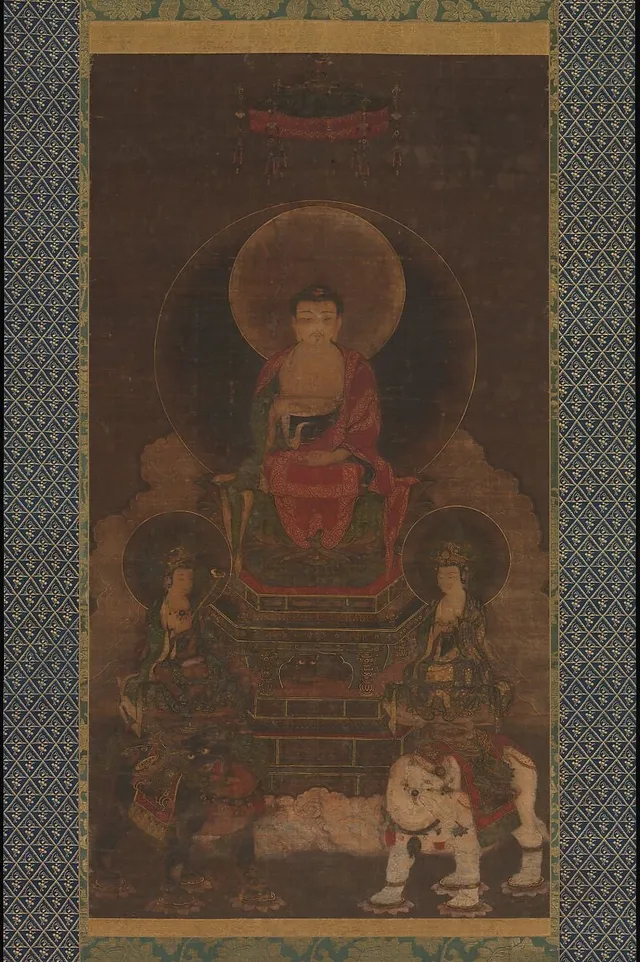
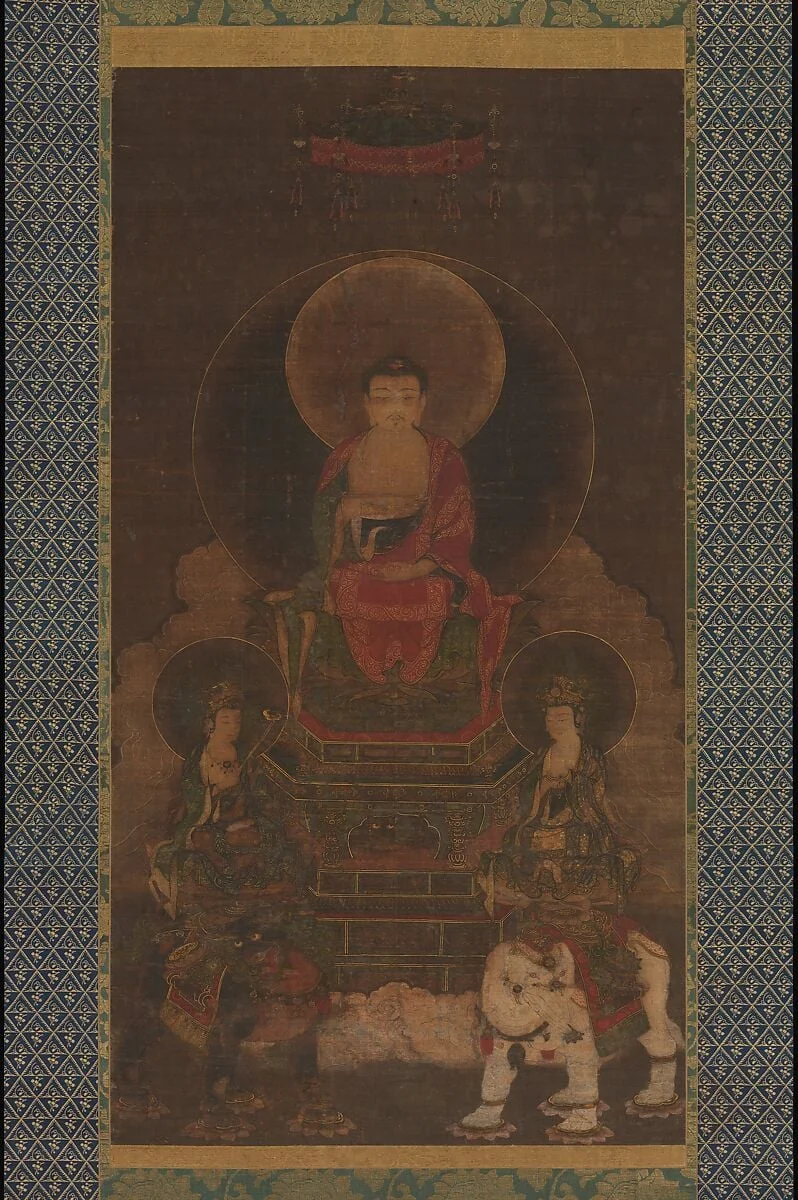
Look hard at the Shaka (Shakyamuni) Triad in the archive. The composition is rigorously symmetrical. Shakyamuni sits dead center on a lotus pedestal, drawn larger than the two bodhisattvas attending him, and he faces straight out at whoever stands before the scroll. The drapery is built from fine, even contours and then filled with color on silk, the folds traced in gold so they read less as cloth than as ornament laid over the body. A circular head halo and a full-body mandorla press the figure flat against the picture plane. There is almost no recession; the depth a landscape painter would insist on is deliberately refused. The attendants tilt inward, hips swung in a soft curve, crowns and jewelry picked out in the same gold. Nothing here is casual. Every line is a decision about reverence.
That last point is the whole argument of the devotional answer. This is an image made to be addressed, not browsed, and that is precisely the kind of object the court wanted to nudge to the margin of cultural life. The archive holds the same logic in related forms: the Death of the Historical Buddha, a Nehan-zu in which mourners ring the reclining Buddha in a grief that the symmetry only sharpens; the Four Deities of Mount Kōya, a protective assembly arranged with the same hierarchic care; and the fierce Daiitoku Myōō, a wisdom king whose bared teeth and ringed flames exist to frighten obstruction out of the worshipper's path. These pictures answer the dynasty's question by denying its premise. A painting, they insist, can still be a place where the sacred is met.
The archive even holds the working layer beneath such finished scrolls. The Iconographic Drawings of the Five Kings of Wisdom is a sketch-manual, a record of how the wrathful deities were to be drawn before any color or gold touched the silk. Strip away the pigment and you see the bones of the tradition: the prescribed count of arms, the placement of each attribute, the set of the brow. A painter did not improvise a wisdom king. He inherited him, line for line, from a book like this one. That is the devotional answer stated as a craft fact. The image was governed, and the governing was the point. Where the true-view landscape trusted the eye, the devotional workshop trusted the pattern, and it copied that pattern on purpose.
Works discussed in this article
Fourth answer: the scholar's desk
The fourth answer is the most self-aware, and in some ways the most Confucian of all, because it turns the scholar's own world into the subject. Chaekgeori, which translates roughly as books and things, is the painted still life of the study: shelves of bound volumes, brushes, inkstones, bronze vessels, fruit, spectacles. The genre flourished from the second half of the eighteenth century into the first half of the twentieth, a long run that carried it from court walls into ordinary homes. Its logic is sly. A culture that ranked the written word above the image found a way to make the image about the written word, painting the library so the library could hang where the library was not.
There is a wink in the form. The chaekgeori painter renders the scholar's tools with a precision that is itself a display of skill, then lets the books stand in for a learning the owner may or may not possess. The picture flatters and tests its viewer at once. It is the only Joseon answer that takes the orthodoxy's own scale of value, words over pictures, and turns it into a picture about that scale. The eye is invited to read a wall it cannot open.
Portraiture answered along a parallel track. A Confucian state had a clear, sanctioned use for the painted face: the commemoration of an official, kept and honored by his descendants. The archive's Portrait of an imperial censor and his wife belongs to this tradition of the recorded likeness, where the sitter's rank and rectitude matter as much as the resemblance. Read together, chaekgeori and the commemorative portrait give the same answer from two angles. A picture earns its place when it serves the scholar's order, either by furnishing his study or by fixing his standing for the generations after him. That is the orthodoxy meeting the painters halfway, and it produced work of real subtlety rather than mere compliance.
What the archive actually holds
Our own holdings tell a lopsided, instructive version of this story. Artifact World Gallery holds 202 works catalogued under Joseon dynasty painting, spread across 11 venues, attributed to 73 named or anonymous hands, with dates ranging from roughly 1125 to 1926. Set that against the moment Korean art first reached a broad Western public. The National Gallery of Art's 1957 exhibition, Masterpieces of Korean Art, was the first large showing of Korean art outside the Far East, presenting 187 objects, of which only 34 were paintings, spanning about 200 B.C. to roughly 1900.The National Gallery records those figures. Two hundred paintings in one online archive is, by that yardstick, an embarrassment of riches, and the bias toward devotional scrolls in our set is itself a finding worth stating plainly.
The named hands deepen the point. The collection threads works through painters such as Watanabe Kazan and Uto Gyoshi, alongside the monk-painter Ryūshū Shūtaku, and singly attributed works under Nagano Yasunosuke, Arai Kōu, and the workshop tradition recorded as After Gessen. A directory like this rewards the patient viewer who treats each attribution as a thread to pull, and who keeps the devotional imagery of Buddhism in mind as the connective tissue running through the set. The wider sweep of Korean painting puts those names in their long context, but the cluster of unsigned scrolls is where our archive earns its keep.
Where the answers went
None of the four answers won, and that is the right outcome. When the dynasty fell in 1910 the arguments it had hosted did not resolve into a victor; they scattered into the modern museum and the modern exhibition. The J. Paul Getty Museum's recent show, Hanbok: Mesmerizing Beauty, reached back across two thousand years of Korean dress and visual culture, the Joseon centuries among them, and treated that material as living heritage rather than archaeology.The Getty framed it that way. The pattern of these exhibitions is telling. Each one re-poses the dynasty's old question to a new public and lets the several answers stand side by side.
So the honest summary is not a unifying phrase. It is a confession that the Joseon dynasty asked its painters what a picture is for and accepted, in practice, four incompatible replies: record the land, witness the living, keep the sacred visible, and serve the scholar's order. The textbook tidiness that flattens all of this into restraint mistakes the silence of the court for the silence of the painters. They were not quiet. They argued, in ink and gold and silk, for three hundred years.
Sources & further reading
- Mountain and Water: Korean Landscape Painting, 1400-1800 — The Metropolitan Museum of Art (Heilbrunn Timeline of Art History)
- Four Preaching Buddhas (Joseon) — Smarthistory
- Kim Hongdo — Wikipedia
- Work and Leisure: Eighteenth-Century Genre Painting in Korea — The Metropolitan Museum of Art (Heilbrunn Timeline of Art History)
- Masterpieces of Korean Art (1957 exhibition) — National Gallery of Art
- Getty Celebrates 2,000 Years of Korean Fashion and Culture (Hanbok: Mesmerizing Beauty) — The J. Paul Getty Museum
- Korean painting — Wikipedia
- Chaekgeori — Wikipedia