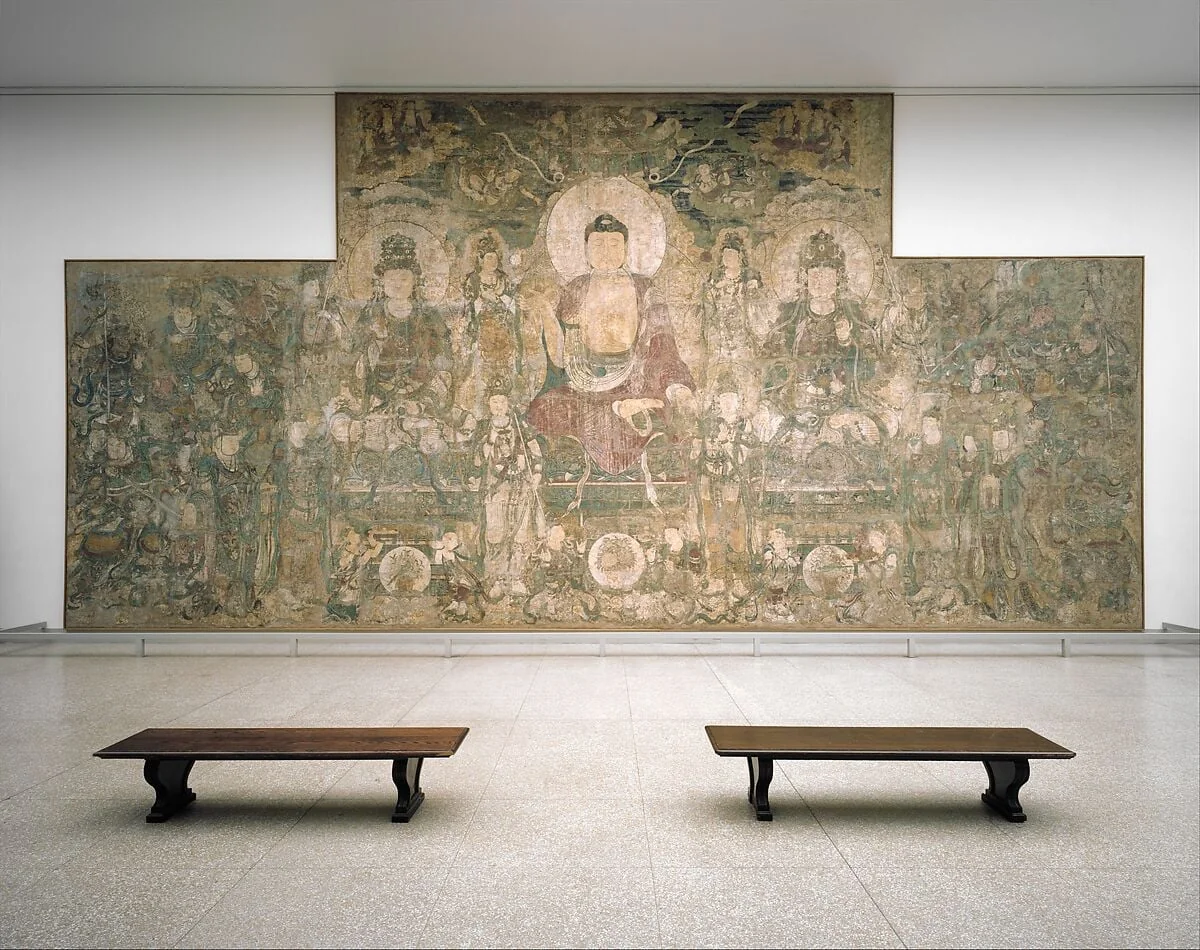
The works we file under Ming dynasty painting refuse to behave like a single school. A monumental temple wall crowded with gilded deities sits in the same drawer as a loose ink sketch a scholar made for a friend in an afternoon. Both are real, both are Ming, and the distance between them is the whole subject. My claim is plain. The label hides an argument between two ideas of what a picture is for: the picture as a made object, built by trained professional hands for a patron or a temple, and the picture as a trace of one cultivated mind thinking on paper. You can read survey after survey about the difference. It is faster to stand in front of one object and look until the argument becomes visible, until the two ambitions stop being categories in a textbook and become two different things a brush can be asked to do.
So this essay does one thing. It chooses a single defining work, the great Buddha of Medicine assembly, and reads it slowly enough that the rest of the period organizes itself around what we have seen. The mural belongs to the devotional, professional tradition the Ming inherited and never abandoned, even as the literati painters of Suzhou were rewriting what a serious picture could be. Hold that one wall in your eye and the two ambitions stop being abstractions. They become two ways of using a brush, two attitudes toward depth, two answers to the question of who a painting is addressed to. Once you can feel that switch, you can throw it yourself in front of any Ming object and know, almost before you have read the label, which side of the argument it was made on.
The work in front of us
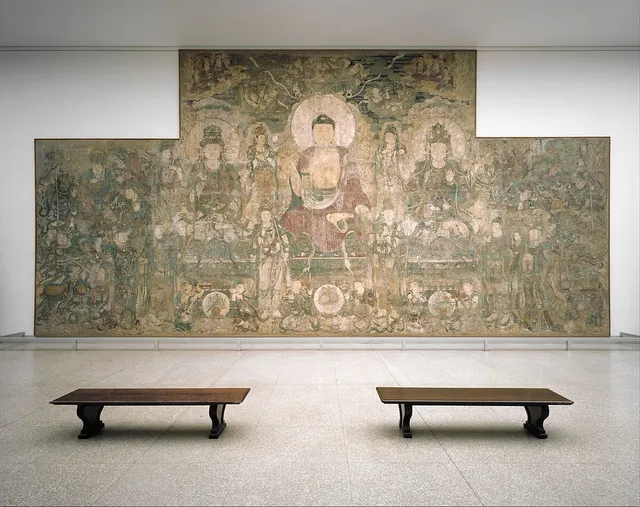
Begin with the scale of address. This is a wall, not a scroll. It was painted to be met by a standing worshipper, not unrolled across a desk, and every formal choice follows from that fact. The Medicine Buddha sits enthroned at the center, frontal, symmetrical, his hands resting in a quiet mudra around the small jar of healing. Around him the assembly does not recede into a landscape. It stacks. Bodhisattvas, attendants and armored generals are ranked upward across the surface in tiers, the higher figures simply placed higher on the wall rather than pushed back into measured space. The painter wants you to feel a presence filling a flat field of gold and mineral color, not to believe you are looking through a window at a real room. The composition is closer to a heraldic chart than to a stage set, and that is deliberate. A worshipper does not need perspective. A worshipper needs to find the deity instantly and to know, by sheer position and size, exactly who outranks whom.
Then look at the line. The drapery is carried by a long, even, confident contour, the kind of iron-wire outline that takes years of workshop discipline to lay down without a tremor. It does not describe weight the way European modeling does. It sings around the body and the robes as pure rhythm, and the color is poured inside it like enamel inside cloisons. The faces are calm and a little generalized, turned at gentle angles so the ranks read as a congregation rather than as portraits. Notice the jewelry, the crowns, the banded haloes: these are passages of sheer craft, repeated motifs executed at speed by a hand that has painted them a hundred times. Nothing here is improvised. Nothing here is private. The picture is a public instrument, an aid to devotion built to outlast the people who commissioned it, and it hides the labor that made it so that the labor will not distract from the god.
That is the first definition of a picture, stated about as loudly as it can be. A trained professional, often anonymous, serving a function outside himself, suppressing his own hand so the image can do its work. Keep that wall in mind, because the second definition begins by rejecting almost every value it embodies. The literati painter wants the tremor back. He wants the line to reveal the man, to record the pressure of a single wrist on a single afternoon, and he would rather a picture fail as illusion than succeed as a piece of anonymous furniture.
Two ambitions under one dynasty
In the early Ming the painters who mattered most worked close to the throne. The professional Zhe School and the court-supported Yuanti School set the tone, reviving the grand Song manner of monumental landscape and decorative bird-and-flower painting for an imperial audience, before the scholar-amateurs of the Wu School rose to dominate nationwide in the later dynasty (Wikipedia, Ming dynasty painting). The court styles prized polish, finish and a recognizable lineage back to the Song academy. They were paintings made to be received, hung, admired by an audience that included the most powerful patron in the empire. The devotional and decorative crafts kept running underneath all of this the whole time. Temple walls were still painted. Buddhist hells and paradises were still filled in by workshops that thought in outline and mineral pigment, the same way the Buddha of Medicine assembly thinks. None of this stopped when fashion at the top shifted toward the scholar's brush. It simply stopped being written about.
Our own holdings make the continuity hard to miss, and they also make a point about how messy the category really is. Artifact World Gallery keeps 751 works under the Ming painting facet, spread across 11 venues, by 247 named or attributed artists, with dates running from roughly 1072 to 1904. That span is the tell. A pure dynastic bracket would read 1368 to 1644. The wider range exists because the works that cluster here belong to a tradition with long roots in the Song and a long afterlife in the Qing, and because so many of the devotional pictures carry conservative styles that look backward by design. The facet is not a date. It is a family of intentions, and the family is large enough to argue with itself. Eleven venues for 751 works also tells you how thinly this material is distributed: no single museum holds the period whole, so the canon you carry in your head is always assembled from fragments held continents apart.
You can watch the professional, narrative impulse at work in pieces like the Ten Kings of Hell by Jin Chushi, where judgment scenes are organized for legibility and instruction, the damned processed through their reckoning in registers a viewer can follow like a court docket. The same instinct drives the luohans crossing the sea to the dragon king's palace, a set piece of waves, robes and incident built to be read like a story. Look at how the water is handled there: not as atmosphere but as pattern, each crest a repeated curl drawn with the same workshop assurance as the haloes on the temple wall, the figures riding the surface as clear silhouettes so that no part of the miracle is lost to mood. The serene White-robed Kannon belongs to the same devotional lineage, the figure carried almost entirely by the rhythm of a single drapery line against empty ground. These are pictures with jobs to do, and they do them without once asking you to think about the person holding the brush.
The Four Masters and the Suzhou pivot
The other definition of a picture had its capital in Suzhou. The Wu School took its name from the region, and it was held together by a shared theory rather than by any academy or court appointment. Shen Zhou, who lived from 1427 to 1509, is the figure usually named as its founder (Wikipedia, Wu School). The painters who carried it forward are remembered as the Four Masters of the Ming: Shen Zhou, Wen Zhengming who lived from 1470 to 1559, Tang Yin from 1470 to 1523, and Qiu Ying who worked into the middle of the sixteenth century (Wikipedia, Four Masters of the Ming dynasty). Outside the court these scholar-artists painted with self-expressive, calligraphy-trained brushwork, carrying forward the literati ethos earlier masters had championed before them. Wen Zhengming, who outlived the others and taught a generation, made the manner into something teachable, a discipline of dry brush and reticent color that a cultivated man could practice as a form of self-cultivation rather than a trade. Qiu Ying complicates the neat story, because he came up through professional training and worked for collectors, yet the field files him among the Four. The category, even at its most canonical, leaks.
Tang Yin is the most useful of them for our argument, because he stood on the seam. He had the technical command of a professional, the kind that could have filled a temple wall, and he spent it on the private, allusive subjects of the literati. The gallery holds seventeen works under his name, more than any other Ming hand in the collection. Look at a sheet like the untitled work attributed to Tang Yin, and the contrast with the Buddha of Medicine wall becomes physical. Where the mural buries the brush inside an even outline, the literati sheet lets the brush show its speed and pressure. Where the mural denies recession, the scholar's landscape opens a path for the eye to wander, often deliberately awkward, the depth handled as a series of moves rather than a smooth illusion. The mural addresses a crowd. The sheet addresses one friend who will know how to read it, who will recognize the borrowed manner of an old master and smile at the place where Tang Yin bent it.
This is also where the figural and the linear traditions of the literati cross. The court-trained Wang Zhenpeng shows what the fine-line manner could do in the hands of a master draftsman. His Vimalakirti and the Doctrine of Nonduality builds an entire dramatic encounter from pure outline, no color needed, the seated layman and his visitors defined by line alone. The whole debate of the sutra, the silence that answers the question of nonduality, is carried by nothing but the cadence of a contour. Set that beside the bamboo and ink studies of Wang Fu, where a few strokes stand for an entire grove and the empty paper does as much work as the ink, or the landscapes done in the manner of the Song master by an artist the collection records as After Guo Xi, and you can feel the period's full range across a single shelf: monumental devotion, fine-line narrative, expressive ink, and the studied revival of an older style. Four ambitions, one drawer, and not one of them willing to defer to the others.
Works discussed in this article
Dong Qichang and the theory of the past
The literati argument reached its most articulate form at the very end of the dynasty, in the work and the writing of Dong Qichang, who lived from 1555 to 1636 and ranks among the most influential late Ming painters and theorists. His central idea was that an artist transforms himself through creative engagement with the styles of the past, treating earlier masters as a vocabulary to be absorbed and then bent (The Met, Heilbrunn essay on the Ming dynasty). This is the opposite of the temple workshop's relationship to tradition. The muralist repeats an inherited type to make it function. Dong absorbs an inherited manner in order to depart from it, and to leave the record of that departure visible on the page. He sorted the whole history of painting into lineages so that a painter would know whose hand he was arguing with, and the argument itself, conducted in brush, became the content of the work.
Once you have looked hard at the Buddha of Medicine wall, Dong's project reads as a precise inversion of it. He flattens space too, but for the opposite reason. The mural flattens to enthrone a presence. Dong flattens to foreground structure, to let you watch a landscape being assembled out of brush conventions, the trees and rocks reading almost as a diagram of how to paint trees and rocks. The professional hides the method to deliver the image. The scholar exposes the method and makes the method the image. Stand the two side by side and you are looking at two crafts that happen to share tools and share nothing else: one that wants you to forget there was ever a hand, and one that wants you to think about nothing but the hand.
Where the dynasty ends, and where the line goes next
The Ming ran from 1368 to 1644, and its collapse did not end the visual habits it had refined. The crisp painted line that organized so much Ming work outlived the political dynasty. The professional draftsman's confidence in pure contour, the same discipline that built the Buddha of Medicine wall, kept describing form long after the wars that ended the dynasty scattered the workshops that trained it. A figure laid down in clean outline, the color poured in afterward to fill the space the line has already claimed, is a habit of hand that the seventeenth century carried into the new order without losing a step. The convention was stronger than the regime that happened to be in power when it was perfected.
The two definitions of a picture did not resolve into one winner. They both survived into the Qing and beyond, which is why the dates on our Ming shelf run so far past 1644. The professional devotional manner kept its temples and its workshops. The literati manner became the prestige language of the educated class, and Dong Qichang's theory of learning through the past hardened into orthodoxy, taught and copied until the freedom it was meant to license curdled into a set of approved moves. Anyone who wants to track that handoff at scale can read it in the great surveys, including James Cahill's study of the late Ming, and can see the canonical objects gathered in the landmark museum exhibitions of Chinese painting drawn from the imperial collections.
Return one last time to the wall. The Buddha of Medicine sits exactly where the painter left him, frontal and unhurried, his small jar of healing held in a hand that will never move. Nothing about him asks you to admire the artist. Everything about a Tang Yin sheet or a Dong Qichang landscape asks precisely that. To look at the period through a single defining work is to learn to feel that switch the instant a new picture is set in front of you, the moment the brush stops serving a deity and starts confessing a man. That switch, thrown back and forth for three centuries, is the real history hiding inside the word Ming.
The collection sits between two neighbors worth keeping in view. The scholar's brush that Tang Yin and Dong Qichang sharpened was inherited from the great masters who worked under the Yuan before the dynasty began, and it was carried forward, hardened into doctrine, by the painters of Qing painting. Trace the same line through all three and the Ming stops looking like an island and starts looking like the hinge it was, the place where an old craft of devotion and a new craft of self-portrayal-in-ink shared a brush for three hundred years and never once agreed on what it was for.
Sources & further reading
- Ming Dynasty (1368-1644), Heilbrunn Timeline of Art History — The Metropolitan Museum of Art
- Ming dynasty painting — Wikipedia
- Four Masters of the Ming dynasty — Wikipedia
- Wu School — Wikipedia
- The art of the Ming dynasty in China — Smarthistory
- The Distant Mountains: Chinese Painting of the Late Ming Dynasty, 1570-1644 — James Cahill, Weatherhill, 1982 (Internet Archive)
- Chinese Art Treasures exhibition — National Gallery of Art