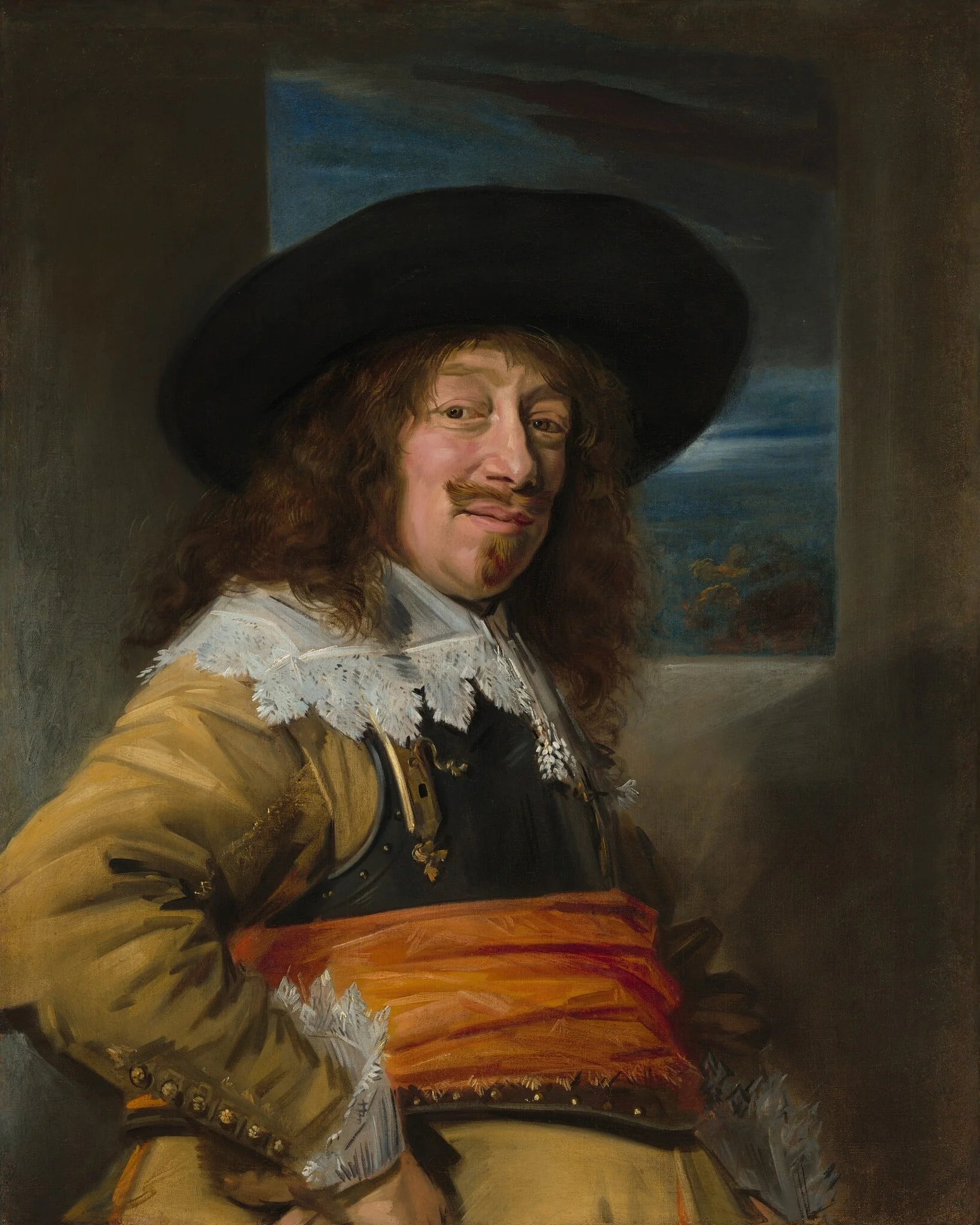
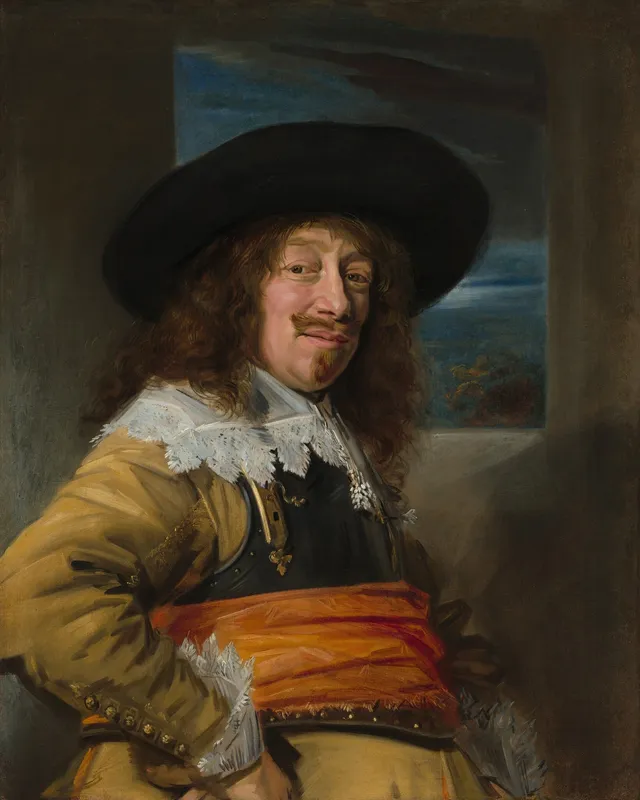
The pictures now gathered under the roof of the Hermitage Museum in St. Petersburg were not made for it. A militia portrait was made to hang in a Haarlem guard hall where the sitter's comrades would recognize his face. A small panel of a woman holding a flower was made for a Dutch household that understood what the flower meant. A society portrait of a young Englishman in costume was made to flatter a patron who would walk past it daily. None of these works was painted for an empress, a marble gallery, or a turnstile. The Hermitage is, before anything else, a machine for moving images out of the rooms that gave them meaning and re-coding them as imperial property. That is my argument here.
So the honest way to look at this collection is against the grain of the building that holds it. To ask what these paintings meant to their first viewers is to recover the layer the museum was designed to suppress: the local, devotional, civic, and domestic codes that a Calvinist burgher or an Antwerp dealer read fluently and that a museum label flattens into a name and a date. The scale of the displacement is easy to underestimate. Artifact World Gallery alone traces 3,085 works to this single venue, by 1,098 different hands, spanning roughly a thousand years from medieval objects to the twentieth century. Every one of those 1,098 painters worked for a first audience that was not Russian and not imperial. Reading the iconography back into the pictures is the closest we get to standing where those first viewers stood.
A collection assembled by purchase, not piety
The founding gesture sets the tone. The Hermitage began in 1764, when Catherine the Great acquired a block of paintings, mostly Flemish and Dutch, from the Berlin merchant Johann Ernst Gotzkowsky, who had assembled them for a Prussian king who could no longer pay for them (Hermitage Museum, Wikipedia). The collection was born as a transaction redirected. A Berlin debt became a Russian asset, and a few hundred pictures crossed a border on the strength of a cancelled sale rather than any shared faith or civic tie with their new owner.
What followed was acquisition at a continental scale, guided by agents who knew the European market better than any Russian court had before. The Metropolitan Museum's Heilbrunn essay on St. Petersburg credits Catherine, advised by Prince Dmitrii Golitsyn, Denis Diderot, and Baron Friedrich Melchior von Grimm, with assembling the core of what became the State Hermitage (Heilbrunn Timeline of Art History). Diderot, the encyclopedist, was effectively buying paintings for an empress he served as a kind of remote cultural minister. The point is worth holding onto: the people choosing these works were philosophers and diplomats, not the priests, guildsmen, and merchants the pictures were originally meant to address. A new grammar of value was laid over the old one. Rarity, attribution, and prestige replaced devotion, civic membership, and household instruction. The breadth our own catalog records, 1,098 artists under one venue, is the residue of that buying campaign, and it reads less like a community's accumulated faith than like a market cornered.
What a militia portrait meant in Haarlem
Start with the picture that anchors this group, the Portrait of a Member of the Haarlem Civic Guard by Frans Hals. Look at how it is built. The sitter turns toward us at an angle, his weight settled, his collar a bright slab of white laid in with a few decisive passes rather than worked to a finish. The flesh of the face is alive with quick, broken strokes, the comma-marks Hals used so that a cheek or a mustache reads as movement caught mid-breath. There is no varnished smoothness here, no courtly polish. The paint is frank about being paint, and the man looks back with the easy confidence of someone who knows exactly who is going to see this.
That confidence is the iconography. To a Haarlem viewer of the 1630s, a civic guard portrait was not a private vanity. The schutterij, the militia company, was the armed citizenry of a Dutch town, and membership signaled standing: a man prosperous enough to equip himself, trusted enough to bear arms for the commune, sociable enough to belong to the banquets and parades that bound the company together. The sash, the bearing, the slightly swaggering ease were a legible claim to a place in the civic order. Hals's whole company knew the difference between a captain and an ensign by the cut of a collar and the color of a sash. Hung in St. Petersburg under crystal light, the same picture becomes a generic Dutch worthy, admirable for its brushwork and emptied of its address. The first viewers saw a neighbor and a rank. We are taught to see a Hals.
Flattery, family, and the language of attributes
Court portraiture worked by a different code, and Anthony van Dyck was its supreme practitioner. Consider Philip, Lord Wharton, a young English aristocrat presented in pastoral costume, leaning with cultivated nonchalance. To a modern eye the shepherd's-crook conceit looks like fancy dress. To Wharton and his circle it was a precise statement: the Arcadian guise borrowed from court masque and poetry announced refinement, leisure, and a noble distance from the labor it pretended to evoke. Van Dyck gave English sitters a way to look effortlessly bred, and they paid handsomely for the illusion. The picture's first job was social positioning inside a specific aristocratic world, a job invisible the moment the canvas hangs beside a Dutch burgher and a French street scene.
His Susanna Fourment and Her Daughter carries another buried meaning. Susanna was a sister-in-law within the Antwerp circle of Peter Paul Rubens, whose workshop van Dyck came out of, and the double portrait of mother and child belongs to a Flemish genre that fused tenderness with lineage. A child beside a mother is partly affection and partly an heir, a future, a family's continuity made visible. Our catalog holds forty-two works under Rubens at this venue, a reminder that the Hermitage's Flemish core was an entire interlocking society of patrons and kin, not a list of masterpieces. The first viewers of a Fourment portrait knew exactly whose daughter that was and what alliance the child represented. The museum visitor sees a charming pair.
Dutch household painting pushed iconography into the smallest details, and this is where reading the first audience pays off most. Take A Woman Holding a Pink by Rembrandt. The pink, a clove-scented carnation, was a standing emblem in Netherlandish painting: betrothal, marriage, fidelity, the bond of a couple. A pendant portrait of a husband and wife would often place a single bloom in the woman's hand as a quiet vow. Rembrandt sets the flower in a pool of warm light against a dim ground, the woman's face emerging from shadow with that gravity he gave to age. The flower is not decoration. It is the sentence the picture is speaking. A seventeenth-century viewer read the carnation the way we read a wedding ring, without effort. Strip the pendant away, hang the panel alone in an imperial gallery, and the vow goes silent.
The anonymous A Girl with a Broom, catalogued simply as Dutch seventeenth century, shows the same logic at the humble end. A broom in a girl's hands carried the Dutch household virtue of cleanliness as a moral state, the well-ordered home standing in for the well-ordered soul. Genre pictures of maids and chores were not neutral snapshots of daily life. They taught, gently and repeatedly, what a virtuous household looked like, and they hung in the very rooms whose order they praised. The attribution may be lost, but the message was once perfectly clear to the family that owned it.
Works discussed in this article
From private cabinet to public hall
For most of a century these pictures meant whatever the court chose them to mean, because almost no one outside it could see them. The hermitage in the name was literal. It described a private retreat, a set of cabinet rooms where the empress and her favored guests looked at paintings that the public could not. The first viewers in St. Petersburg were a tiny circle, and the works addressed that circle as tokens of taste and reach rather than as the civic or devotional objects they had once been.
That changed with architecture. The purpose-built New Hermitage opened to the public on 5 February 1852, one of the first collections in Russia accessible beyond the imperial household (Hermitage Museum, Wikipedia). A new kind of first viewer arrived, the ticketed visitor walking room to room, and a new genre arrived with him: the illustrated guide-book that told him what to look at and in what order. The Internet Archive preserves one such room-by-room survey, Sergei Vesnin's stroll around the halls and galleries, which walks the reader through the museum gallery by gallery (Internet Archive). The guide-book is the museum teaching its public how to read pictures whose original codes were already a foreign language. It is the third layer of meaning laid down on the same canvases, after the workshop and after the cabinet.
When the icons walked out the door
The clearest proof that this collection had become pure asset came when the state spent it. Between 1930 and 1934 the Soviet government clandestinely sold off more than two thousand works from the Hermitage at foreign auctions and directly to foreign buyers, raising hard currency from the accumulated devotion of centuries (Hermitage Museum, Wikipedia). Raphael's Alba Madonna, painted around 1510 as a tondo of the Virgin and Child for Christian devotion, had been a jewel of the imperial gallery. In 1931 it was sold to the American financier Andrew Mellon, and since 1937 it has hung in the National Gallery of Art in Washington (National Gallery of Art). A picture made to focus a worshipper's prayer became, across four centuries, an altar object, then a Romanov trophy, then a Soviet export, then an American civic treasure. The iconography of mother and child stayed constant on the panel. Everything it meant to the people in front of it changed four times.
The traffic also ran inward, and the modern acquisitions invert the old story in a way worth noticing. The Russian industrialist Sergei Shchukin commissioned Matisse's mural Dance in 1909, and the final 1910 version is in the Hermitage, while the preparatory version went to New York (Smarthistory). Here the first viewer was a Moscow merchant who hung radical French painting on his own staircase before most of Europe had caught up. Shchukin's collection was nationalized after the revolution and eventually flowed into the Hermitage, so a privately commissioned modernist mural became state property by a route exactly opposite to the Raphael's. One devotional masterpiece was sold abroad for cash. One avant-garde commission was seized at home and kept. The building absorbs both with the same marble equanimity.
- Workshop meaning: a militia rank, a marriage vow, a devotional focus, a household virtue, legible to the first local audience.
- Cabinet meaning: a token of imperial taste and reach, seen by a closed court circle.
- Museum meaning: a named masterpiece on a public wall, read through a guide-book and a label.
Reading against the building
Modernity supplies the final case, and it almost mocks the whole project of recovering first meanings. Edgar Degas's Place de la Concorde shows a Parisian gentleman and his daughters crossing a vast urban square, cropped at the edges like a photograph, figures drifting past one another without quite connecting. Its first subject was the anonymity of the modern city, the way a boulevard turns even a portrait into a passing glance. A picture about the impossibility of fixing meaning in a crowd now hangs, fixed, in an imperial palace. The irony is total, and it is the irony this whole collection runs on.
The lesson generalizes beyond any one school. A devotional panel by Maurice Denis, whose Nabi pictures were made to recover a sacred art for a secular age, sits a few galleries from an Orientalist set-piece by Jean Léon Gérôme built to feed a Parisian appetite for the exotic, and from a Venetian mythology by Lambert Sustris that once decorated a humanist's palazzo. Each was made for a different first viewer with a different code. The museum's genius, and its quiet violence, is that it makes them all look like neighbors on a wall, as if they had always been speaking to the same person. They never were.
So the most useful thing a visitor can do in these halls is to refuse the building's flattening, at least for one picture at a time. Stand in front of the Hals and put him back in the guard hall. Put the carnation back in a marriage. Put the Raphael back on an altar and the broom back in a scrubbed Dutch kitchen. The pictures did not start as masterpieces in a row. They started as messages to particular people, and the messages are still there, under the varnish and the wall label, waiting for a viewer willing to read them the old way.
Sources & further reading
- Hermitage Museum — Wikipedia
- Saint Petersburg — The Metropolitan Museum of Art, Heilbrunn Timeline of Art History
- Raphael, The Alba Madonna — National Gallery of Art
- Matisse, Dance (I) — Smarthistory
- The Hermitage: a stroll around the halls and galleries — Internet Archive
- Photograph of the Hermitage, St. Petersburg — The J. Paul Getty Museum