Ask six people what Rococo painting actually is and you will get six answers that do not quite agree. One will say it is a kind of ornament, all shells and scrolls and asymmetry. Another will say it is a genre, the painted daydream of aristocrats flirting in a park. A third will give you a span of years and a king's name. A fourth will hand you a moral verdict: powdered, frivolous, the art a revolution was right to sweep away. None of them is wrong, and that is the argument of this essay. Rococo is not a thing with a single definition waiting to be recovered. It is one question that the eighteenth century kept answering in different registers, and the answers contradict each other because the people giving them wanted different things from the same paintings.
So the lens here is plural by design. Instead of marching toward one tidy definition, I want to hold four good answers up against each other and against the works themselves, then let our own archive cast a deciding vote on which answer the surviving evidence actually supports. The thesis: the disagreement is the subject. Rococo looks unstable because it genuinely was a moving target, an ornamental impulse that escaped the wall and became a way of painting figures, then a period label, then a slur. Watch the question pass through those four hands and you understand the style better than any single sentence could tell you.
The case that started as a problem of classification
It is worth starting with an institutional embarrassment, because it tells you the trouble was there from the beginning. When Antoine Watteau sought admission to the French Royal Academy, the Academy had no box to put him in. He did not paint history, the grand machine of gods and battles that sat at the top of the official hierarchy. He did not paint plain portraits or still life either. He painted elegant people doing nothing in particular in gardens that shade off into mist. Faced with a candidate its own categories could not name, the Academy invented a category, the fête galante, in 1717, rather than turn him away. Watteau delivered The Embarkation for Cythera as his reception piece that same year.
Think about what that means. The defining genre of the new style did not grow out of theory. It was reverse-engineered from a single artist the rules could not accommodate. That is a clue worth keeping. Rococo did not announce a program the way later movements would. It accreted, picked up names after the fact, and forced its categories open as it went. The very first official answer to the question, what is this, was a shrug dressed as a decision.
Answer one: it is an ornament
The oldest and most literal answer lives in the word. Rococo comes from the French rocaille, the rock-work and shell-work of grottoes and fountains, the curling, encrusted forms decorators borrowed from coral and seashells. Tate keeps the etymology plain: the name derives from rocaille, rock-work, built on the forms of shells and corals used in eighteenth-century ornament. Before it was ever a way of painting a face, the Rococo was a vocabulary of edges. The S-curve and the C-scroll. Surfaces that refuse to sit still. A frame that sprouts into a cartouche, a mirror that dissolves into gilded weed.
This is not a footnote to the painting. It is the grammar underneath it. The American scholar Fiske Kimball spent a career arguing exactly that, and his 1943 study tracing the style's genesis through the Parisian interior decorators of the 1700s remains the case for reading Rococo from the moulding outward rather than from the easel in. The Getty made a related wager more recently, gathering eighteenth-century drawings under the banner of a Rococo revolution and tracing the whole sensibility back to those decorative rocaille roots. Once you have the ornament in your eye, you see it migrate. The asymmetry of a console table becomes the off-center composition of a canvas. The serpentine line of a candelabra becomes the pose of a shepherdess. The answer that says Rococo is an ornament is really saying that the painting learned to behave like the room it hung in.
Answer two: it is a genre, and a temperature
The second answer moves from the wall to the figures. Here Rococo is the fête galante and its relatives, the painted leisure of a class with nothing to do and a great deal of silk to do it in. Smarthistory makes the useful point that the eighteenth century did not call this Rococo at all. It called it le style moderne, the modern style, and it understood Watteau's Rubens-soaked outdoor reveries as a brand-new genre rather than a decadent late chapter. The word Rococo, as a label for paintings, is mostly something the nineteenth century pinned on afterward, often with a sneer.
No painter answered the question this way more confidently than François Boucher, the great machine of the style, who could turn out a goddess or a milkmaid with the same buttery ease. He is well represented in our holdings, and his Washerwomen is a good place to catch the trick. The subject is labor, women at a stream with their linen, the kind of thing a Dutch realist would have rendered as work. Boucher renders it as an idyll. The drudgery has been combed out of it. The light is theatrical, the poses are arranged, and the whole scene tilts toward pastoral fantasy. That is the genre answer in miniature: Rococo takes the world and warms it past the point of fact.
But the genre is broader than the flirtation it is famous for, and that breadth is easy to miss. Venice gave it a topographic branch, the view painting, where the same appetite for sparkle attached itself to architecture and water instead of skin. Antonio Joli worked that vein, and his Procession of Gondolas in the Bacino di San Marco carries the Rococo love of staged spectacle out onto the lagoon, the Doge's barge and its flotilla laid out for the eye like a society party with the palace as backdrop. Still life answered too. Jan van Huysum brought the same restless, asymmetric energy to a vase of blooms; his Flowers in an Urn builds a swag that spirals off-axis, petals at the peak of freshness next to a curling brown leaf, a snail and a bead of dew set down with jeweller's precision. The genre answer, taken seriously, is not one subject. It is one temperature applied to many.
Close looking: Fragonard's reader
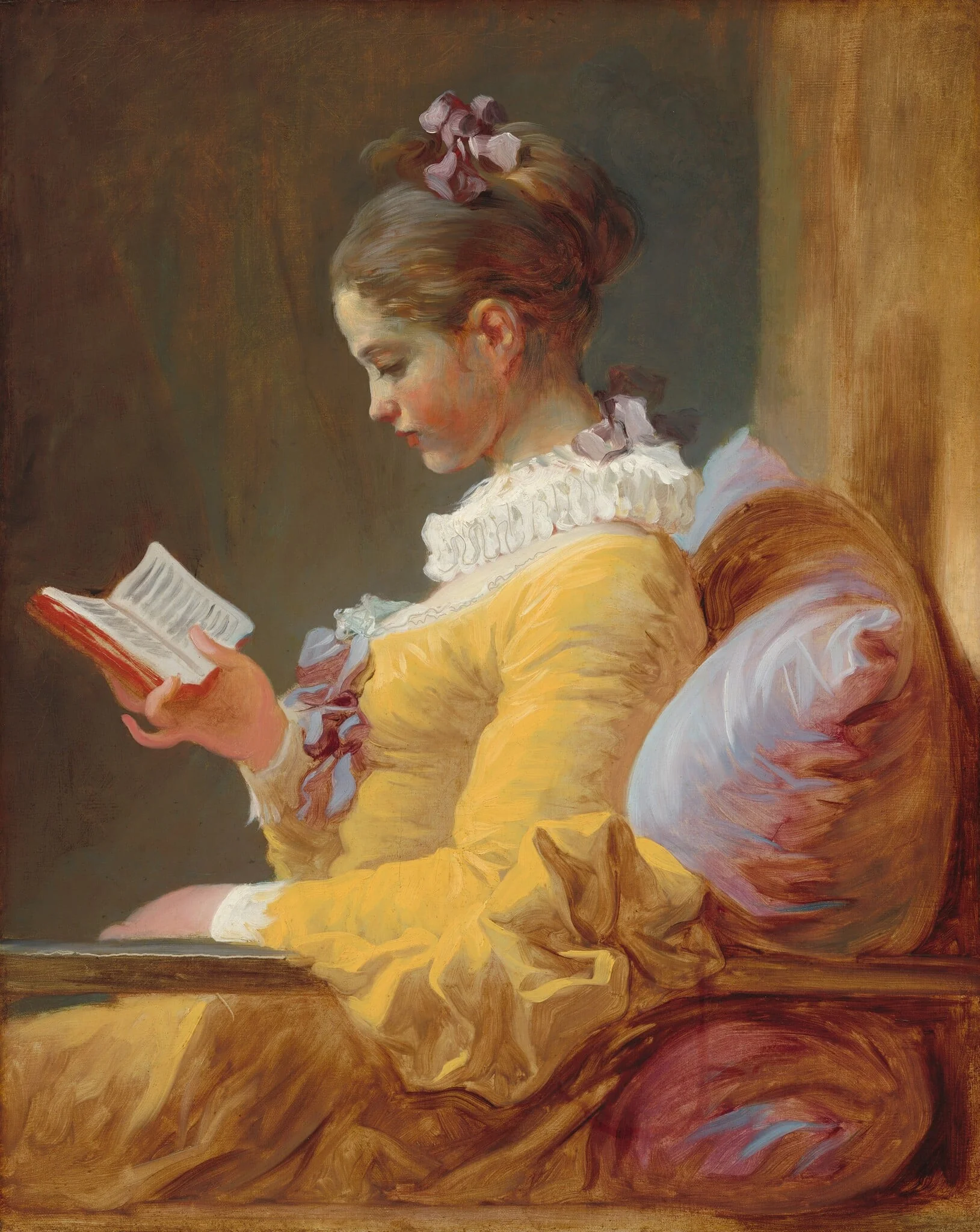
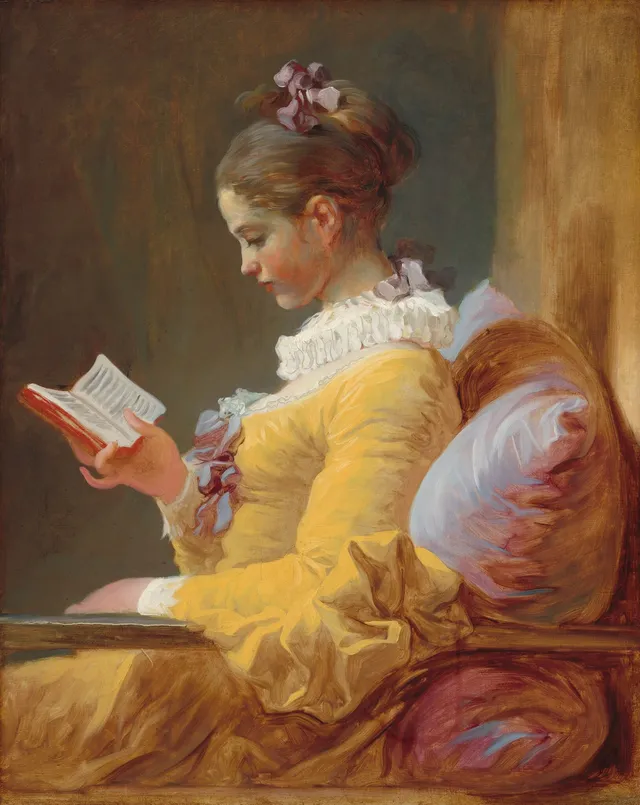
To test whether the genre answer holds, look hard at one small canvas. Jean Honoré Fragonard painted Young Girl Reading as a pure profile, the sitter turned cleanly to our left, a slim book held up in one hand. Start with the dress. It is a saturated lemon gold, and Fragonard lays it on in long, loaded strokes that you can almost count, the fabric catching light along the forearm and the bodice while the back falls into shadow. He is not hiding the brush. The ruff at her throat and the lilac bow in her hair are flicked in wet and fast, a few decisive touches standing in for lace and ribbon. Behind her the wall is a warm, undifferentiated brown, doing nothing but pushing her forward. A bolster cushion behind her back, mauve and plump, props the figure and gives the eye a second curve to follow.
Now the interpretation. Everything here serves attention. The profile pose means we cannot meet her eyes, so we are left watching her watch the page, and the painting becomes about absorption rather than display. This is the genre answer at its best and its limit at once. It is leisure, yes, a girl with the time and the book, exactly the cultivated idleness the fête galante traffics in. But the handling refuses the charge of mere frivolity. The paint is doing something earnest. Fragonard cares more about the speed of his own wrist and the weight of that yellow than about telling you anything flattering. The frivolous subject hides a serious picture. That gap is the reason the genre answer alone never quite settles the question.
Answer three: it is a period and a map
The third answer reaches for the calendar. Rococo, on this account, is a stretch of years and a court. It emerged in France in the 1730s as a reaction against the heavy, symmetrical grandeur of the Louis XIV style, took hold in Paris under Louis XV, and had its strongest run across roughly the second quarter of the century. That dating is clean and useful, and it is the answer a textbook reaches for first.
It is also the answer that travels worst, because the style did not stay in Paris on a schedule. The Met's account of the ornamental style maps its spread as a relay: origins in Italy, full flowering in France from the 1730s, a crossing into England in the 1740s, and an arrival in the American colonies by the 1750s. So the period answer is really several periods stacked by geography, the same forms reaching London a decade after Paris and Philadelphia a decade after that. A date that is true in one city is wrong in another. The map keeps overruling the calendar.
This is exactly where our own archive earns its keep, because a collection at scale can show you the spread the textbook flattens. Artifact World Gallery holds 8,822 Rococo works by 1,673 artists across 135 venues, with dates running roughly from 1453 to 2022. Read those numbers against the tidy 1730s-to-1759 window and they tell a more honest story. Sixteen hundred-odd hands is far too many for a Parisian court style; that figure is the relay made visible, the engravers and provincial decorators and colonial portraitists who kept answering the question long after and far away. The improbable date range is the giveaway too. A label that supposedly belongs to two French decades is sitting on works spread across half a millennium, because cataloguers attach Rococo to things that share its temperature, not just its years. The period answer is not false. It is just smaller than the evidence.
Answer four: it is a moral verdict
The fourth answer is the loudest and the least about paint. For a long stretch, to call a work Rococo was to convict it. The charge sheet was drawn up by the Neoclassical generation that followed, who looked at all that pink and gilt and saw a ruling class fiddling while the country slid toward 1789. Seriousness, civic virtue, the firm outline and the noble subject, these were the corrective. The curl and the blush were the disease. On this reading Rococo is not a style at all but a symptom, the visual signature of a society about to be swept away.
The verdict stuck, and it is why the word still carries a faint smell of disapproval. Even Fragonard's most famous picture gets enlisted for the prosecution. The Swing, that confection in the National Gallery of Art, with its young man positioned to look up the skirts of a woman kicked high into the foliage, is taught as the style's self-indictment, charm curdled into something complicit. There is force in the reading. But notice what it does. It answers an aesthetic question with a political one, and then it forgets that it switched. The moral answer is the only one of the four that does not really look at the painting. It looks past it to the society that paid for it.
And that is the trouble with letting it win. The same period produced Marie-Victoire Lemoine, a woman building a serious career inside a system that barely let her, and it produced devout works that wear Rococo dress without a hint of decadence. Our archive holds a small, strange one, The Ark by Lodewijk Tieling, a painter we can place only loosely around 1695 to 1700. A biblical subject treated with the curling, decorative sensibility of the moment is not the art of a class drowning in its own pleasure. It is just a style being used, the way styles always are, for whatever the patron wanted. The moral answer mistakes a tool for a confession.
Works discussed in this article
Which answer wins
Put the four answers side by side and a pattern surfaces. The ornament answer is the truest to origins and the least satisfying about pictures, since it stops at the frame. The genre answer is the richest about pictures and the weakest about boundaries, since it keeps spilling into Venice and Amsterdam. The period answer is the most teachable and the most easily disproved by a large enough collection. The moral answer is the most influential and the least curious, an aesthetic question wearing a political coat. Each captures something the others miss, which is why a serious account cannot pick one and discard the rest.
If I have to weight them, I weight toward the first. Rococo is best understood as an ornamental logic that learned to walk. The off-center composition, the serpentine pose, the refusal of the heavy axial symmetry that came before, the preference for the curve over the column, all of it starts in the rocaille and ends up governing how a figure is placed and how a still life is bunched. The genre, the period, the verdict are all downstream of that one formal decision to let asymmetry and the curve run the eye. Watteau's misfit candidacy, Boucher's warmed-over washerwomen, Fragonard's loaded yellow, Joli's flotilla, van Huysum's spiralling bouquet, they are the same grammar in different sentences. Hold the shell-work in your eye and the contradictions stop being contradictions. They become dialects.
Which leaves the question productively open, where it belongs. The next time the word Rococo comes up and someone hands you a single definition, ask which of the four answers they are giving, and whether they know they are choosing. The honest reply is that the style was a question its own century never closed, and the eight thousand surviving answers in one archive are proof that it stayed open far longer, and far further from Paris, than the tidy story admits.
Sources & further reading
- Rococo (art term) — Tate
- Fête galante — Wikipedia
- A beginner's guide to Rococo art — Smarthistory
- American Rococo — The Metropolitan Museum of Art
- The Swing — National Gallery of Art
- Creation of the Rococo (Fiske Kimball, 1943) — Internet Archive / Philadelphia Museum of Art
- Rococo Revolution — The J. Paul Getty Museum
- Rococo — Wikipedia
- The Embarkation for Cythera — Wikipedia