Artwork
Ad Astra
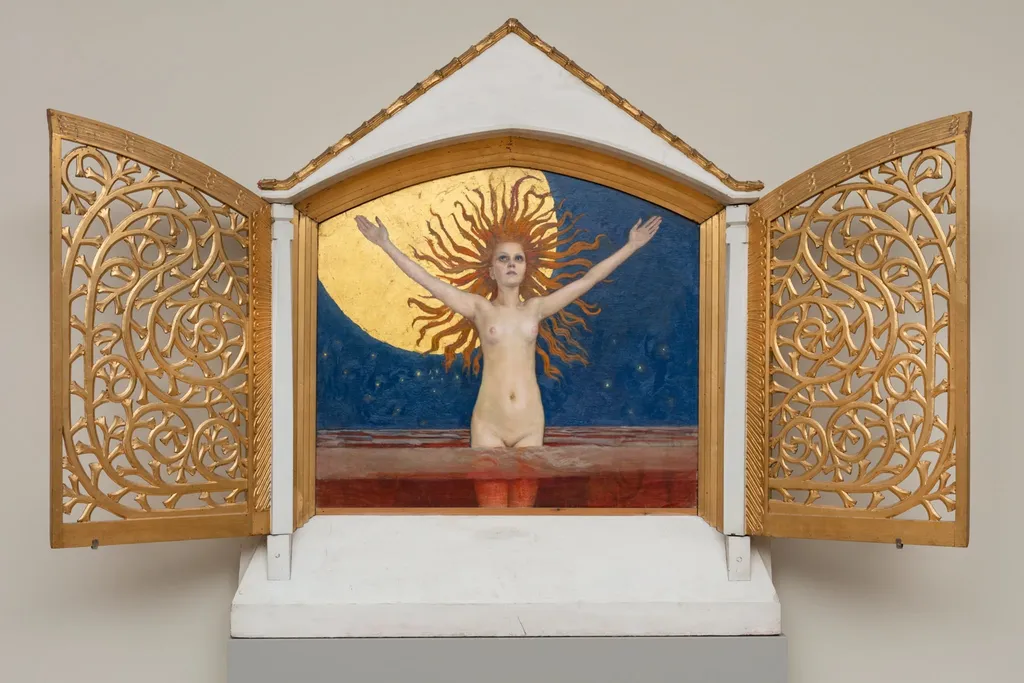
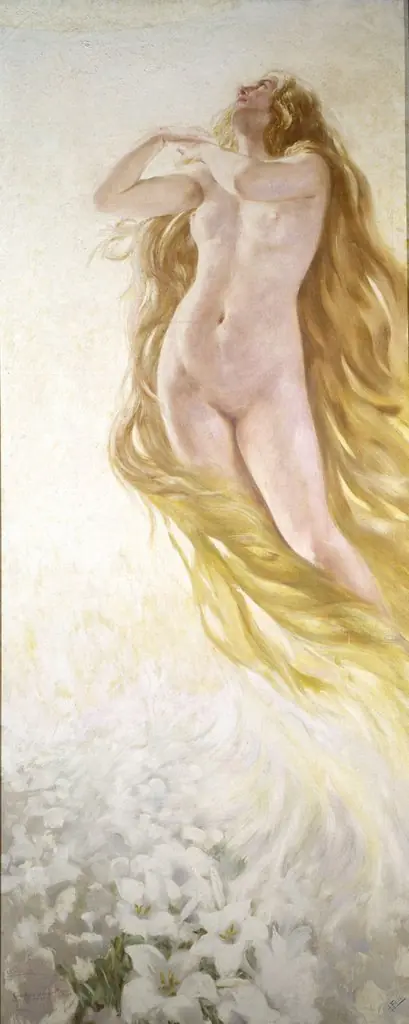
Ad Astra is an oil painting by the Impressionist artist Akseli Gallen-Kallela. It dates from 1895 and is held in the collection of the Art Institute of Chicago.
- Accession no.
- 234877
- Credit line
- The Lacy Armour Fund; Old Masters Society; European Painting General Sales Proceeds, Charles H. and Mary F. Worcester, Josephine and John Louis funds, through prior gift of Mrs. Gilbert Chapman; European Painting Acquisition, Carol Rosenthal-Groeling, and Irving Lauf funds.
About this work
Overview
Created in rural Finland, the work emerged from his immersion in both Symbolist aesthetics learned in Paris and the mythic traditions of Finnish folklore.
Ad Astra is an oil painting on canvas, housed within a custom-built, gilded wooden frame designed by Akseli Gallen-Kallela. Created in rural Finland, the work emerged from his immersion in both Symbolist aesthetics learned in Paris and the mythic traditions of Finnish folklore. The piece functions not merely as a painting but as a devotional object, integrated into the artist’s personal sanctuary and later used in his daughter’s baptism.
Subject & Meaning
The painting depicts a young girl suspended in a moment of stillness, her hair drifting upward as if defying gravity. Gallen-Kallela interpreted this posture as a reference to Christ’s crucifixion, yet the upward motion suggests resurrection rather than suffering. The image merges earthly realism with spiritual symbolism, evoking transcendence and renewal without direct religious narrative, aligning with the artist’s interest in mythic transformation.
Technique & Style
Gallen-Kallela employed glazing techniques to achieve luminous, atmospheric color transitions, characteristic of Symbolist practice. His brushwork blends naturalistic detail with dreamlike distortion, particularly in the rendering of hair and light. The composition avoids linear perspective, favoring a flattened, decorative plane that echoes both Nordic folk art and the mystical tonalities of Symbolism.
History & Provenance
Painted during Gallen-Kallela’s retreat to the Finnish countryside, Ad Astra adorned his self-built wilderness studio, a space he designed as a sanctuary for creative and spiritual reflection. The frame, entirely crafted by the artist, was conceived as an altarpiece. The painting was later used in the baptismal rite of his daughter, reinforcing its role as a sacred object within his personal life.
Context
Created during a period of rising Finnish nationalism under Russian rule, the work reflects broader cultural efforts to forge a distinct national identity. Gallen-Kallela fused indigenous legends with European Symbolist trends to articulate a uniquely Finnish spiritual vision, resisting cultural assimilation through art. His synthesis of folk motifs and modernist techniques contributed to a visual language that resonated with Finland’s emerging sense of autonomy.
Legacy
Ad Astra exemplifies Gallen-Kallela’s role in shaping Finnish cultural modernism. By embedding national myth within Symbolist form and integrating art into ritual space, he expanded the boundaries of painting as both aesthetic and spiritual practice. The work remains a touchstone in Finnish art history for its fusion of personal devotion, ethnic identity, and innovative technique.
Own this work as a print
Artist & collection

Artist
Akseli Gallen-Kallela (born Axel Waldemar Gallén; 26 April 1865 – 7 March 1931) was a Finnish painter and a leading figure of Finnish romantic nationalism around the turn of the 20th century.