Artwork
Valley of the Yosemite
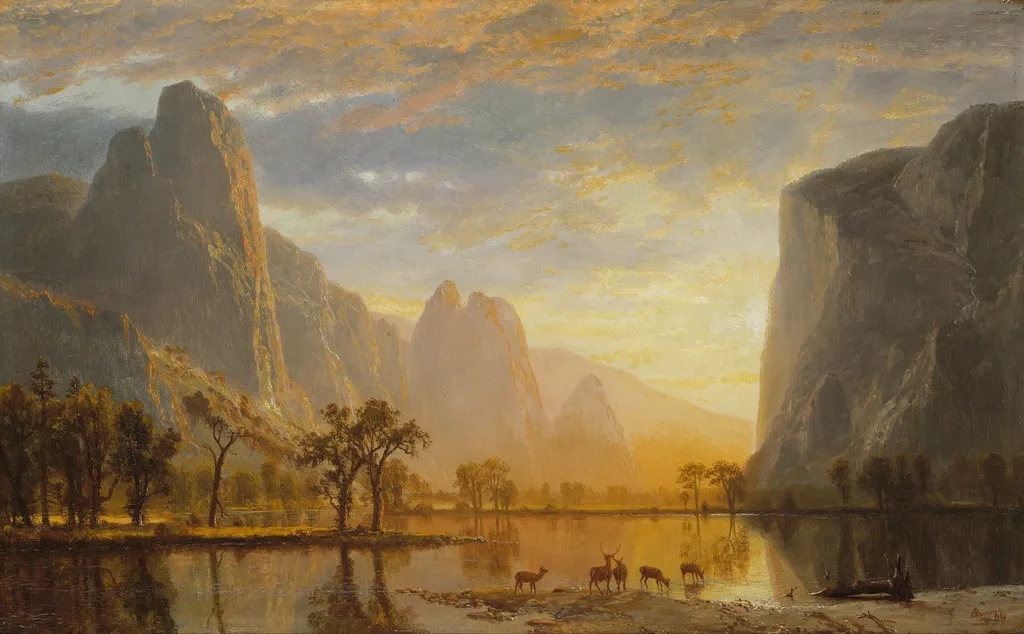
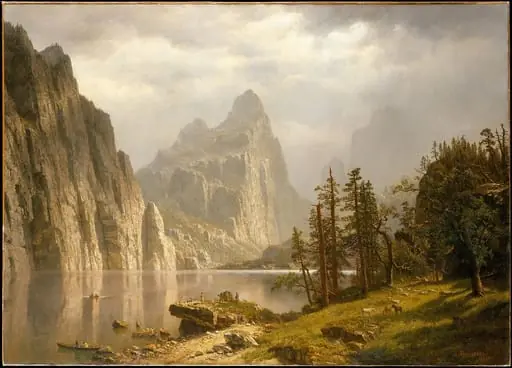
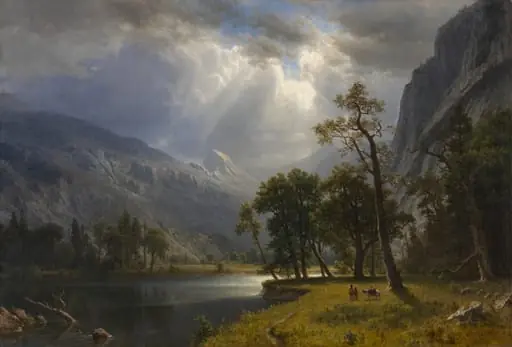
Valley of the Yosemite is an oil painting by the Hudson River School artist Albert Bierstadt. It dates from 1864 and is held in the collection of the Museum of Fine Arts Boston.
About this work
This painting shows a sweeping view of Yosemite Valley. It’s an oil painting made in 1864 by Albert Bierstadt. The work helped make him well-known for his dramatic western landscapes.
Bierstadt started out linked to the Hudson River School. His Yosemite scenes later won big praise from critics and the public.
See it at the Museum of Fine Arts Boston.
Subject & Meaning
Created during the American Civil War, the painting resonated with viewers as a symbol of an unspoiled sanctuary amidst national unrest.
Albert Bierstadt's Valley of the Yosemite depicts an idealized vision of the American wilderness, specifically featuring deer, a river, shores, trees, and mountains within Yosemite Valley. The artist portrayed this landscape as a completely untouched paradise, reminiscent of the Garden of Eden, with a cluster of deer lingering peacefully in the foreground to emphasize tranquility. Executed in a style blending Hudson River School traditions with luminism, the work captures a setting sun casting a yellow-orange glow over the scene, reinforcing its idyllic nature.
Created during the American Civil War, the painting resonated with viewers as a symbol of an unspoiled sanctuary amidst national unrest. Bierstadt's depiction of Yosemite as a pristine environment helped spur public support for conservation, contributing to the momentum that led President Abraham Lincoln to sign legislation in 1864 protecting the area's natural beauty for public enjoyment.
Technique & Style
Executed in 1864, this landscape is rendered in oil paint on a paperboard support. The work's modest dimensions and choice of material have led to interpretations that it served as a preliminary sketch for Bierstadt's larger panoramic canvas, Looking Down Yosemite Valley, California, completed the following year. Stylistically, the painting merges the grandeur of the Hudson River School with luminist qualities, characterized by a setting sun that bathes the scene in a yellow-orange glow.
Bierstadt constructed an idealized vision of the American wilderness, depicting a cluster of deer resting peacefully in the foreground to emphasize a landscape untouched by human presence. This composition reflects the artist's en plein air studies conducted in Yosemite Valley during the summer of 1863, which he later synthesized in his New York studio to create an idyllic representation of nature.
History & Provenance
Valley of the Yosemite was painted by Albert Bierstadt in 1864 in his New York studio, following a summer 1863 trip to Yosemite Valley with writer Fitz Hugh Ludlow during which he made plein-air studies used as references. The work is executed on paperboard and measures 30.16 cm × 48.89 cm.
Commissioned by the Metropolitan Fair held in April 1864 to benefit the United States Sanitary Commission, the painting sold there for $1,600, the highest price at the sale. It was purchased by James Lenox for his private collection and displayed in the Lenox Library galleries. After Lenox’s death, the painting entered the New York Public Library in 1895.
In April 1943, the Library auctioned it through Coleman Auction Galleries to Newhouse Galleries, which sold it the same year to dealer A. F. Mondschein. Mondschein then sold it to Maxim Karolik, whose wife donated the work to the Museum of Fine Arts, Boston on June 12, 1947.
Valley of the Yosemite is held by the Museum of Fine Arts, Boston. The work was gifted to the museum on June 12, 1947, by the wife of collector Maxim Karolik, who had acquired it earlier that year. Prior to this acquisition, the painting passed through several notable hands, including art dealer A. F. Mondschein and Newhouse Galleries, after being sold at auction by the New York Public Library in April 1943.
The library had received the work from the Lenox Foundation following the merger of the Lenox Library, Tilden Trust, and Astor Library. James Lenox originally purchased the painting for $1,600 in April 1864 after it was exhibited at the Metropolitan Fair in aid of the United States Sanitary Commission. The work was displayed in Lenox's New York galleries before entering the public library system.
Context
Valley of the Yosemite (1864) situates Albert Bierstadt within the Hudson River School while also reflecting luminist tendencies in its luminous, atmospheric handling of light. Executed on paperboard at a relatively modest scale, the work was likely a preparatory study for the larger Looking Down Yosemite Valley, California (1865), underscoring Bierstadt’s practice of synthesizing plein-air sketches into grand, idealized compositions.
The painting’s reception was immediate and enthusiastic. Exhibited at the Metropolitan Fair in April 1864, it fetched $1,600, the highest price at the Sanitary Fair sale, securing its place as a celebrated emblem of the American West. Its glowing sunset palette and untouched wilderness imagery resonated during the Civil War era, framing Yosemite as a national paradise and catalyzing public support that led to its 1864 legislative protection.
Bierstadt’s portrayal thus bridged aesthetic idealism with environmental advocacy, embedding the work in both art-historical and conservation narratives.
Legacy
Valley of the Yosemite helped crystallize Yosemite’s status as an American Eden during the Civil War era, reinforcing the region’s symbolic value as an untouched wilderness. Bierstadt’s idealized depiction contributed to growing public support for conservation, prompting President Abraham Lincoln to sign the 1864 bill protecting Yosemite as a public park.
The painting’s immediate impact was evident at the April 1864 Metropolitan Fair, where it sold for $1600, the highest price at the Sanitary Commission sale, and entered the collection of James Lenox. After passing through the Lenox Library and New York Public Library, it was auctioned in 1943 and acquired by dealer A. F. Mondschein before entering the collection of Maxim Karolik. Karolik’s gift to the Museum of Fine Arts, Boston in 1947 secured its legacy in a major American institution.
Overview
Albert Bierstadt’s 1864 oil on canvas, Valley of the Yosemite, presents an expansive panorama of the iconic valley. Executed during the artist’s mature period, the work captures the dramatic light and scale that characterize his western landscapes. The painting is part of the collection at the Museum of Fine Arts, Boston, and exemplifies the grandeur that made Bierstadt a leading figure in 19th‑century American art.
Own this work as a print
Artist & collection

Artist
Albert Bierstadt (January 7, 1830 – February 18, 1902) was a German-American painter best known for his lavish, sweeping landscapes of the American West.