Artwork
Adam and Eve
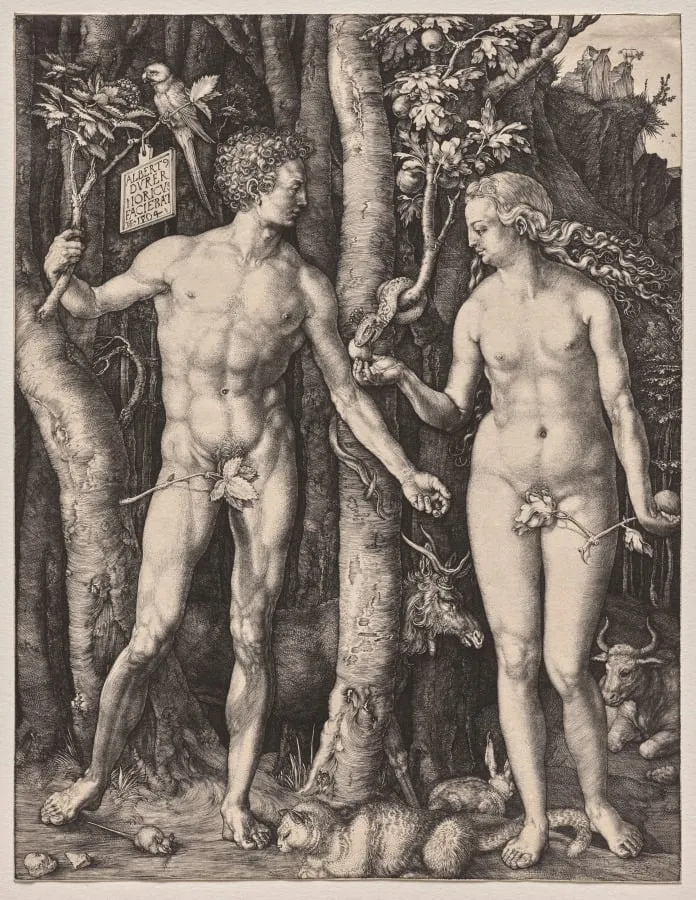
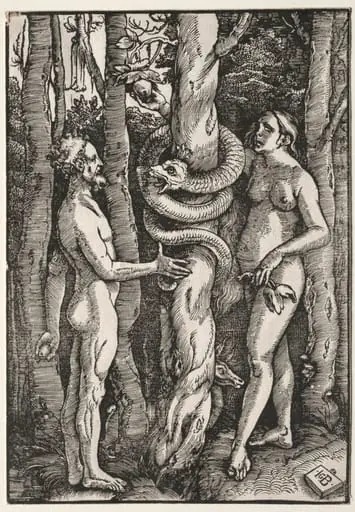
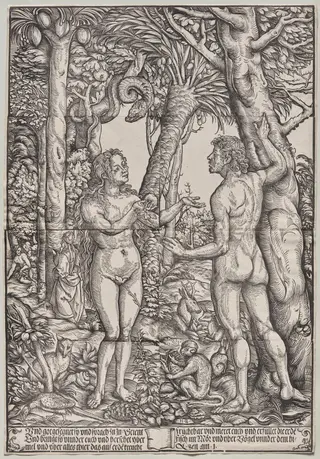
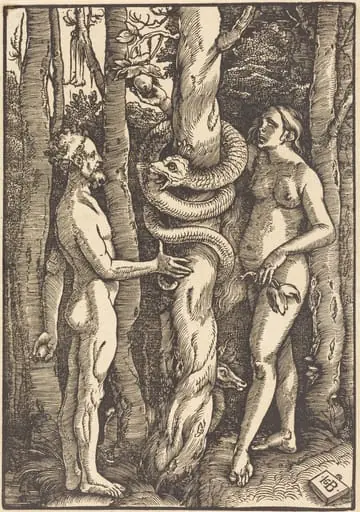
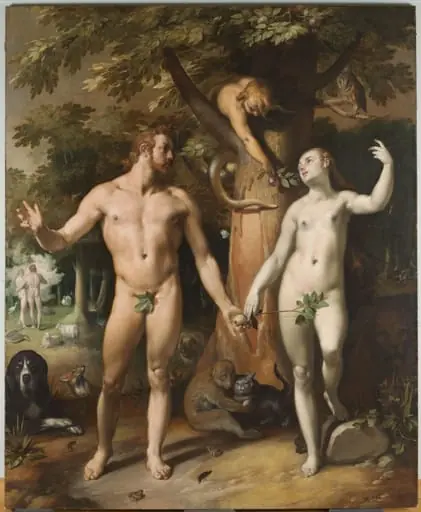
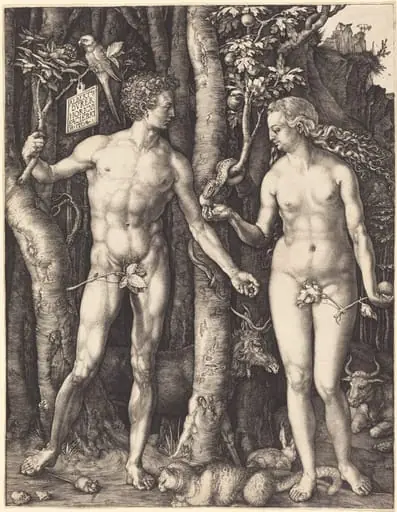
Adam and Eve is a print by the Renaissance artist Albrecht Dürer. It dates from 1504 and is held in the collection of the Cleveland Museum of Art.
- Accession no.
- 1944.473
- Credit line
- Dudley P. Allen Fund
About this work
Overview
Unlike painted versions of the time, this work was produced through intaglio printing, allowing for extraordinary detail in skin, fur, and foliage.
Albrecht Dürer’s 1504 engraving of Adam and Eve presents the biblical pair in a dense, shadowed forest, rendered with meticulous line work. Unlike painted versions of the time, this work was produced through intaglio printing, allowing for extraordinary detail in skin, fur, and foliage. The composition centers on the moment before the Fall, capturing both harmony and latent tension in the figures and their surroundings.
Subject & Meaning
Adam and Eve are depicted in idealized, unblemished forms, embodying prelapsarian perfection. The fig tree, bearing the serpent, represents the Tree of Knowledge, while the mountain ash behind Adam symbolizes the Tree of Life. The parrot, brightly lit against the gloom, alludes to the Virgin Mary as the redemptive counterpoint to Eve. Subtle signs, the cat’s alertness, the mouse’s proximity, foreshadow the disruption to come.
Technique & Style
Dürer employed copperplate engraving to achieve fine, controlled lines that model form through subtle gradations of light and shadow. Each animal’s fur, the texture of bark, and the musculature of the figures are rendered with precision. The use of chiaroscuro enhances volume and depth, while the dense, dark forest contrasts with the illuminated figures, drawing focus to their idealized anatomy and symbolic environment.
History & Provenance
Created in Nuremberg in 1504, the engraving was part of Dürer’s effort to elevate printmaking to the status of fine art. Its technical sophistication and intellectual depth made it widely circulated across Europe, influencing both religious imagery and artistic theory. Copies and studies of the print were collected by scholars and artists, cementing its role as a benchmark in Northern Renaissance print culture.
Context
Dürer’s work reflects Renaissance humanism’s fascination with classical ideals and natural observation. He combined ancient sculptural proportions with Northern European flora and fauna, merging theological symbolism with empirical detail. The inclusion of the four animals as temperaments aligns with medieval and classical humoral theory, demonstrating how Renaissance artists synthesized ancient knowledge with Christian narrative.
Legacy
The engraving became a reference point for later artists exploring the human form and symbolic landscape. Its integration of naturalism, allegory, and technical mastery influenced generations of printmakers and painters. The work’s enduring study lies in its layered meaning, where every element, from the curve of a branch to the gaze of a cat, contributes to a complex meditation on innocence, knowledge, and consequence.
Artist & collection
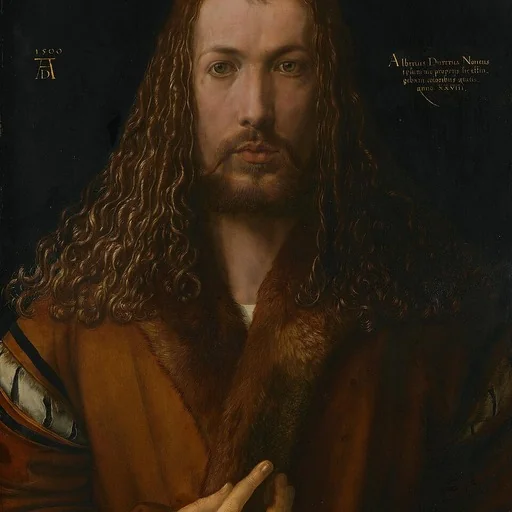
Artist
Albrecht Dürer spent his life in Nuremberg, a busy German city where artists traded prints like currency.

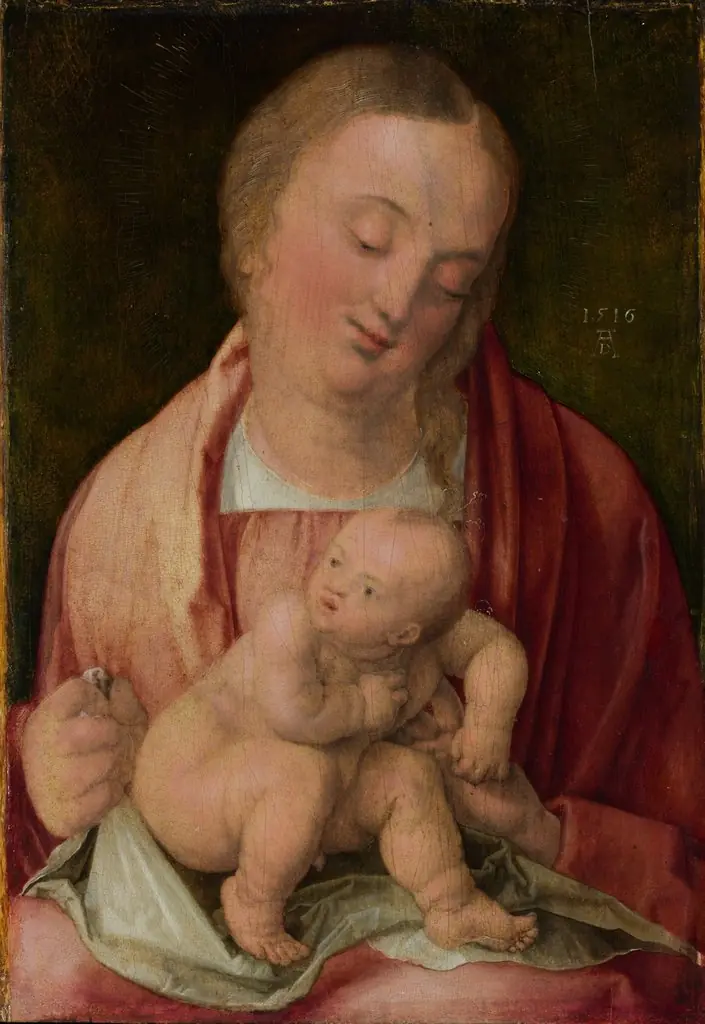
![Madonna and Child [obverse], by Albrecht Dürer](https://artifactworldgallery.com/img/albrecht-durer--madonna-and-child-obverse--d7b8ebf05d22ebe5-w320.webp)
![Lot and His Daughters [reverse], by Albrecht Dürer](https://artifactworldgallery.com/img/albrecht-durer--lot-and-his-daughters-reverse--b4ebf9b282faa17a-w320.webp)