Artwork
Adam and Eve
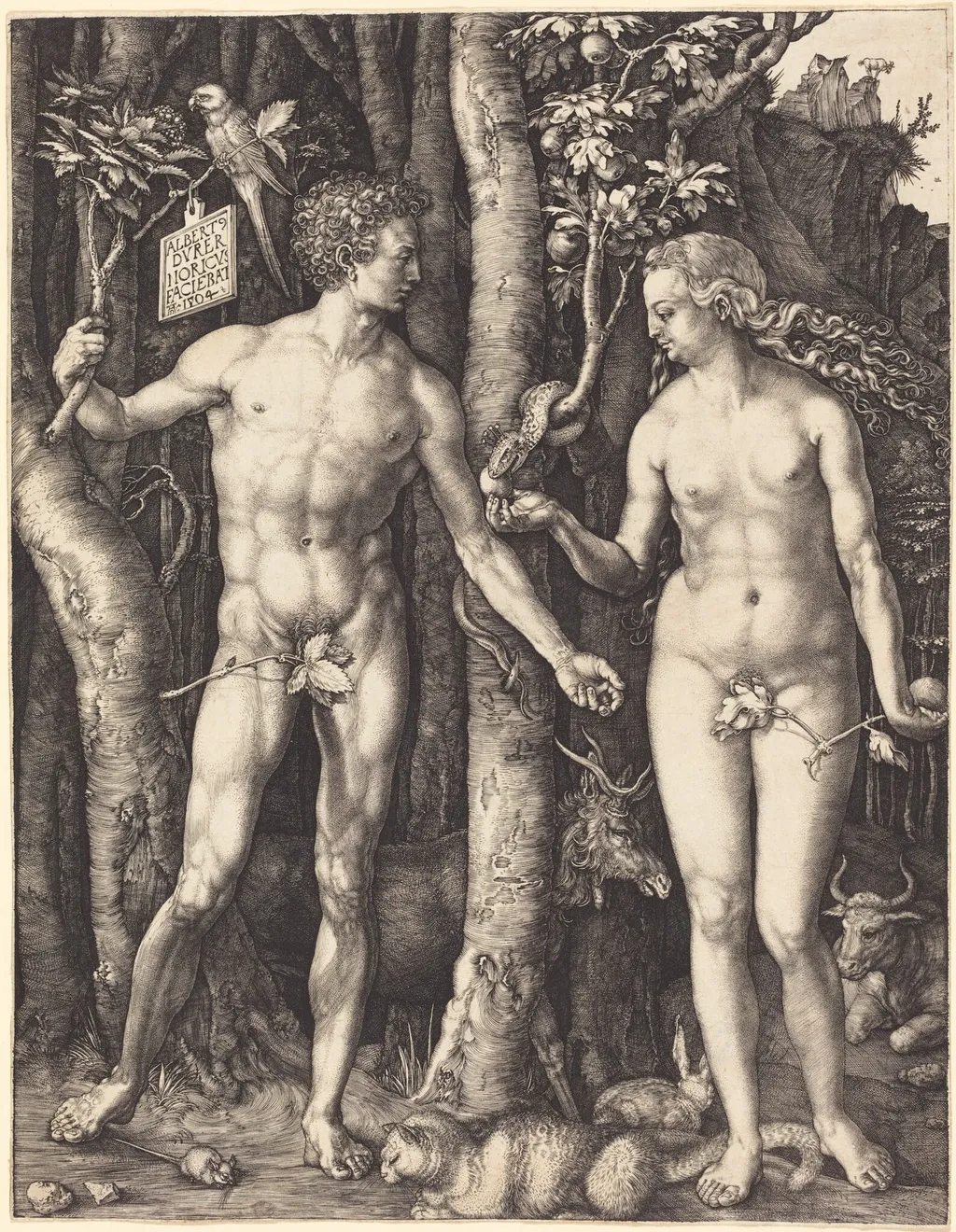
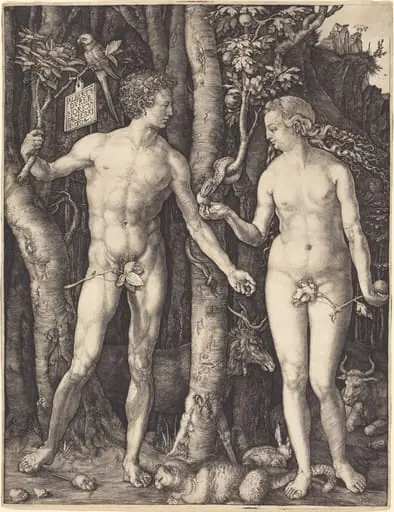
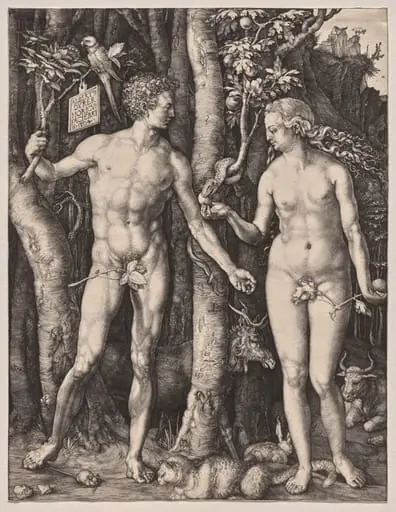
Adam and Eve is an ink print by the Northern Renaissance artist Albrecht Dürer. It dates from 1504 and is held in the collection of the National Gallery of Art.
- Inscription
- Inscribed:in plate, upper left, on hanging tablet: ALBERT [9 shaped form] / DVRER / NORICVS / FACIEBAT / AD [artist's monogram] 1504; verso, lower right, in graphite by a later hand: C.6180 [underlined]; verso, lower right, in graphite by a later hand: K 2581 [underlined] / C 3087; verso, bottom left, in graphite by a later hand: B-15, 224 [upside down]
- Markings
- Marked:R.H.G. NGA stamp
About this work
Subject & Meaning
The work serves as a visual demonstration of Dürer's pursuit of geometric perfection and the dignity of mankind.
This 1504 engraving depicts the biblical Fall of Man from Genesis, capturing the precise moment Eve accepts the forbidden fruit from the serpent while Adam reaches for the Tree of Life. Dürer presents the figures as prototypes of perfect humanity before sin, utilizing classical contrapposto poses derived from the Apollo Belvedere and the Venus de' Medici to embody ideal Vitruvian proportions.
The lush forest setting contains dense symbolic references to medieval humoral theory, where specific animals represent the four temperaments: the cat signifies choleric cruelty, the rabbit sanguine lust, the ox phlegmatic slowness, and the elk melancholic sadness. Additional symbolism includes a chamois on a rock representing the all-seeing eye of God and a parrot, potentially associated with the Virgin Mary, offering praise to the Creator. The work serves as a visual demonstration of Dürer's pursuit of geometric perfection and the dignity of mankind.
Technique & Style
Albrecht Dürer’s 1504 Adam and Eve is a copperplate engraving on laid paper, measuring 25.1 by 19.4 cm. The composition was meticulously developed through preparatory drawings, two trial proofs, and three distinct states, a highly unusual process for the artist. He employed a virtuosic, refined technique to render dramatic contrasts of light and dark, meticulously differentiating the textures of human skin, animal coats, tree bark, and lush vegetation based on his nature studies. The sculptural figures of Adam and Eve stand in slight contrapposto poses inspired by classical antiquity, specifically the Apollo Belvedere and the Medici Venus.
Dürer aimed to depict prototypes of perfect humanity before the Fall, constructing the musculature and contours through geometric methods and Vitruvian proportions. The figures are set within a dense, shadowy forest populated by symbolic animals representing the four humors.
History & Provenance
Albrecht Dürer created this copperplate engraving in Nuremberg in 1504. The work was meticulously developed using preparatory drawings, two trial proofs, and three distinct states, an unusually elaborate process for the artist. Dürer initially considered depicting Apollo and Diana, but ultimately adapted his anatomical studies into the biblical subject of Adam and Eve. He took a supply of the finished prints with him on his 1505 journey to Venice.
The documented ownership chain of this specific impression begins with August Sträter in Aix-la-Chapelle, followed by Paul Davidsohn. It subsequently passed through Knoedler & Co. in New York before R. Horace Gallatin purchased it in 1922. Gallatin gifted the print to the National Gallery of Art in Washington, D.C. in 1949.
Specific impressions of Albrecht Dürer's 1504 engraving are held in numerous institutions, including the Staatliche Kunsthalle Karlsruhe, the Rijksmuseum, the British Museum, the Metropolitan Museum of Art, and the National Gallery of Art in Washington, D.C. A notable copy at the National Gallery of Art carries a detailed provenance: it passed from the collection of August Sträter in Aix-la-Chapelle to Paul Davidsohn, then through Knoedler & Co. in New York. R. Horace Gallatin purchased this impression in 1922 and subsequently gifted it to the museum in 1949. While the engraving itself is widely distributed across global collections, related works on the same subject by Dürer, such as a 1504 watercolor, are housed at the Morgan Library & Museum, and painted panels from 1507 reside in the Museo del Prado.
Context
Albrecht Dürer's 1504 engraving Adam and Eve stands as the first culmination of his sustained investigation into ideal human proportions, a project he pursued after encountering Jacopo de' Barbari in Nuremberg around 1500 and engaging with Vitruvius and Platonic aesthetics. The work is widely regarded as one of his most virtuosic prints, demonstrating an unusually refined command of light, shadow, and surface texture. Its monumental Latin inscription marks it as the first print in his engraved corpus to carry such a signature device, signaling his ambition to position himself among the eminent successors of antiquity.
The figures derive their contrapposto poses from classical models, notably the recently unearthed Apollo Belvedere and the Medici Venus, sources Dürer likely accessed through Italian drawings and prints. The dense surrounding forest carries symbolic weight legible to contemporary humanist viewers, including a chamois signifying God's all-seeing eye, a parrot evoking praise of the Creator, and four animals associated with the four humors. Erwin Panofsky's scholarship, particularly The Life and Art of Albrecht Dürer (1954) and his study on Dürer and Classical Antiquity, has been foundational to interpreting these symbolic and proportional layers.
Legacy
Dürer's 1504 engraving of Adam and Eve is widely regarded as one of the most virtuosic prints in his oeuvre, demonstrating his refined handling of light, shadow, and varied surface textures including human skin, animal pelts, bark, and foliage. The work stands as the first culmination of his sustained investigation into ideal human proportions, a project he pursued through geometric methods after encountering Jacopo de' Barbari and reading Vitruvius around 1500. It served as a prelude to his later theoretical treatise on proportion published posthumously in 1528.
The engraving directly informed Dürer's subsequent treatments of the same subject: a watercolor of 1504 now at the Morgan Library and Museum, and two painted panels of 1507 housed at the Museo del Prado, in which the figures appear more elongated. The Fall of Man and the Expulsion from Paradise also reappear as woodcuts within his Little Passion series, extending the iconography across media.
Its wide institutional survival, held by collections including the British Museum, the Metropolitan Museum of Art, the Rijksmuseum, the Kupferstichkabinett Berlin, the National Gallery of Art in Washington, and the Staatliche Kunsthalle Karlsruhe, reflects the print's enduring prominence within the canon of Northern Renaissance graphic art.
Overview
Albrecht Dürer's 1504 engraving, Adam and Eve, depicts the biblical progenitors standing in a dense, wooded landscape prior to the Fall. The composition is structured around a central tree, with Adam on the left holding a branch of a mountain ash and Eve on the right plucking fruit from a fig tree, while a parrot perches above. Dürer utilizes the medium of engraving to render an unprecedented level of anatomical precision and textural variety, contrasting the smooth skin of the figures with the rough bark of trees, the fur of the animals, and the intricate foliage.
Four animals representing the four temperaments, a cat, rabbit, elk, and ox, surround the couple, symbolizing the harmony of nature before sin. Created during the height of Dürer's second Italian journey and his subsequent mature period, this work synthesizes Northern European detail with Italian Renaissance ideals of proportion and classical beauty. It stands as a definitive masterpiece of the German Renaissance, demonstrating the artist's mastery of line and his deep engagement with humanist theories of ideal form.
Own this work as a print
Artist & collection
Artist
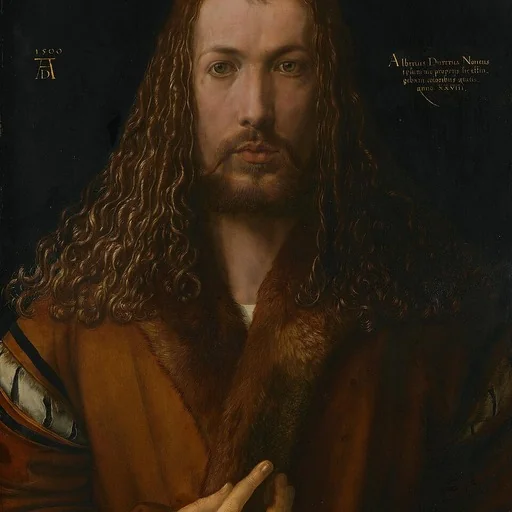
Albrecht Dürer spent his life in Nuremberg, a busy German city where artists traded prints like currency.

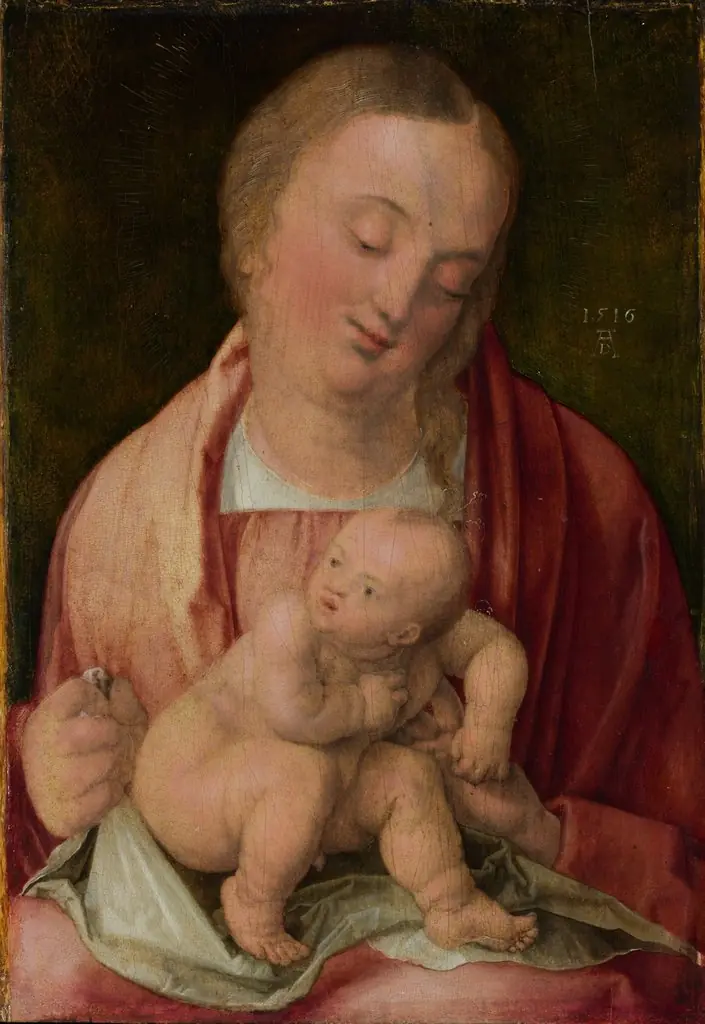
![Madonna and Child [obverse], by Albrecht Dürer](https://artifactworldgallery.com/img/albrecht-durer--madonna-and-child-obverse--d7b8ebf05d22ebe5-w320.webp)
![Lot and His Daughters [reverse], by Albrecht Dürer](https://artifactworldgallery.com/img/albrecht-durer--lot-and-his-daughters-reverse--b4ebf9b282faa17a-w320.webp)